Vacating Before Reconstruction or Sale: Understanding Justifiable Reasons, Relocation Fees, and the Process
Xiao Li (licensed real estate broker, 宅地建物取引士)Sales & Property Management Lead
22 min read
When considering rebuilding an old apartment or selling it after vacating, landlord requests for tenants to vacate are unavoidable. A landlord cannot unilaterally terminate a lease simply because “the building is old” or “because they decided to sell.”
This article organizes the legal premise of vacating based on Article 28 of the Land and Building Lease Law (借地借家法, chichi shakuyaku hō) regarding "justifiable reasons," the differences from fixed-term leases, how to think about relocation fees, how to negotiate, and precautions to avoid troubles. The legal provisions are confirmed via e-Gov Law Search, and relocation fees are explained as a concept built from components rather than fixed "market" amounts.
Key points of this article
- In ordinary lease contracts (普通借家契約), to refuse renewal the landlord must give notice between 1 year and 6 months before the contract expires, and if terminating, a 6-month period must elapse after notice before termination takes effect. Both require recognition of "justifiable reasons" (Land and Building Lease Law Articles 26–28, e-Gov, confirmed October 2026).
- Justifiable reasons are determined by comprehensively considering landlord's and tenant's needs for the building, previous contract history, usage status, current condition of the building, and offers such as relocation fees. Paying a relocation fee alone does not automatically form a justifiable reason.
- Relocation fees are calculated based on actual moving costs, initial costs of the new residence, differences in rent, and more. As a reference, median rents for 18–30㎡ units were Nakano 93,000 yen, Kamata 108,000 yen, Kitasenju 98,000 yen, and Akabane 89,000 yen (Urbalytics rental listing data, October 2025–October 2026, 209–558 properties per station).
Vacating Cannot Proceed Solely on Landlord's Convenience
In ordinary lease contracts (contracts automatically renewed upon expiration), landlords face restrictions on terminating contracts in order to protect tenants' homes.
- Contracts with a fixed term: If the landlord does not intend to renew, they must notify the tenant between 1 year and 6 months before the lease expires. Without such notice, the lease is deemed renewed under the previous conditions (Land and Building Lease Law Article 26, Paragraph 1).
- Contracts without a fixed term: If the landlord proposes termination, the contract ends six months after the proposal (Article 27, Paragraph 1).
- In either case, the landlord’s refusal to renew or request for termination must be based on recognized justifiable reasons (Article 28).
In other words, the contract can only terminate after observing notification periods and obtaining recognition of justifiable reasons. In practice, voluntary termination agreements (“mutual termination”) are often reached with tenants before entering legal disputes.
How Justifiable Reasons Are Judged (Land and Building Lease Law Article 28)
Article 28 lists factors to consider when determining the presence of justifiable reasons (e-Gov, confirmed October 2026):
- Landlord’s and tenant’s (including sub-tenants) individual circumstances requiring use of the building
- History of the rental contract (contract background, rent levels, rent arrears, etc.)
- Building usage status
- Current condition of the building (degree of aging, seismic resistance, repair costs, etc.)
- Landlord’s offer of financial benefits to tenant as a condition or in exchange for vacating (the so-called relocation fee)
The primary focus is on item 1: whether both parties need the building; items 2–5 serve to supplement that judgment. For example, even if seismic issues and urgent rebuilding needs exist, justifiable reasons are harder to recognize if the tenant is elderly and faces difficulty finding a new residence or if a long-standing store operation is involved. In such cases, the offer of relocation fees is taken into account to compensate for the lacking circumstances.
Note that “because I want to sell” is often considered a weak landlord necessity on its own. If selling is the goal, consider also selling with tenants in place (owner change).

Differences from Fixed-Term Lease Contracts
Fixed-term lease contracts (定期建物賃貸借契約, teiki tatemono chintaishaku) have no renewal rights, and automatically end at contract expiration (Article 38). Unlike ordinary leases, justifiable reasons are not required for termination at the end of the term.
| Item | Ordinary Lease | Fixed-Term Lease |
|---|---|---|
| Renewal | Generally renewed | Not renewed (re-contracting possible) |
| Landlord termination | Requires justifiable reasons (Article 28) | Ends at expiration, no justifiable reasons needed |
| Contract form | Can be verbal | Requires written form such as notarized documents (including electronic records) |
| Prior explanation | No regulation | Landlord must provide written explanation that contract ends without renewal at expiration; otherwise, non-renewal clause is invalid |
| Termination notice | For refusal to renew, 1 year to 6 months before expiration | If contract term is 1 year or more, termination notice 1 year to 6 months before expiration required |
Source: Land and Building Lease Law Articles 26–28, 38 (e-Gov Law Search, confirmed October 2, 2026). Prepared by TLL.
For properties with foreseeable rebuilding or sale, employing fixed-term leases when recruiting new tenants simplifies future planning. However, because fixed-term leases are more restrictive for tenants, lowering rent may be necessary to secure tenants. Also, converting existing ordinary leases to fixed-term leases requires tenant consent and prescribed procedures. Conversion can be limited, especially for older residential leases.
Thinking About Relocation Fees (Calculating Rather than Relying on Market Rates)
Relocation fees have no statutory fixed amount and vary greatly depending on the property condition, tenant circumstances, and intensity of landlord necessity. Therefore, it is incorrect to say “relocation fee is X months’ rent.” Instead, consider the costs and disadvantages the tenant bears due to moving by stacking up the following:
- Actual moving expenses: Moving costs; deposits, key money, brokerage fees, and prepaid rent for new residence; fire insurance and key replacement expenses
- Rent differences: If moving to a similar unit with a higher rent, the difference for a certain period
- Business losses (for stores and offices): Suspension during relocation, interior and equipment alterations, and potential customer loss
- Other circumstances: Burden of leaving a long-time residence, effects on school or hospital attendance, etc.
When considering rent differences, refer to listed rents in the same area and similar size. The following table aggregates rents for 18–30㎡ units at four stations.
| Station | Number of Listings | Lower 25% | Median | Upper 25% |
|---|---|---|---|---|
| Nakano | 347 | 79,000 yen | 93,000 yen | 129,000 yen |
| Kamata | 558 | 90,000 yen | 108,000 yen | 127,000 yen |
| Kitasenju | 311 | 84,000 yen | 98,000 yen | 110,000 yen |
| Akabane | 209 | 75,000 yen | 89,000 yen | 110,000 yen |
Source: Urbalytics rental listing data. Properties listed between October 2, 2025 and October 2, 2026 within Tokyo near the listed stations, consisting of 18–30㎡ dwellings (including condominiums, wooden and light steel-frame apartments). Duplicate listings with identical property, size, and rent removed. These are listing rents, not contract rents. Data compiled on October 2, 2026.
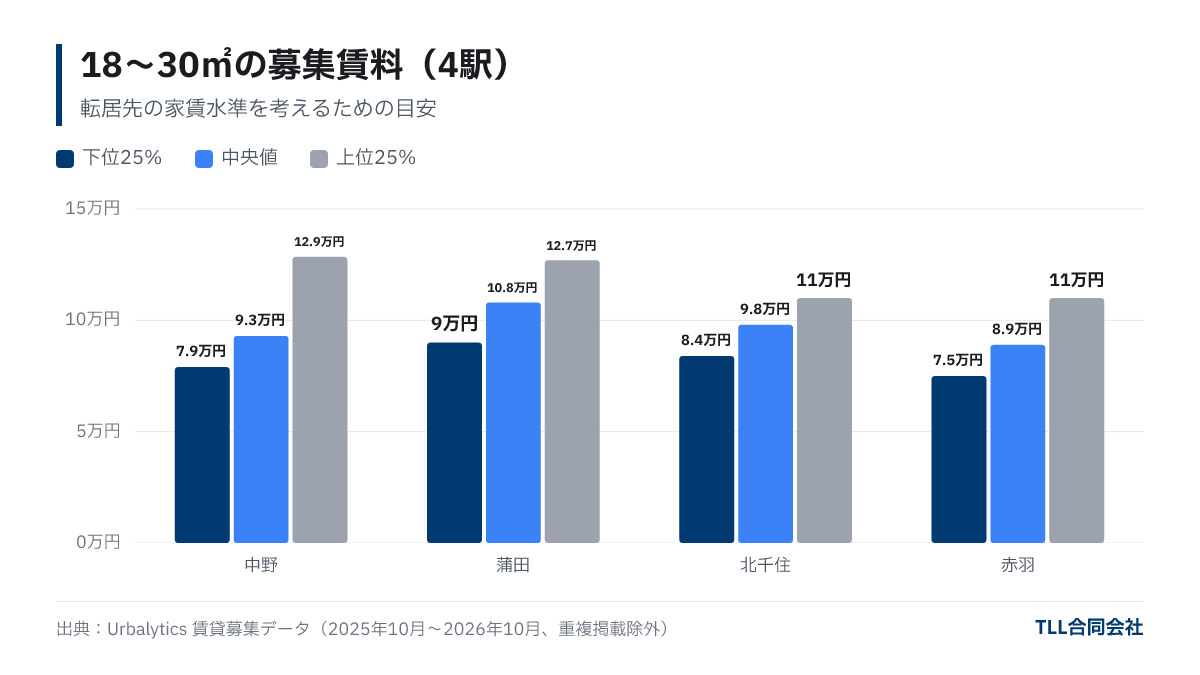
For example, if a tenant living in an old 1K around Nakano station paying 65,000 yen/month moves to a similar-sized unit renting around the median 93,000 yen/month, the difference is 28,000 yen/month. How many months’ worth of difference, plus initial costs for the new residence (about three months’ rent for deposit, key money, brokerage fees) and moving costs, are to be borne depends on discussions related to tenant circumstances and landlord necessity. These numbers are examples illustrating the concept, not actual amounts.
How to Proceed with Vacating Before Reconstruction or Sale
The earlier and more time you allocate to plans, the easier it is to reach agreement. The general process is as follows.
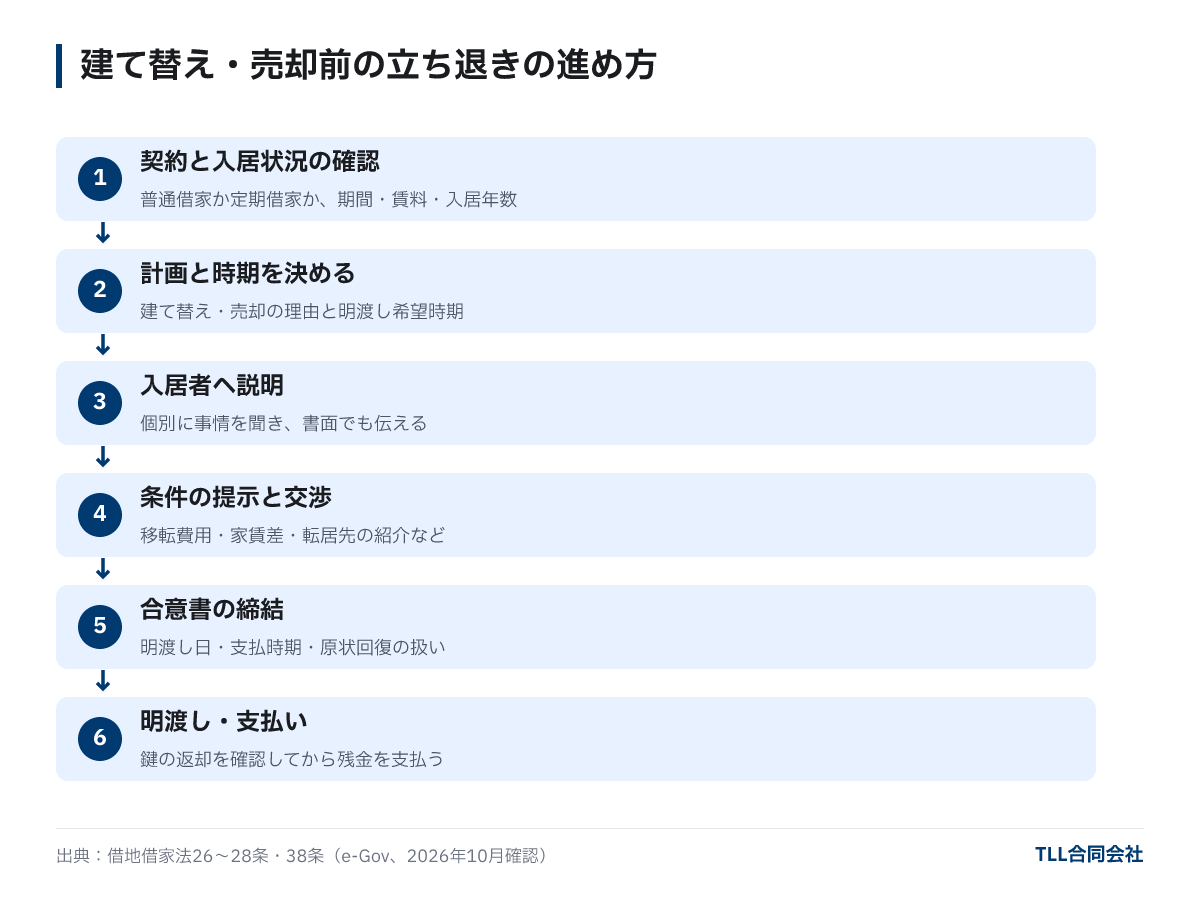
- Confirm contracts and occupancy status: Prepare a list showing for each unit whether it is ordinary or fixed-term lease, contract period, rent, length of occupancy, and any arrears.
- Decide plan and timing: Establish the reason for rebuilding or selling, desired vacating date, and back-calculate notification period (6 months or more).
- Explain to tenants: Do not only provide written notice but hear individual circumstances. Understand differences such as elderly tenants or stores.
- Present conditions and negotiate: Propose terms such as moving costs, rent differences, introducing moving destinations, rent exemption until vacating, etc., and negotiate.
- Sign agreement: Document vacating date, amount and timing of relocation fee, exemption from restoring condition, handling of remaining items.
- Vacate and pay: Confirm key return and room condition before paying balance.

Precautions to Avoid Troubles
- Do not negotiate aggressively: Repeated visits, intimidation, changing locks or stopping utilities are legally problematic and hinder negotiations.
- Carefully consider who conducts negotiations: Outsiders acting on behalf of a landlord for fee-based negotiations can violate Article 72 of the Attorney Act. Consult a lawyer if delegating negotiations.
- Do not insist on uniform conditions: Each tenant’s circumstances differ, so conditions should be considered individually. However, maintain consistency in rationale to avoid accusations of unfair treatment later.
- Put everything in writing: Document explanations, proposed terms, and agreements to avoid relying on verbal promises alone.
- Allow ample time in planning: Tenants who do not agree will delay rebuilding or sale plans, often taking months to over a year.
Considering the time and costs of vacating, choosing to “sell with tenants in place” or “selling including the effort of managing tenant removal” may be more practical financially and temporally. Selling difficult properties is explained in Selling Unbuildable Land, Leasehold Rights, and Inherited Old Apartments, and differences between brokerage and direct purchase are explained in Comparison of Purchase and Brokerage.

Frequently Asked Questions
Q. Does the aged condition of the building constitute justifiable reason for vacating?
Deterioration and insufficient seismic resistance are considered as part of the “current condition” of the building, but alone do not guarantee recognition of a justifiable reason. The tenant’s need for the building is weighed comprehensively, with relocation fee offers supplementing.
Q. Is payment of relocation fees mandatory?
There is no legal obligation to pay. However, because they are considered a supplementary factor for justifiable reasons, it is common to cover moving costs when negotiating voluntary tenant departure.
Q. Does a fixed-term lease avoid vacating issues?
If contract and written explanation requirements are met, and for terms of one year or more termination notice is given between 1 year and 6 months before expiration, the lease terminates at expiry. Without meeting these requirements, the non-renewal clause is invalid, so check contract documents carefully.
Q. Can the property be sold without tenants vacating?
Yes. In owner change sales with tenants, the buyer inherits lease contracts and security deposit refund obligations. Decide by comparing time and cost of tenant removal against sale price effects.
Summary
- In ordinary leases, refusal of renewal requires notice between 1 year and 6 months before expiration, and termination proposals require 6 months after notice; both require justifiable reasons (Land and Building Lease Law Articles 26–28).
- Justifiable reasons are comprehensively judged focusing on the needs of both parties, contract history, usage, building condition, and relocation fee offers.
- Relocation fees are not fixed market sums but calculated by adding up moving expenses, rent differences, business losses, etc. Median rents for 18–30㎡ units provide a reference.
- When comparing options including rebuilding, vacating before sale, or selling with tenants, contact us for a free property appraisal.
Featured image (image): Photo: Salvador Rios / Unsplash
About this article
- Author
- Xiao Li(Sales & Property Management Lead)Qualifications: Real Estate Transaction Specialist, Building Management Specialist
Leads the practical work connecting investment property purchases and sales with property management after acquisition. At NTT Communications, he spent more than eight years managing digital transformation projects for major corporate clients, coordinating work from requirements through implementation and operation. He applies this experience in managing multiple stakeholders to real estate transactions and property management. He holds Japan's Real Estate Transaction Specialist and Building Management Specialist qualifications. At TLL, he oversees the property management business and handles sales strategy, investor proposals, contracts, settlement and handover. His property assessments consider rental income together with loan terms, repair costs and building age at exit, keeping purchase decisions connected to subsequent operations. His articles also cover decisions during ownership, including portfolio expansion, refinancing and management for owners living overseas.
View profile → - Publisher
- TLL合同会社宅地建物取引業 東京都知事(1)第108202号住宅宿泊管理業 国土交通大臣(01)第F03424号
Data in this article cite their source and as-of date. Market conditions and regulations change, so check the latest information and consult a professional before deciding. Translated from the Japanese original.