
Refinancing Real Estate Investment Loans: Conditions, Costs, Break-even Estimates, and How to Proceed
Xiao Li (licensed real estate broker, 宅地建物取引士)Asset Management
21 min read
If the interest rate on your real estate investment loan arranged at the time of purchase was relatively high, or if repayments have increased due to a review of a variable interest rate, refinancing with another financial institution is an option to consider. While a lower interest rate reduces annual repayments, various fees such as penalty fees, registration fees for mortgage cancellation and new registration, administrative fees, and stamp taxes are also incurred. Therefore, refinancing does not always lead to benefits just because the interest rate goes down.
This article calculates and verifies the conditions under which refinancing is advantageous by estimating the break-even point based on the interest rate difference, remaining loan term, and various fees. It also organizes the breakdown of costs, the procedure, and points to keep in mind.
Key points of this article
- In the case of refinancing an 80 million yen loan balance, the total fees are approximately 2.21 million yen, assuming a penalty fee of 1% and an administrative fee of 1.1% (registration license tax for mortgage registration is 0.4% of the loan amount, or 320,000 yen).
- If refinancing from an interest rate of 4.0% to 3.0% (difference of 1.0%), the annual repayment decreases by approximately 450,000 to 490,000 yen, and the fees can be recovered in about 4.5 to 4.9 years. With a 0.5% difference, it takes about 9 to 10 years to recover (TLL estimate).
- The Bank of Japan's policy interest rate was raised to about 1.25% on September 18, 2026. If the refinancing loan also has a variable interest rate, it is necessary to factor in the possibility that the rate difference may narrow due to future rate increases.
When is refinancing advantageous?
Refinancing is beneficial when the reduced repayment amount calculated by "interest rate difference × balance × remaining term" sufficiently exceeds various fees. As a rough guide, when the interest rate difference is about 1%, the remaining term is 10 years or more, and the loan balance is several tens of millions of yen or more, in many cases, the fees can be recovered within a few years.
Refinancing is not just about lowering interest rates.
- Lowering interest rates: Moving from a higher interest rate loan, such as one arranged through a non-bank lender at purchase, to bank terms.
- Extending the term: Reducing annual repayments to increase cash flow, although the total repayment amount often increases.
- Changing the interest rate type: Switching from a variable interest rate to a fixed interest rate to mitigate the impact of rising rates.
- Organizing collateral and conditions: Removing joint collateral, or restructuring the loan under a corporate name, etc.
The characteristics of loan types and financial institutions are explained in "Real Estate Investment Loan Basics".

Breakdown of costs involved in refinancing
When refinancing, you incur fees both to prepay the current loan in a lump sum and to arrange the new loan. We estimated costs assuming an 80 million yen balance secured by mortgages on two separate real estate assets (land and building).
| Cost | Basis of Calculation | Estimated Amount |
|---|---|---|
| Prepayment penalty (fee) | Determined by contract. Here assumed as 1% of balance | 800,000 yen |
| Registration license tax for mortgage cancellation | 1,000 yen per property × 2 properties | 2,000 yen |
| Registration license tax for new mortgage registration | Loan amount (claim amount) × 0.4% | 320,000 yen |
| Stamp duty on the monetary loan agreement | 60,000 yen for loans over 50 million yen up to 100 million yen | 60,000 yen |
| Loan administrative fee | There are fixed and percentage types. Here assumed as 1.1% of loan amount | 880,000 yen |
| Judicial scrivener fee (for cancellation and new registration) | Confirmed by estimate. Here assumed as 150,000 yen | 150,000 yen |
| Total | Approximately 2.21 million yen |
Source: Registration license tax based on the Registration License Tax Act Schedule 1 Section 1 (5)(15) (e-Gov Law Search), stamp tax based on National Tax Agency Tax Answer No. 7140 (as of April 1, 2026). Penalty fees, administrative fees, judicial scrivener fees are TLL assumptions. Estimation date: October 2, 2026.
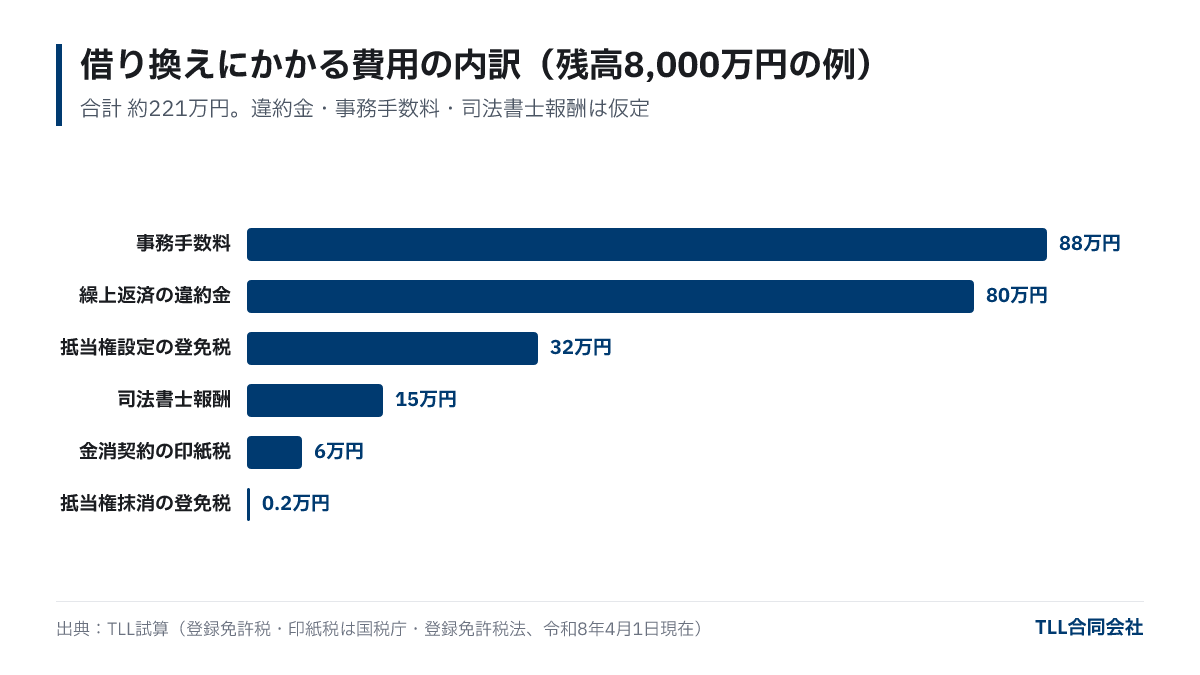
The largest costs are the penalty fees and administrative fees. Penalty fees vary depending on contracts; for example, some charge higher penalty fees for prepayment during a fixed interest rate period or only apply fees within a certain number of years from the loan disbursement. First, confirm the clause in your current monetary loan agreement. Additionally, guarantee fees if a guarantor company is used, property appraisal fees, and changes related to pledge of fire insurance rights may also be incurred.
Break-even estimate: How much difference does interest rate and remaining term make?
For the same interest rate difference, the longer the remaining term, the greater the total repayment reduction. We estimated refinancing an 80 million yen balance loan currently at 4.0% interest rate with the same remaining term.
| Remaining Term | Post-refinance Interest Rate (Difference) | Annual Repayment Reduction | Total Repayment Reduction (Remaining Term) | Reduction after Fees | Years to Recover Fees |
|---|---|---|---|---|---|
| 10 years | 3.5% (0.5%) | About 230,000 yen | About 2.26 million yen | About 50,000 yen | About 9.8 years |
| 10 years | 3.0% (1.0%) | About 450,000 yen | About 4.5 million yen | About 2.29 million yen | About 4.9 years |
| 10 years | 2.5% (1.5%) | About 670,000 yen | About 6.7 million yen | About 4.48 million yen | About 3.3 years |
| 20 years | 3.5% (0.5%) | About 250,000 yen | About 5.0 million yen | About 2.78 million yen | About 8.9 years |
| 20 years | 3.0% (1.0%) | About 490,000 yen | About 9.87 million yen | About 7.65 million yen | About 4.5 years |
| 20 years | 2.5% (1.5%) | About 730,000 yen | About 14.61 million yen | About 12.39 million yen | About 3.0 years |
Source: TLL estimate (principal and interest equal repayments, fees assumed as the above 2.21 million yen, interest rate assumed constant over the term. Total is a simple sum without discounting). Estimation date: October 2, 2026.
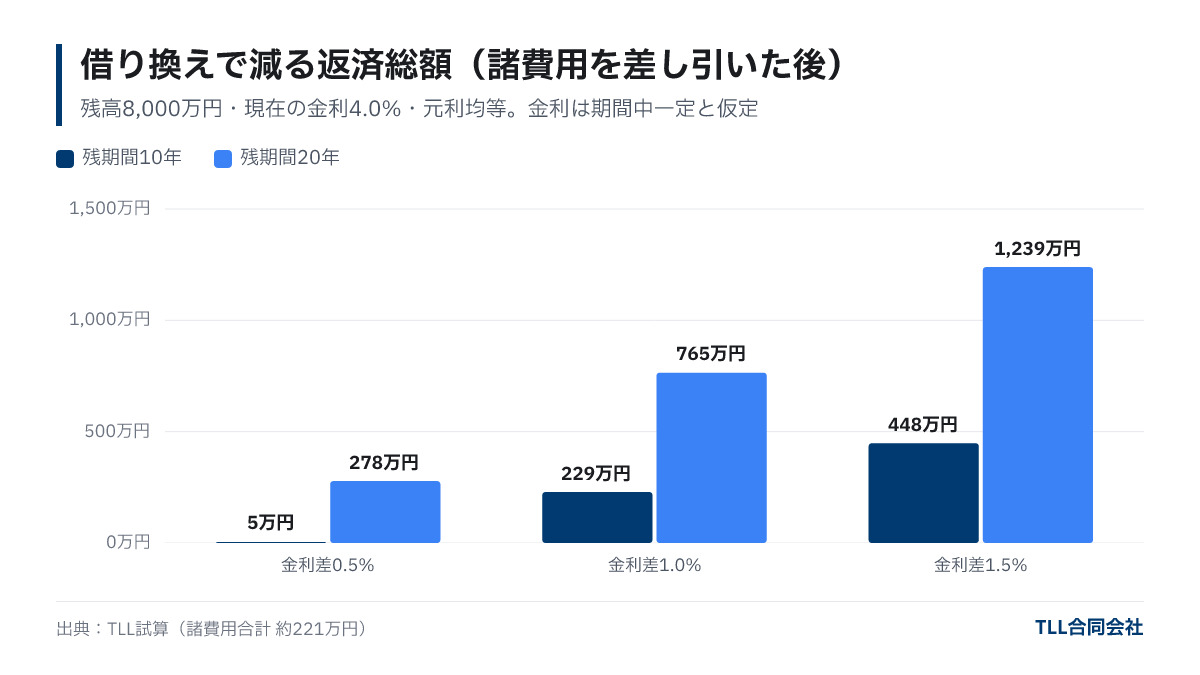
For a 10-year remaining term and a 0.5% interest difference, it takes about 9.8 years to recover fees, which is almost the entire remaining term. This is not worth the effort. On the other hand, with a 1% interest difference, fees can be recovered in about 5 years, and subsequent repayment reduction directly increases cash flow.
Refinancing by extending the loan term reduces the annual repayment significantly but may increase the total repayment amount. For example, refinancing an 80 million yen balance loan from "4.0% interest, 15 years remaining" to "3.0% interest, 25 years remaining" reduces the annual repayment from about 7.1 million yen to about 4.55 million yen, but increases the total repayment from about 106.52 million yen to about 113.81 million yen (TLL estimate). Decide whether you want to increase cash flow or reduce total payments, then compare conditions accordingly.
How to proceed with refinancing
Refinancing requires screening like when purchasing a new property. It is easier to proceed if you allow 2 to 3 months from preparation to settlement.
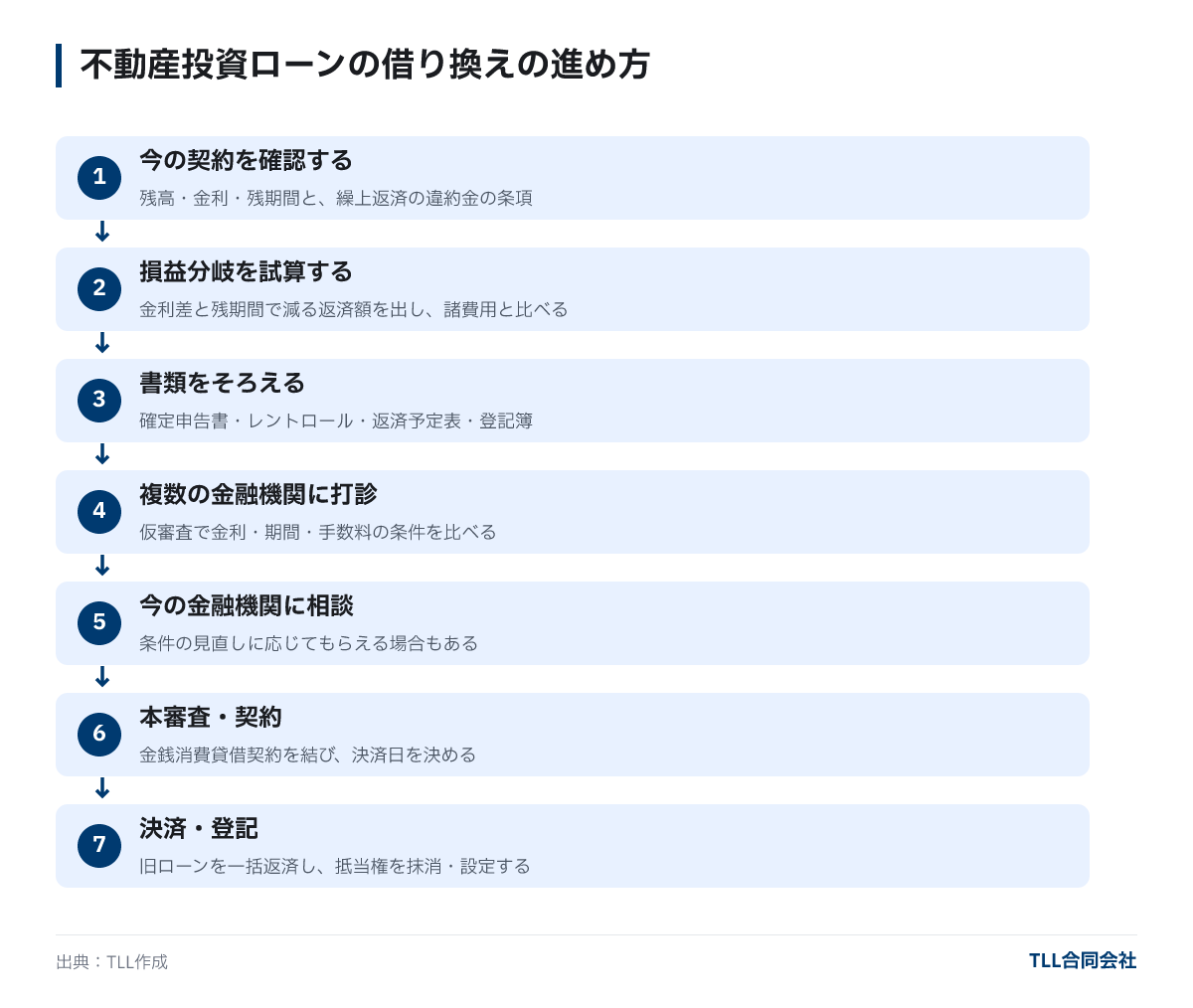
- Check your current contract: Confirm balance, interest rate, remaining term, interest type, and prepayment penalty clauses using your repayment schedule and contract.
- Estimate break-even: Compare the reduction in repayments to the various fees as in the tables above.
- Prepare documents: Tax returns (2–3 years), rent roll and income and expenditure statements per property, repayment schedule, certified copy of registry, property tax notification, etc.
- Inquire multiple financial institutions: Obtain preliminary screenings and compare interest rates, terms, fees, and required own capital.
- Consult your current financial institution: You may negotiate better terms using other banks’ offers as leverage, potentially avoiding costs like registration fees or penalty fees, which helps reduce costs compared to refinancing.
- Main screening and contract: Enter into a monetary loan agreement with the new institution and notify your current institution of the lump-sum repayment date.
- Settlement and registration: On the same day, the new loan disburses, the old loan is fully repaid, and the judicial scrivener executes cancellation of the old mortgage and registration of the new mortgage.
Precautions regarding refinancing
- The loan amount available may be less than the current balance: During screening, the loan amount and term are determined based on current property appraisals and building age. If the property is older, the loan term may shorten, which could increase annual repayments.
- Possible narrowing of interest rate gap during rising rate phases: The Bank of Japan raised the policy interest rate to about 0.75% on December 19, 2025, 1.0% on June 16, 2026, and about 1.25% on September 18, 2026 (Bank of Japan "Announcement on Change of Monetary Market Operations Policy"). If the new loan also has a variable interest rate, the current interest rate gap may not persist.
- Re-application for group credit life insurance (団体信用生命保険, dantai shin’yo seimei hoken): Loans that include this insurance require new health declarations and screening at refinancing. Depending on health status, joining may not be possible.
- Impact on future financing: Relationships with current financial institutions may affect financing for your next property. Deciding on refinancing while considering future acquisition plans is advisable.

While revising repayments through refinancing, it is also worth reviewing rental income, vacancy rates, and management costs to potentially improve your net cash flow significantly. Property management review is introduced on the Management Agency & Asset Management page.
Frequently Asked Questions
Q. How much interest rate difference is needed to make refinancing worthwhile?
It depends on the loan balance, remaining term, and fees. In the estimation in this article (balance 80 million yen, fees about 2.21 million yen), a 1.0% interest rate difference allowed fees to be recouped within about 4.5 to 4.9 years, whereas a 0.5% difference took about 9 to 10 years.
Q. How much are the various fees when refinancing?
For an 80 million yen balance example, estimated fees total about 2.21 million yen. The breakdown includes penalty fees, administrative fees, registration license tax for mortgage registration (0.4% of loan amount), stamp duty, registration license tax for cancellation (1,000 yen per property), and judicial scrivener fees. Penalty fees and administrative fees vary significantly depending on contracts and financial institutions.
Q. How many years should pass after purchase before refinancing is possible?
There are no legal restrictions, but some contracts impose penalty fees for prepayment within a short period. Additionally, having 1 to 2 years' rental business track record (tax returns) helps the approval screening. First, confirm clauses in your contract.
Q. Can I negotiate a lower interest rate without refinancing?
You can consult your current financial institution for revised terms. Presenting preliminary offers from other banks can facilitate negotiations, and if they agree, you can save costs like registration fees and penalty fees, reducing expenses compared to refinancing.
Summary
- Refinancing is beneficial when the repayment reduction from the interest rate difference, balance, and remaining term significantly exceeds various fees.
- In an 80 million yen balance example, fees amount to about 2.21 million yen, with penalty and administrative fees making up a large portion.
- A 1.0% interest rate difference leads to fee recovery in about 4.5 to 4.9 years; 0.5% takes about 9 to 10 years.
- Extending the term reduces annual repayments but may increase total repayments. With the policy interest rate now about 1.25%, consider the interest rate type of the refinancing loan as well.
Featured image (image): Photo: Scott Graham / Unsplash
About this article
- Author
- Xiao Li(Asset Management)Qualifications: Real Estate Transaction Specialist, Building Management Specialist
The operational lead for real estate sales and property management. At NTT Communications, he spent more than eight years managing DX projects for major enterprises, overseeing the full process from requirements definition through delivery and operations. At TLL, he handles the entire deal management cycle for income-producing properties, including sales strategy planning, investor sourcing, contract execution, settlement, and handover, providing well-matched opportunities and smooth transaction execution for domestic and international investors and operators.
View profile → - Publisher
- TLL合同会社宅地建物取引業 東京都知事(1)第108202号住宅宿泊管理業 国土交通大臣(01)第F03424号
Data in this article cite their source and as-of date. Market conditions and regulations change, so check the latest information and consult a professional before deciding. Translated from the Japanese original.