Can Co-Owned Property Be Sold?|Selling a Share, Selling Together and Direct Purchase
Takanobu EzakiAccommodation Business Manager
14 min read
Property acquired through inheritance or joint purchase can be sold. Selling the entire property and selling only your ownership share require different cooperation and give the buyer different rights.
Even when a sale is urgent, define what is being sold first. This article explains title, co-owner and occupation checks, and how to compare net proceeds from a joint sale and a share purchase. Legal information was checked on 9 October 2026.
Key points
- A normal voluntary sale of the entire property requires all owners' cooperation; an owner can generally dispose of their own share independently.
- An ownership share is a proportionate right in the whole property, not a particular room or floor.
- Whole-property reference value multiplied by the share is not an established share sale price or guaranteed purchase offer.
What does co-ownership mean?
Co-ownership means several people hold title to the same property; a share represents each owner's proportionate right. Land and building ownership may differ, so obtain registration records for both.
A half share does not automatically confer exclusive use of half the rooms. Use, management and alteration are subject to different rules. See the co-ownership provisions of the Civil Code on e-Gov.
If inheritance is unresolved, identify the current rights holders as well as registered names. An undivided estate and ordinary co-ownership with established shares may require different procedures. Ask a judicial scrivener or lawyer to review family registers, the will and estate-division documents before defining the rights to be sold.

Compare a joint sale, a share sale and direct purchase
Separate the rights being sold from the type of buyer. Direct purchase by a property company can apply to the whole property or just a share.
| Method | Rights sold | Cooperation and checks | Main comparison |
|---|---|---|---|
| Joint voluntary sale | Entire property | All owners' agreement and completion cooperation | Marketability and allocation of proceeds |
| Sale of your share | Your ownership share | Generally independent; check security and contracts | Use restrictions and limited buyers |
| Direct company purchase | Whole property or share | Buyer review and contract terms | Price, timing and liability |
One owner cannot transfer the others' shares in a normal joint sale. Confirm cooperation with contracts and completion, and any authority to act, rather than agreement on price alone. If everyone cooperates, consider the option that gives the buyer complete title.
Consent from the other owners is generally unnecessary to dispose of your own share. Security interests, contractual duties and condominium land rights may create separate constraints. The contract should make clear that the buyer does not obtain unilateral control over use, rebuilding or sale of the entire property.
Court procedures may be available where a co-owner's whereabouts are unknown. See the Ministry of Justice's co-ownership reform material. An unlocatable owner and an owner opposing a sale are different situations.
How is an ownership share priced?
Pricing depends on the whole property's reference value and the practical ability to use or dispose of the rights. A share does not automatically achieve a proportionate whole-property price.
For an income-producing building, nearby listed yields can inform an initial whole-property comparison. This original aggregation is not a survey of ownership-share transactions.
| Station | Buildings | Median gross yield |
|---|---|---|
| Akabane | 9 | 4.80% |
| Takadanobaba | 6 | 4.04% |
| Nerima | 4 | 5.21% |
Source: Urbalytics BUILDING listings in Tokyo with a listing or price update during 1–30 September 2026; retrieved 9 October 2026. Duplicates, completed sales, unpublished appraisals and defined outliers are excluded. Listed annual income may be actual or full-occupancy income. Age, structure and walking distance are not matched; samples are small and are not limited to lodging facilities.
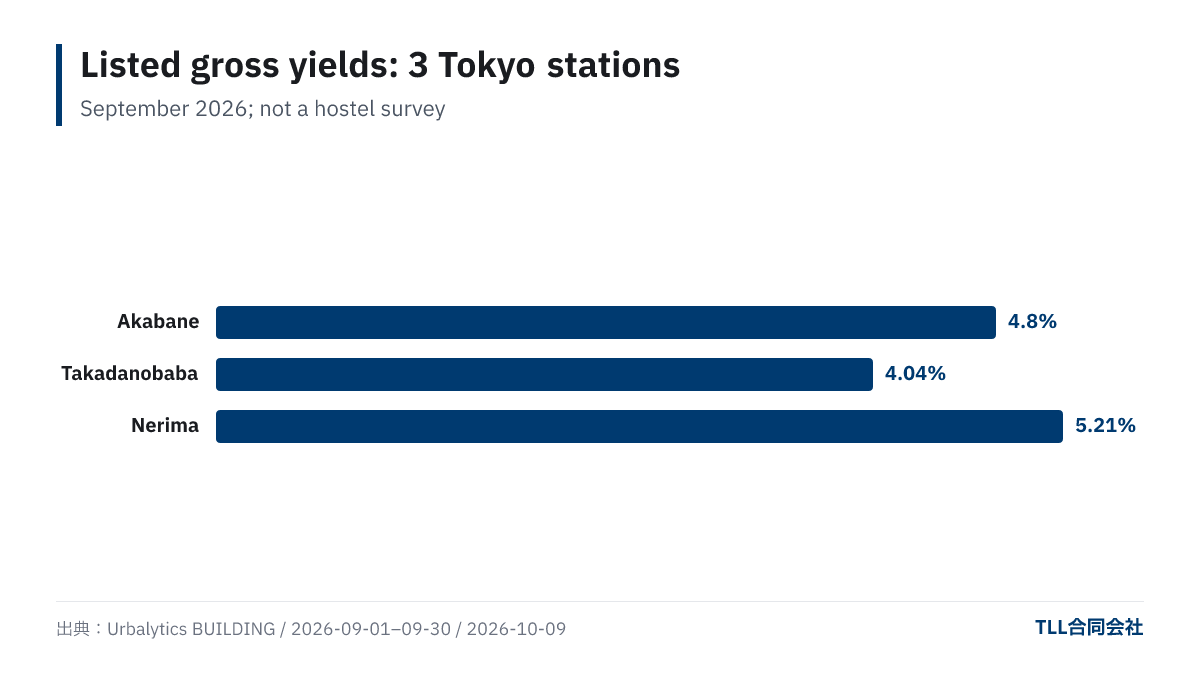
For illustration, assume annual rent of JPY 6 million for an Akabane building. Dividing by a 4.80% gross yield gives JPY 125 million; multiplying by one-half gives JPY 62.5 million. These are arithmetic reference figures, not a share appraisal. The rent is a hypothetical assumption, not subject-property income (6 million ÷ 0.048, then × 1/2).
A share buyer must still coordinate with the other owners. Occupation, rent collection, cost allocation, co-owner agreements, disputes and liens affect price and procedures. There is no supported universal discount percentage.
Compare prices for the same scope of rights when assessing a whole-property brokerage appraisal, whole-property purchase and share purchase. Comparing an aspirational listing price directly with a share offer does not explain the difference. See whole-building valuation and direct purchase versus brokerage.

Clarify rights, costs and net proceeds
Separate the sale price from net proceeds. Check brokerage, registration, security-release costs, outstanding expenses and taxes, then record who pays each item.
Check registered security and loan obligations separately. Selling a share does not automatically extinguish the seller's debt or personal guarantee. Arrange lender consent, repayment and security treatment as completion conditions.
Establish whether a co-owner occupies the building, a third party rents it or it is vacant. For rented property, collect leases, rent and deposit records, and repair history. Record whether property taxes or repair costs advanced by a co-owner will be adjusted through proceeds allocation.
The contract should specify the share, handover condition, unresolved disputes and liability for non-conformity. Direct purchase does not necessarily eliminate all seller liability. Residential or rental use and acquisition history can affect tax treatment; take the records to a tax adviser for a specific calculation.
How to progress a sale
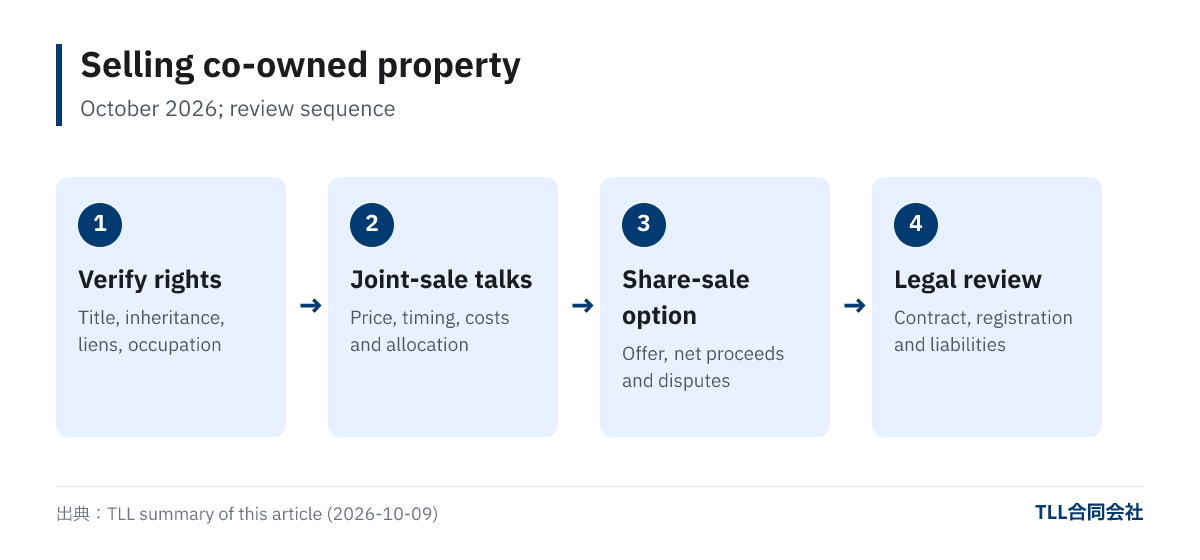
First establish whether a joint sale can be agreed. If not, compare a share sale with procedures for ending co-ownership. Where relations are contentious, discuss communications and proposals with a lawyer.
- Verify land and building title, inheritance, debt, security and occupation, then map the rights.
- Discuss a joint sale and record price, timing, costs and allocation.
- If a joint sale is difficult, compare share-purchase terms and net proceeds with the burden of partition or other procedures.
- Review the contract and registration papers with professionals, and coordinate completion with the lender where debt remains.
Partition negotiations or litigation do not immediately produce a sale at the desired price. They determine how co-ownership is resolved; assess time and cost. The ordinary whole-building process is covered in valuation through completion.
Frequently asked questions
Q. Can I sell if another owner objects?
You can generally sell your own share independently. A normal voluntary sale of the whole property requires cooperation in transferring the other owners' rights.
Q. Is a half share worth half the property?
Not necessarily. Use restrictions, occupation and co-owner coordination affect its price.
Q. Does selling the share clear my loan?
Not automatically. Review debt, guarantees and mortgage rights separately with the lender.
Q. What if a co-owner cannot be contacted?
Investigate whereabouts and inheritance, then ask a lawyer whether court procedures apply. Distinguish an unknown location from opposition to the sale.
Summary
- A whole-property sale and a share sale transfer different rights and require different cooperation.
- A share is neither a physical room allocation nor a guaranteed price fraction.
- Compare net proceeds after security, occupation, costs and debt are considered.
- If agreement is difficult, assess share sales and co-ownership resolution with professionals.
References: Civil Code co-ownership provisions, Ministry of Justice reform material and original Urbalytics aggregation. Checked 9 October 2026.
Cover image (illustrative): Photo: Tierra Mallorca / Unsplash
About this article
- Author
- Takanobu Ezaki(Accommodation Business Manager)Qualifications: Type A Fire Prevention Manager, Type 1 Health Officer, Hazardous Materials Engineer, Class B-4, Class 2 Boiler Engineer
Leads accommodation projects from pre-opening preparation to stable operations, bringing together permits, refurbishment and operating budgets. He has held manager, general manager and director roles at hotels, ryokan and golf courses over more than 30 years. His experience includes facility operations, P&L management, liaison with authorities, obtaining permits and major refurbishment, from opening new glamping facilities to repositioning existing ryokan. At TLL, he oversees accommodation operations and prepares new properties for opening. For each property, he brings together the applicable operating framework, facility requirements and staffing arrangements to develop a workable operating plan. His articles explain the differences between minpaku and hotel-business requirements across Tokyo's 23 wards and the implications of different operating models. His qualifications include Type A Fire Prevention Manager and Type 1 Health Officer.
View profile → - Publisher
- TLL合同会社宅地建物取引業 東京都知事(1)第108202号住宅宿泊管理業 国土交通大臣(01)第F03424号
Data in this article cite their source and as-of date. Market conditions and regulations change, so check the latest information and consult a professional before deciding. Translated from the Japanese original.