Exit Strategies for Real Estate Investment: 3 Perspectives to Decide Before Buying
Eiichi Suto (licensed real estate broker, 宅地建物取引士)Real Estate Brokerage / Renovation
18 min read
When purchasing income property, many investors focus on the gross yield, loan conditions, and location. However, fewer decide "when, to whom, and at what price to sell" before buying. Yet, the final net outcome is determined almost as much by the sale price and taxes at disposition as by rental income during ownership.
This article distills three essential exit perspectives to decide upon before purchase: holding period and tax rate, the buyer's loan term (remaining useful life), and changes in yield at sale. For the third point, we aggregated yield distributions for one-building sales at six Tokyo stations using Urbalytics data and estimated "how much price changes if the yield shifts by 0.5 percentage points at sale."
Key points of this article
- Capital gains tax on real estate is divided by whether ownership exceeded five years as of January 1 of the sale year: 20.315% for long-term and 39.63% for short-term (National Tax Agency, law as of April 1, 2026).
- The buyer's loan term is often approximated by "statutory useful life minus building age" (remaining useful life). For wooden structures (housing purpose, 22 years), the buyer segment varies significantly by building age at sale.
- For a one-building property with an annual rent of 12 million yen, if the gross yield at sale rises by 0.5 percentage points, prices drop approximately 8.8–11.0% (about 20 to 33 million yen) based on the median yields at six Tokyo stations (Urbalytics sales data, October 2025 to October 2026).
Why Decide the Exit Strategy Before Buying
The reason to decide the exit before buying is that many key factors affecting net proceeds at sale are almost fixed at purchase. The acquisition date determines the long- or short-term capital gains classification, the structure and building age establish the buyer's eligible loan term at sale, and the purchase yield sets the baseline against the expected sale yield.
Post-purchase changes mainly include rent level, occupancy rate, and maintenance condition. Deciding the exit early also clarifies which factors to prioritize during ownership. For how to consider the timing itself, see the article on best timing to sell apartments, which organizes five decision axes.

Perspective 1: Holding Period and Capital Gains Tax Rate
The first perspective is how many years to hold before selling. Capital gains from land and building sales are classified as long- or short-term based on ownership as of January 1 of the sale year, with roughly a twofold tax rate difference (National Tax Agency Tax Answer Nos. 3208 and 3211, law as of April 1, 2026).
- Long-term capital gains (ownership exceeding 5 years as of January 1): 15% income tax, 5% resident tax, plus 2.1% special reconstruction income tax on the income tax amount, totaling 20.315%
- Short-term capital gains (ownership 5 years or less as of January 1): 30% income tax, 9% resident tax, plus special reconstruction income tax, totaling 39.63%
Note it is not simply five years from acquisition but ownership exceeding five years as of January 1 of the sale year. For example, a property acquired in October 2026 sold in 2031 counts as short-term because ownership as of January 1, 2031, is just over four years. Long-term status begins with sales on or after January 1, 2032. Practically, plan assuming "five years plus the remainder of that year."
The tax difference by holding period is estimated in the article on long-term vs short-term capital gains tax. If owned by a corporation, corporate tax rules apply instead—consult a tax accountant.
Perspective 2: Buyer's Loan Term and Remaining Useful Life
The second perspective is the buyer's available loan term at sale. Most buyers of entire buildings use loans, so shorter loan terms increase monthly repayments and reduce the maximum purchasable price.
Many financial institutions estimate loan terms as "statutory useful life minus building age" (remaining useful life). Statutory useful lives for residential buildings are wood: 22 years; steel frame (with structural material thickness over 4 mm): 34 years; reinforced concrete: 47 years (Ordinance on Depreciable Assets, Table 1). Some lenders accept loans beyond these periods but conditions vary individually.
For example, owning a 15-year-old wooden apartment for 10 years means it is 25 years old at sale and exceeds statutory useful life. Buyers then often opt for loans with shorter terms or self-financing, narrowing the buyer pool. Conversely, if purchased at 5 years old and held 10 years, 7 years of useful life remain at sale. Writing down "building age at sale" and "remaining useful life then" at purchase helps clarify exit challenges. Yield differences by building age are organized in the article on building age appropriate for investment.

Perspective 3: Impact of Yield Changes at Sale on Price
The third perspective is the yield at sale. Income property prices are often considered as "annual rent divided by yield," so even if rent remains stable, rising market yield expectations cause price declines.
We aggregated gross yields of one-building sale listings and price changes from October 2025 to October 2026 by station (excluding duplicates) using Urbalytics data. Taking a sample property with 12 million yen annual rent (full occupancy assumed), we compared prices at median yield and median plus 0.5 percentage points.
| Station | Number of Listings | Yield p25 | Median | p75 | Price at Median | Price at +0.5pt | Difference (Change Rate) |
|---|---|---|---|---|---|---|---|
| Ikebukuro | 75 listings | 3.97% | 4.81% | 5.56% | 249.65 million yen | 226.13 million yen | −23.52 million yen (−9.4%) |
| Nakano | 46 listings | 4.00% | 4.38% | 5.20% | 273.90 million yen | 245.84 million yen | −28.06 million yen (−10.2%) |
| Kamata | 52 listings | 4.22% | 5.01% | 5.88% | 239.68 million yen | 217.92 million yen | −21.76 million yen (−9.1%) |
| Kita-Senju | 53 listings | 4.34% | 5.18% | 6.00% | 231.81 million yen | 211.39 million yen | −20.42 million yen (−8.8%) |
| Kinshicho | 36 listings | 4.00% | 4.30% | 5.76% | 279.29 million yen | 250.17 million yen | −29.11 million yen (−10.4%) |
| Sangenjaya | 55 listings | 3.73% | 4.05% | 4.32% | 296.36 million yen | 263.79 million yen | −32.57 million yen (−11.0%) |
Source: Urbalytics one-building (BUILDING) sales data. Aggregation period October 2, 2025 to October 2, 2026, including properties listed or with price changes during this period (excluding duplicates; yields under 1% or over 25% excluded). Yields are gross yields calculated as asking rent divided by listing price, not prices at closing. Prices are TLL estimates assuming annual rent of 12 million yen. Aggregation date: October 2, 2026.
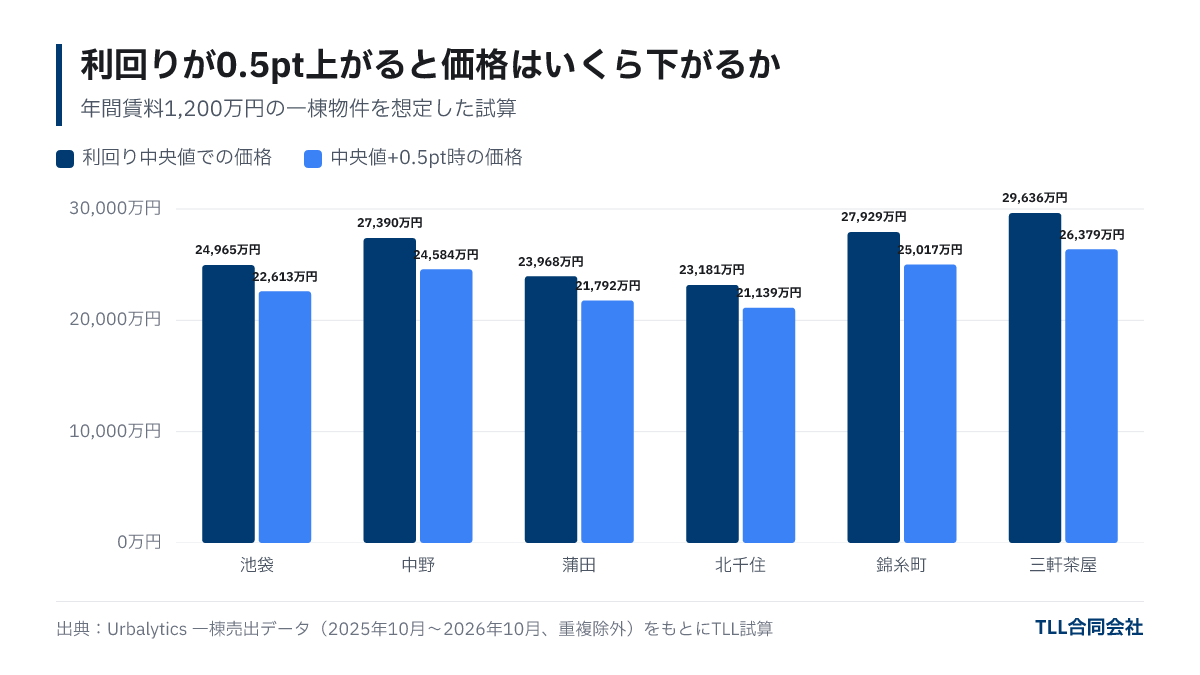
Two insights can be drawn from this table. First, stations with lower yields experience greater price moves from the same 0.5pt yield increase. Sangenjaya (median 4.05%) showed −11.0%, while Kita-Senju (5.18%) showed −8.8%. Second, yields vary widely even within the same station. At Ikebukuro, prices with p25 yield (3.97%) and p75 yield (5.56%) range from about 302.51 million yen to 215.78 million yen, an 87 million yen difference, for the same 12 million yen rent.
When considering exits, it is more realistic to estimate sale prices not just assuming yield stability but also within station yield ranges (p25–p75) and scenarios of yield rising by 0.5 to 1 percentage point. Future yields and prices depend on interest rates and market conditions, so these figures do not guarantee future trends. Valuation approaches are also explained in the article on one-building apartment appraisal.
Steps to Decide the Exit Before Buying
Incorporating the three perspectives into pre-purchase considerations results in five steps.
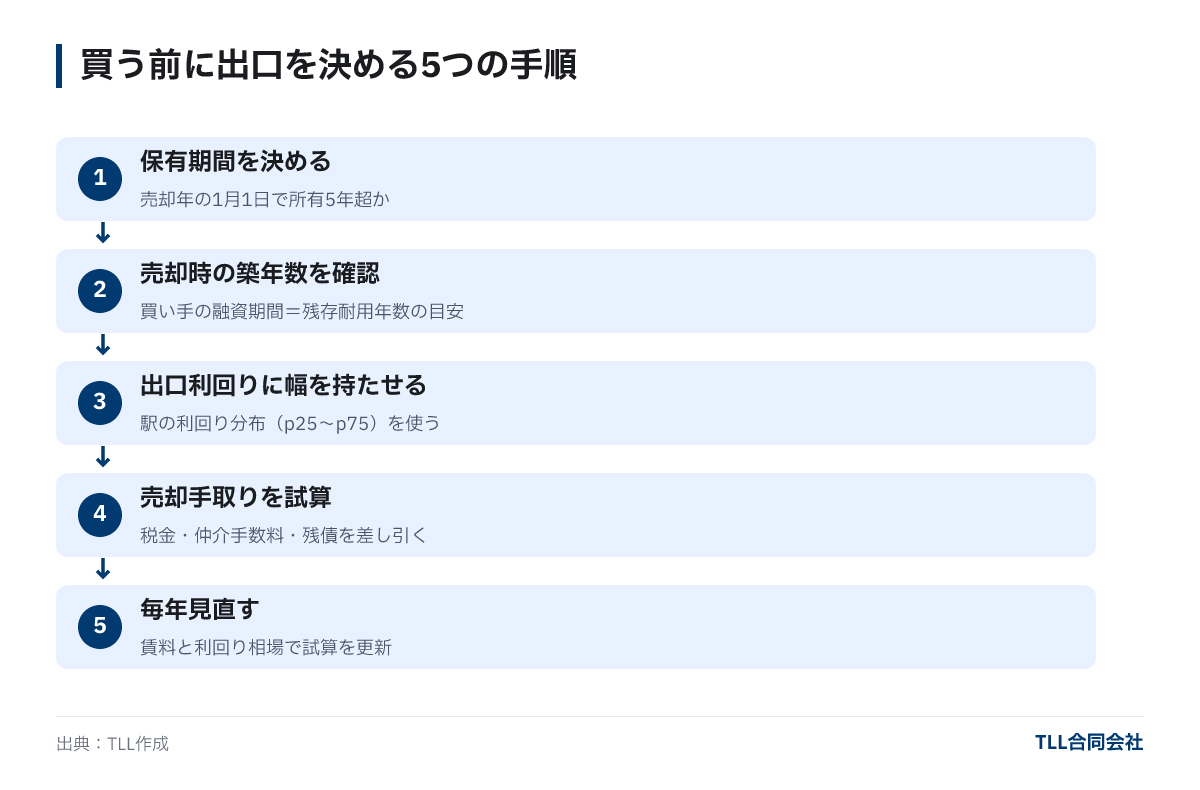
- Decide holding period: Confirm ownership exceeds 5 years as of January 1 of the planned sale year.
- Confirm building age at sale: Assess the buyer's likely loan term by the remaining useful life at that time.
- Allow a range for exit yield: Use yield distribution (p25–p75) at the station and price calculations at median, median +0.5pt, and +1pt.
- Estimate net proceeds: Deduct capital gains tax, brokerage fees, and loan balance from sale price.
- Review annually: Update rents, occupancy, and yield market annually to refine sale timing decisions.
If you want to know the current approximate sale price of a property you already own, you can estimate it from current rent and local yield trends via free appraisal.
Frequently Asked Questions
Q. Should I assume the exit yield is higher than purchase yield?
As building age increases, buyers seek higher yields due to shorter loan terms, so estimating with the exit yield equal to or slightly above the purchase yield is safer. In this article’s six stations, a 0.5pt yield increase lowers prices by about 8.8–11.0%.
Q. How much does tax differ if sold within 5 years?
If ownership as of January 1 of the sale year is 5 years or less, short-term capital gains tax is 39.63%; if over 5 years, it is 20.315% (law as of April 1, 2026). Tax amount roughly doubles even for the same capital gain.
Q. Can wooden apartments exceeding statutory useful life be sold?
They can be sold but with shorter loan terms required, buyers tend to be those with more equity or property purchasers, and prices are often decided with an emphasis on yield. Land value and rebuildability also affect price.
Q. Can the exit strategy be changed after purchase?
Yes, it is acceptable. Optimal timing changes with interest rates, rents, and inheritance plans, so review holding period, building age, and yield trends at least once a year.
Summary
- Capital gains tax rates are 20.315% for ownership exceeding 5 years as of January 1 of the sale year, and 39.63% for 5 years or less; plan backwards from acquisition to determine when long-term gains apply.
- The buyer’s loan term is approximated by remaining useful life (22 years for wood, 34 years for steel frame, 47 years for reinforced concrete minus building age), which changes the buyer profile by building age at sale.
- For a one-building property with 12 million yen annual rent, a 0.5pt increase in sale yield lowers prices by about 20–33 million yen in Tokyo’s six stations based on median yields (Urbalytics, Oct 2025–Oct 2026).
- Realistically, calculate exit prices across a yield range (p25–p75) and update yearly.
Featured image (illustration): Photo: Monineath Horn / Unsplash
About this article
- Author
- Eiichi Suto(Real Estate Brokerage / Renovation)Qualifications: Real Estate Transaction Specialist, General Insurance Solicitor Qualification, Assistant Commercial Facilities Planner, Level 2 Assistant Landscape Construction Management Engineer, Level 1 Assistant Civil Engineering Construction Management Engineer
Handles sourcing, acquisition and resale planning for income-producing and commercial properties across Greater Tokyo. He has more than 25 years of real estate experience, including sales and purchase work at Nomura Real Estate Solutions and Daikyo Anabuki Real Estate. He uses his industry network across central Tokyo and the wider metropolitan area to source off-market properties and assets with repositioning potential. He holds Japan's Real Estate Transaction Specialist qualification. When assessing an acquisition, he reviews tenancy, the building and property rights, then considers refurbishment costs and the expected resale price as part of the project economics. His approach connects the purchase negotiation with what can be improved and how the property can be sold. His articles explain sales of tenanted properties and options for older buildings, leasehold interests and other challenging conditions.
View profile → - Publisher
- TLL合同会社宅地建物取引業 東京都知事(1)第108202号住宅宿泊管理業 国土交通大臣(01)第F03424号
Data in this article cite their source and as-of date. Market conditions and regulations change, so check the latest information and consult a professional before deciding. Translated from the Japanese original.