Does Depreciation Increase Taxes When Selling an Apartment? How to Calculate Building Acquisition Costs and Tax Estimates by Structure and Age
Emi Tokudomi (licensed real estate broker, 宅地建物取引士)Acquisitions
21 min read
"Why do I have to pay taxes even if I sell at the same price I bought it?" This is a common question from apartment owners considering selling. The reason lies in the depreciation of the building recorded during ownership.
This article shows how acquisition costs are calculated at sale and how depreciation increases capital gains, illustrated by tax simulations varying structure and building age. We also cover the age distribution of entire building properties for sale in Tokyo and the differences between individuals and corporations.
Key Points of This Article
- The acquisition cost of an apartment is calculated as “land acquisition price + (building acquisition price − cumulative depreciation)” so even if you sell at the purchase price, the depreciated amount becomes part of the capital gain (National Tax Agency Tax Answer No.3258, No.3261; laws as of April 1, 2026).
- In simulations for a property with building value ¥30 million and land value ¥50 million held for 8 years and sold at purchase price, the capital gains tax is about ¥5.55 million for a used wooden building over 22 years old, and about ¥520,000 for a new reinforced concrete (RC) building (long-term tax rate 20.315%, 2026 tax year).
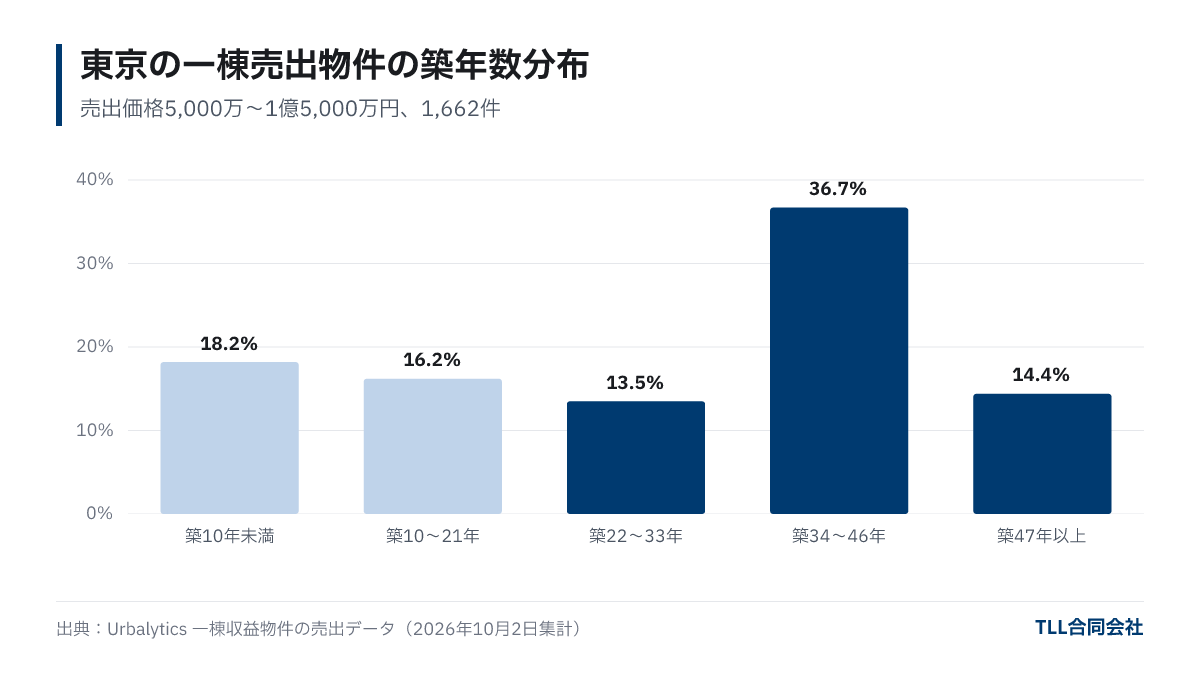
- Among 1,662 entire-building properties for sale in Tokyo priced between ¥50 million and ¥150 million, 64.6% are over 22 years old (Urbalytics sales data, aggregated October 2, 2026).
How to Calculate Acquisition Costs When Selling an Apartment
Acquisition costs consist of the land acquisition price plus the building acquisition price minus cumulative depreciation. Brokerage fees at purchase are also included in acquisition costs.
Because land is treated as an asset whose value does not diminish from use, its acquisition cost remains as the purchase price. In contrast, building values decrease over time, and the "undepreciated balance" after deducting cumulative depreciation during the holding period becomes the acquisition cost for the building.
Capital gain is calculated as follows:
Capital Gain = Sale Price − (Land Acquisition Price + Building Acquisition Price − Cumulative Depreciation) − Selling Expenses
If the purchase agreement does not specify the breakdown between land and building, it is common to allocate based on the ratio of fixed asset tax valuation. The higher the building proportion, the greater the depreciation amount, leading to lower acquisition costs at sale.

Why Does Depreciation Increase Capital Gains?
Depreciation amounts have been deducted as expenses from rental income during ownership. Because the book value of the building decreases accordingly, the amounts used as expenses are excluded from acquisition costs at sale and appear as capital gains.
As a concrete example: Suppose you bought a new wooden apartment building for ¥80 million total (land ¥50 million, building ¥30 million) and sold it 8 years later for ¥80 million. The statutory useful life of wooden housing is 22 years, and using a straight-line depreciation rate of 0.046, cumulative depreciation over 8 years is about ¥11.04 million.
- Building acquisition cost: ¥30 million − ¥11.04 million = ¥18.96 million
- Total acquisition cost: ¥50 million + ¥18.96 million = ¥68.96 million
- Selling expenses (maximum brokerage fee): approx. ¥2.71 million
- Capital gain: ¥80 million − ¥68.96 million − ¥2.71 million = approx. ¥8.33 million
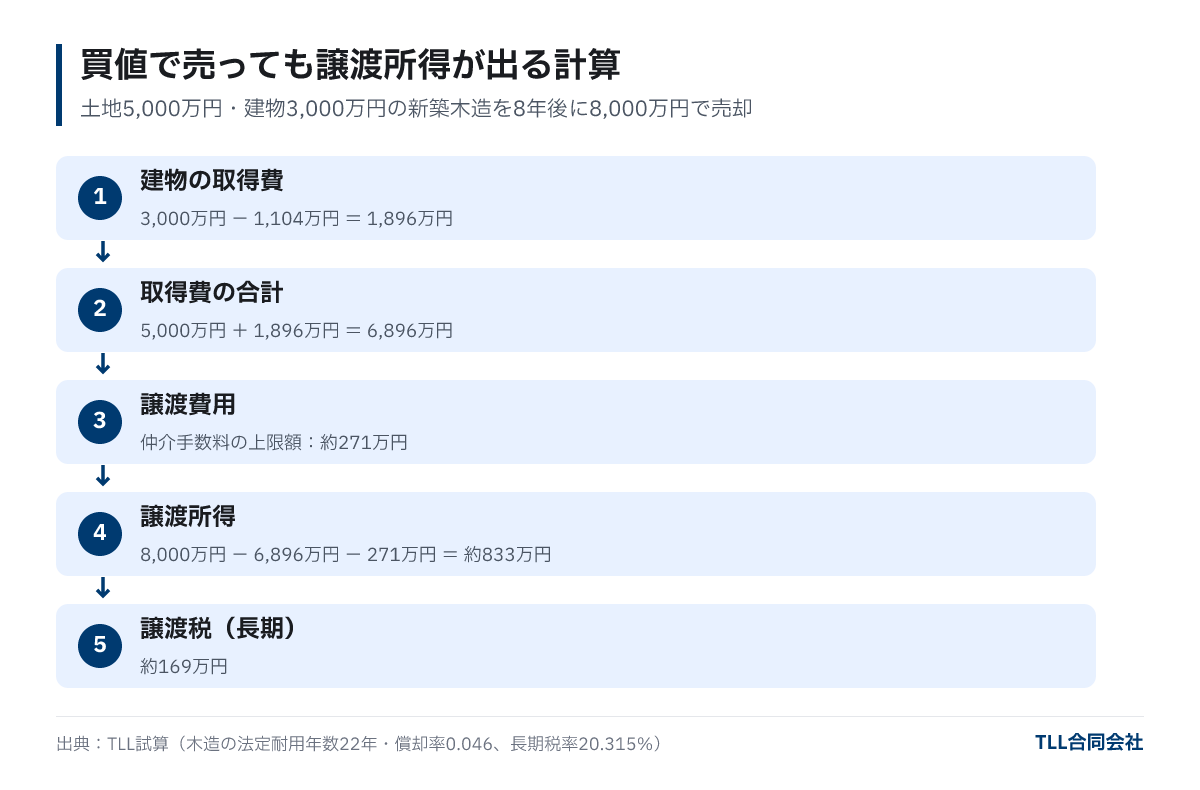
Even without a price increase, capital gains tax applies to approximately ¥8.33 million. Since ownership exceeds 5 years, this is taxed as long-term capital gains, with tax amount about ¥1.69 million. For details on classification between long-term and short-term, see Long-term and Short-term Capital Gains Tax Differences.
Depreciation Speed and Tax Amounts Vary by Structure and Age
Even with a ¥30 million building, the speed of depreciation changes significantly depending on the structure and age at purchase. For used buildings, it is common to use a simplification where the depreciation period equals statutory useful life minus elapsed years plus 20% of elapsed years (simplified method), and if the statutory useful life is fully exceeded, the depreciation period is 20% of statutory useful life (National Tax Agency Tax Answer No.5404).
| Building at Purchase | Depreciation Period (Rate) | Cumulative Depreciation Over 8 Years | Building Acquisition Cost at Sale | Capital Gain | Capital Gains Tax (Estimate) |
|---|---|---|---|---|---|
| New Wooden | 22 years (0.046) | ¥11.04 million | ¥18.96 million | ¥8.33 million | ¥1.69 million |
| Used Wooden 10 Years Old | 14 years (0.072) | ¥17.28 million | ¥12.72 million | ¥14.57 million | ¥2.96 million |
| Used Wooden Over 22 Years | 4 years (0.250) | Approx. ¥30 million (fully depreciated in 4 years) | ¥1 | ¥27.29 million | ¥5.55 million |
| Used RC 20 Years Old | 31 years (0.033) | ¥7.92 million | ¥22.08 million | ¥5.21 million | ¥1.06 million |
| New RC | 47 years (0.022) | ¥5.28 million | ¥24.72 million | ¥2.57 million | ¥520,000 |
Assumptions: Property acquired for land ¥50 million and building ¥30 million, held 8 years, then sold for ¥80 million. Selling expenses are brokerage fees at the maximum limit (approx. ¥2.71 million). Tax rate is long-term 20.315% (2026 tax year). TLL's simulation based on statutory useful life for housing (wood 22 years, reinforced concrete 47 years) and straight-line depreciation rates.
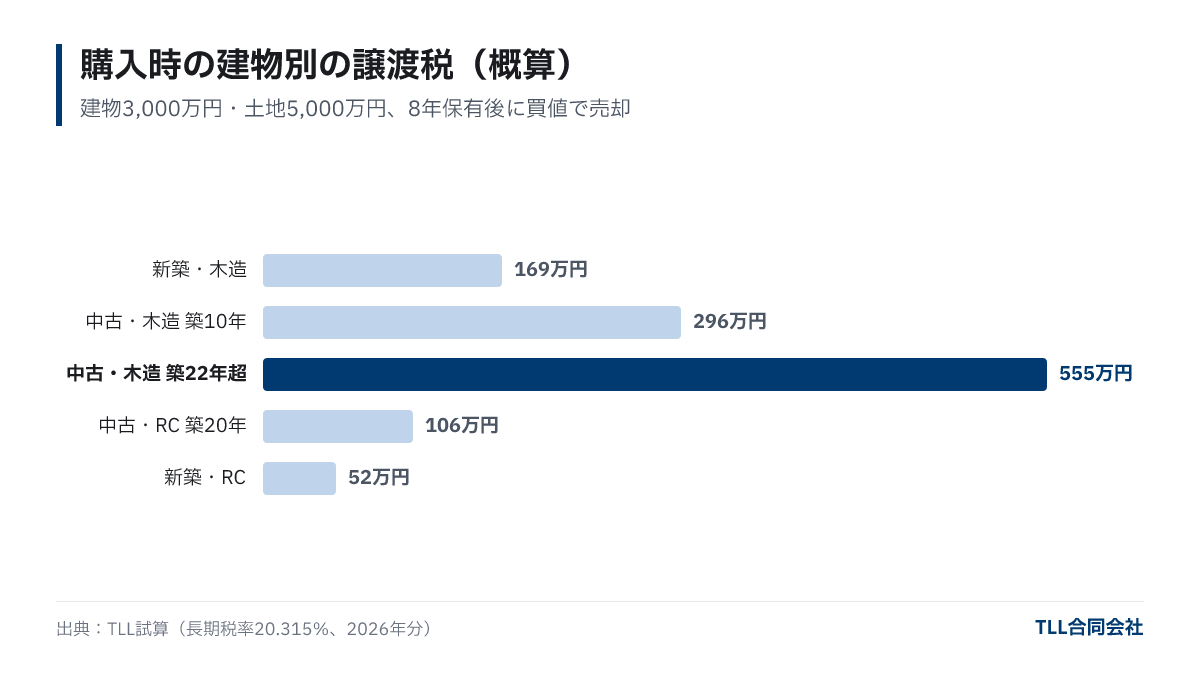
For used wooden buildings over 22 years old, depreciation ends almost entirely within 4 years. Although expenses during ownership are high, the building acquisition cost at sale remains almost zero, causing capital gains to be substantial. The difference in tax amount compared to new RC buildings is about ¥5 million.
Age Distribution of Entire-Building Properties for Sale in Tokyo
Actually, many properties for sale in Tokyo are relatively old buildings. Properties over 22 years old account for over 60%, suggesting that for many, depreciation has progressed significantly depending on purchase time and structure.
| Building Age | Number of Properties | Percentage | Median Gross Yield |
|---|---|---|---|
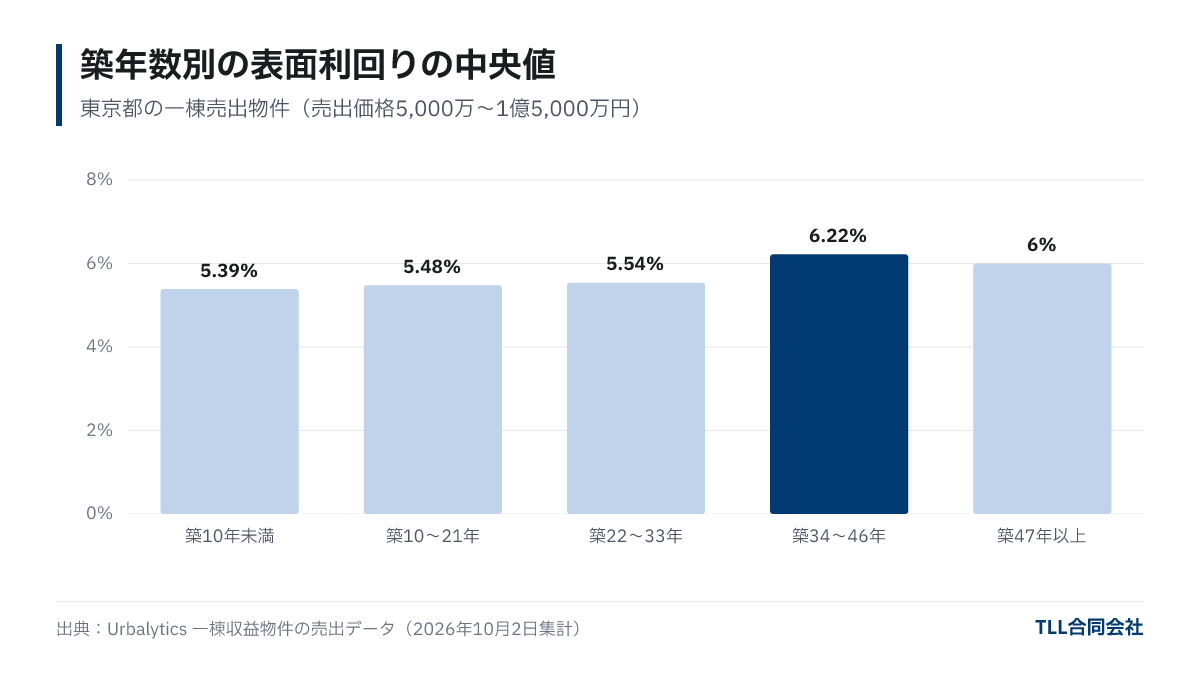
| Under 10 Years | 302 | 18.2% | 5.39% |
| 10 to 21 Years | 269 | 16.2% | 5.48% |
| 22 to 33 Years | 224 | 13.5% | 5.54% |
| 34 to 46 Years | 610 | 36.7% | 6.22% |
| 47 Years or Older | 239 | 14.4% | 6.00% |
Source: Urbalytics entire-building investment property sales data. Tokyo, prices ¥50 million to ¥150 million, among 1,680 properties with prices registered between July and September 2026, 1,662 had known construction years. Building age is calculated by subtracting construction year from 2026. Median gross yields are calculated from properties with annual rental income data. Structure (wood, RC, etc.) is not included in aggregation. Data aggregated October 2, 2026.
The median gross yield tends to rise with building age, reaching 6.22% for properties aged 34 to 46 years. While older properties tend to be evaluated by yield, sellers often face a large gap between selling price and net proceeds due to advanced depreciation and smaller acquisition costs. For details on how appraisal values are determined, see How Are Entire Apartment Appraisal Values Determined?.
Is Depreciation a “Loss”?
Depreciation may seem disadvantageous when looking solely at taxes at sale, but it must be considered together with tax savings from reducing taxable rental income during ownership.
Real estate income is combined with other income and taxed at progressive income tax rates of 5-45% plus a 10% residential tax. In contrast, long-term capital gains are taxed separately at 20.315%. For those with higher income tax rates during ownership, tax savings from depreciation may exceed increased taxes at sale. Conversely, those with lower tax rates during ownership or who sell in the short term may see net increases in tax burden.
Documents to Check Before Selling
- Purchase contract and documents showing the land and building breakdown
- Income and expenditure statements or blue return financial statements attached to each year’s income tax return (including depreciation calculations)
- Records of major repairs performed after purchase that were added to building value as capital expenditures

For individuals, even if depreciation was not claimed in certain years, acquisition cost at sale is generally calculated assuming depreciation has been taken. Organizing past filings makes estimating net proceeds easier. Note: For buildings used as a personal residence, a different calculation applies using 1.5 times the statutory useful life and adjusted depreciation rates (wood 0.031, reinforced concrete 0.015), subtracting acquisition cost × 0.9 × depreciation rate × elapsed years (National Tax Agency Tax Answer No.3261).
Differences Between Individuals and Corporations
For properties owned by corporations, capital gains are combined with other corporate profits and taxed under corporate tax without the long-term/short-term differential applicable to individuals. Additionally, corporations can choose whether to expense depreciation, differing from individuals.
The combination of tax rates on rental income during ownership and at sale varies depending on whether held by individual or corporation. When to consider incorporation and tax rate comparisons are summarized in When to Consider Incorporating Apartment Management. The overall sales process and costs are covered in Flow of Investment Property Sale. Current price estimates can be checked with Free Appraisal.
Frequently Asked Questions
Q. Will I be taxed even if I sell for less than the purchase price?
Yes. If depreciation has progressed on the building, the acquisition cost may be less than the purchase price. Even if the sale price is lower than the purchase price, capital gains tax can arise if sale price exceeds acquisition cost plus selling expenses.
Q. If I did not claim depreciation, does acquisition cost remain the purchase price?
For rental buildings, acquisition cost is generally calculated assuming depreciation was claimed even for missed years. If past filings have errors, it is recommended to consult a tax accountant to organize them.
Q. What if I don’t know the purchase price?
If acquisition cost is unknown or actual costs are low, a standard acquisition cost of 5% of sale price can be used (National Tax Agency Tax Answer No.3258). This method is often applied to inherited old apartments.
Q. Can major repair costs be included in acquisition cost?
Expenses classified as capital expenditures that extend building life or improve value are added to the building acquisition cost and then depreciated. Costs expensed as repairs during ownership are not included in acquisition cost.

Summary
- Apartment acquisition costs are calculated as “land acquisition price + building acquisition price − cumulative depreciation,” so even when selling at purchase price, the depreciated portion appears as capital gains.
- In simulations of a ¥30 million building held 8 years, capital gains tax ranged from about ¥520,000 for new RC buildings to about ¥5.55 million for used wooden buildings over 22 years old, showing roughly a 10-fold difference by structure and age (long-term tax rate 20.315%, 2026 tax year).
- Among properties for sale in Tokyo priced ¥50 million to ¥150 million, 64.6% are over 22 years old—confirming net proceeds is essential when selling properties with advanced depreciation.
- Tax savings from depreciation during ownership and capital gains taxation at sale should be considered together. The net outcome varies whether held by individual or corporation.
*This article is a general explanation based on laws as of October 2026 (laws as of April 1, 2026). Please consult a tax accountant or the relevant tax office for individual tax amounts.
Featured image (image): Photo: Dorothy Kuromi / Unsplash
About this article
- Author
- Emi Tokudomi(Acquisitions)Qualifications: Real Estate Transaction Agent
Handles investment property acquisitions and the review of documents and operating figures, drawing on experience in rental management, brokerage and sales support. She has more than 18 years of practical real estate experience and now works on acquisitions at TLL. With Japan's Real Estate Transaction Specialist qualification and bookkeeping knowledge, she considers management and repair costs alongside property income, as well as the documents needed for a transaction. Her articles explain gross versus net yield, purchase costs, financing fundamentals and purchase procedures for foreign nationals. She emphasizes distinguishing advertised yields from the cash left after expenses and identifying what to verify before buying. Her management and brokerage experience informs acquisition assessments that also consider operations after purchase.
View profile → - Publisher
- TLL合同会社宅地建物取引業 東京都知事(1)第108202号住宅宿泊管理業 国土交通大臣(01)第F03424号
Data in this article cite their source and as-of date. Market conditions and regulations change, so check the latest information and consult a professional before deciding. Translated from the Japanese original.