What Is the Optimal Building Age for Investment? Yield by Age Range in Tokyo's 23 Wards, and Considerations on Statutory Useful Life, Loan Period, Repairs, and Exit Strategy
Xiao Li (licensed real estate broker, 宅地建物取引士)Asset Management
24 min read
When searching for income properties, you often hear that "newer buildings are more reliable but have lower yields," while "older buildings offer higher yields but are harder to finance." So, how much do yields actually differ by building age? And besides yields, what else changes with building age?
This article organizes these points by analyzing sales listing data of whole-building properties in Tokyo's 23 wards (Urbalytics) aggregated by building age range. It examines the relationship between statutory useful life and loan periods, repair risks by building age, and how to think about building age from the perspective of resale (exit) planning.
Key points of this article
- The median gross yield for 1,200 whole-building properties in Tokyo's 23 wards, aggregated by building age range, showed a tendency to increase with building age: 4.6% for buildings under 10 years old and 5.3% for 31–40 years old (September 2026 sales listing data, Urbalytics, aggregated October 2, 2026).
- However, above 41 years old, the median yield plateaus around 5.0–5.2%, with yield variability (interquartile range) widening from 1.2 percentage points for properties under 10 years to 3.1 points for those over 51 years.
- Many financial institutions use "statutory useful life minus building age" as a guideline for loan duration. For example, borrowing 100 million yen at 2% interest results in annual repayments of about 4.44 million yen over 30 years, and about 7.72 million yen over 15 years, meaning building age greatly affects cash flow.
Is there a “correct answer” for the ideal building age for investment?
In conclusion, there is no single optimal building age that applies to all investors. This is because building age simultaneously affects yield, loan period, repair costs, and ease of resale, and the ideal age depends on which factors an investor prioritizes.

Generally, newer properties have lower yields but are easier to finance with long-term loans and often require fewer repairs, while older properties typically offer higher yields but have shorter loan terms and greater uncertainty in repairs and exit strategy. We will confirm these points with data and related regulations below. A comprehensive checklist for selecting properties is summarized in How to Choose Investment Properties.
Yield distribution by building age range (Tokyo 23 wards, whole-building properties)
Among whole-building properties (BUILDING) registered in Urbalytics in Tokyo's 23 wards, 1,200 properties with sales listing or price changes in September 2026, priced between 50 million yen and 500 million yen with annual income and building age specified, were aggregated by building age range.
| Building Age Range | Number of Properties | Gross Yield 25th Percentile | Gross Yield Median | Gross Yield 75th Percentile | Median Listing Price | Median Listing Price per ㎡ of Building |
|---|---|---|---|---|---|---|
| Within 10 years | 417 | 4.10% | 4.60% | 5.26% | 228 million yen | 1.101 million yen |
| 11–20 years | 123 | 4.20% | 4.78% | 5.61% | 168 million yen | 895,000 yen |
| 21–30 years | 101 | 4.00% | 4.76% | 5.50% | 180 million yen | 794,000 yen |
| 31–40 years | 333 | 4.29% | 5.28% | 6.07% | 180 million yen | 700,000 yen |
| 41–50 years | 127 | 3.93% | 5.02% | 6.25% | 158 million yen | 732,000 yen |
| Over 51 years | 99 | 3.80% | 5.17% | 6.94% | 177 million yen | 640,000 yen |
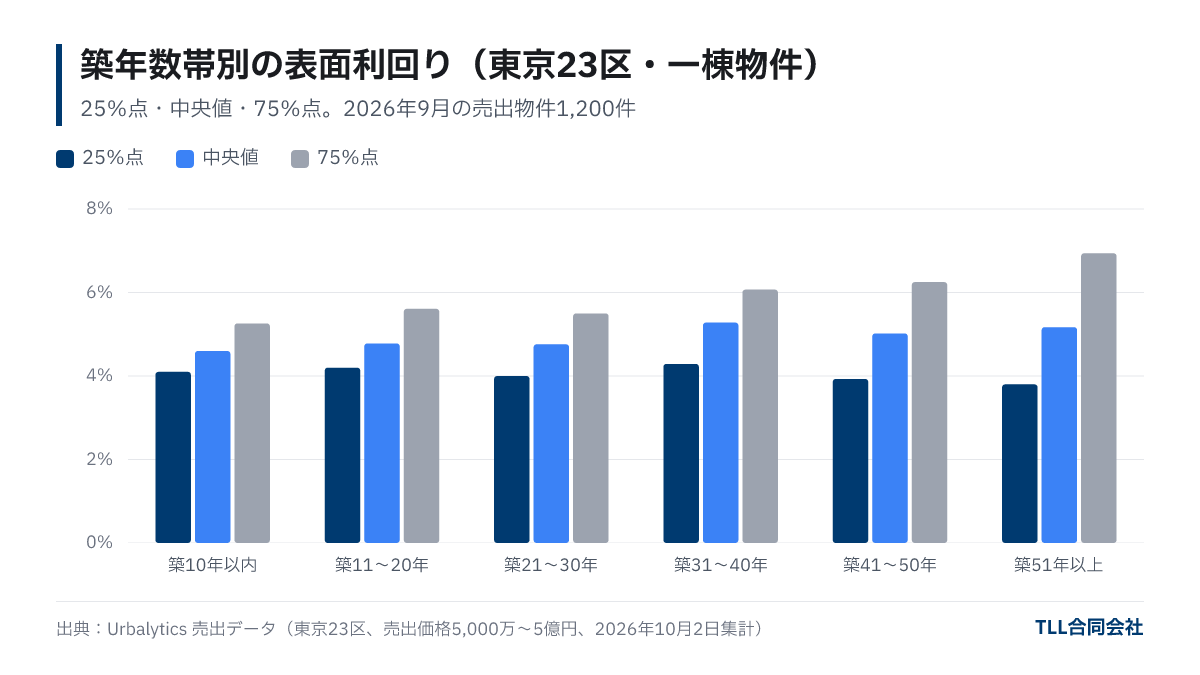
Source: Urbalytics sales listing data (whole-building properties, Tokyo 23 wards = postal codes 100–179, properties listed or price changed between September 1–30, 2026, price range 50 million to 500 million yen). Aggregated October 2, 2026. Building age is 2026 minus construction year. Gross yield is annual income listed at time of sale ÷ sale price, not the contracted price. Duplicate listings with identical sale price, building area, and construction year were consolidated into one entry; gross yields below 0.5% or above 30% were excluded (total data points aggregated were 1,200). Since data does not separate by structure (wooden, steel frame, RC), totals include all structures.
There are three observations from this table:
- Up to 40 years old, older buildings tend to have higher yields. The median rises about 0.7 points from 4.60% (under 10 years) to 5.28% (31–40 years). Sale price per ㎡ decreases from 1.1 million yen to 700,000 yen, reflecting building value depreciation in the price.
- Above 41 years, yields plateau. The median yield remains around 5.02–5.17%, lower than the 31–40 year range. Older buildings in the 23 wards are often priced based more on land value than rental income, limiting yield growth.
- Older buildings have greater variability (“hit or miss”). The interquartile range is 1.16 points for under 10 years and expands to 3.14 points for over 51 years. High-yield older properties require individual investigation into reasons such as vacancy, repairs, or redevelopment feasibility.
Note that gross yield does not deduct operating expenses. Because repair costs tend to increase with building age, net yield differences between newer and older buildings are narrower than shown here.
Relationship Between Statutory Useful Life and Loan Period
Building age strongly influences investment decisions because many financial institutions use the remaining statutory useful life as a guideline for loan duration. The statutory useful life is the number of years used for tax depreciation and does not represent the physical building lifespan, but it is widely used as a loan assessment standard.
| Structure (Residential) | Statutory Useful Life | Remaining Life at 10 Years Old | Remaining Life at 20 Years Old | Remaining Life at 30 Years Old |
|---|---|---|---|---|
| Wooden | 22 years | 12 years | 2 years | Exceeded |
| Light Steel Frame (frame thickness over 3mm up to 4mm) | 27 years | 17 years | 7 years | Exceeded |
| Heavy Steel Frame (frame thickness over 4mm) | 34 years | 24 years | 14 years | 4 years |
| Reinforced Concrete (RC) / Steel Reinforced Concrete (SRC) | 47 years | 37 years | 27 years | 17 years |
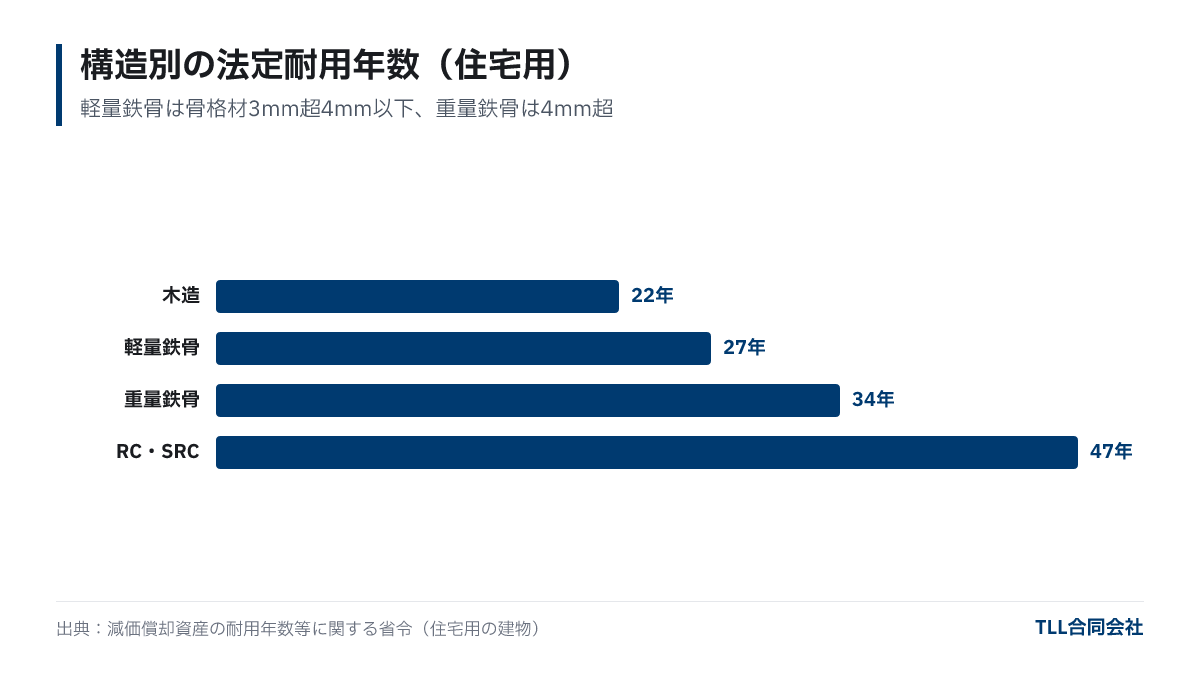
Source: Ordinance on the Useful Lives of Depreciable Assets (residential buildings). For light steel frame with frame thickness 3mm or less, the statutory useful life is 19 years.
By financial institution type, general tendencies include (individual conditions vary by timing and borrower attributes):
- City banks and many regional banks: tend to set loan periods within the remaining statutory useful life, so older wooden buildings often have shorter loan durations.
- Some regional banks, credit associations, and credit unions: may use their own set "economic useful life," lending beyond the statutory useful life. Often, this requires that the property location and borrower’s address or workplace fall within the bank’s service area.
- Non-bank lenders: can accommodate properties exceeding statutory useful life or those not eligible for rebuilding, but usually charge higher interest rates and require larger down payments.
Differences in loan period directly affect annual repayment amounts. Assuming a 100 million yen loan at 2% interest with equal principal and interest payments, the annual repayments are approximately:
| Loan Period | Annual Repayment |
|---|---|
| 35 years | Approximately 3.98 million yen |
| 30 years | Approximately 4.44 million yen |
| 20 years | Approximately 6.07 million yen |
| 15 years | Approximately 7.72 million yen |
| 10 years | Approximately 11.04 million yen |
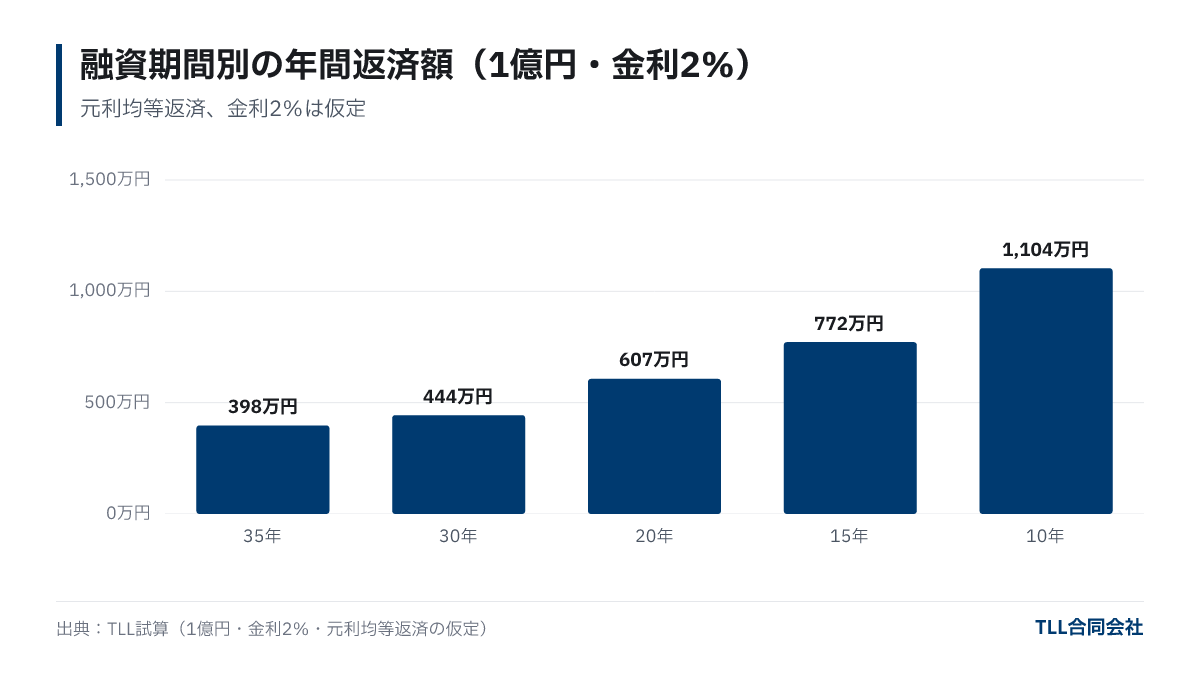
For example, purchasing a property priced at 125 million yen with a 5% gross yield (annual full-occupancy rent 6.25 million yen) funded by a 100 million yen loan, there is a cash flow surplus after repayments if the loan period is 30 years, but if 15 years, the rental income mostly goes to repayments and expenses would cause negative cash flow. Even older properties with higher gross yields may yield less cash flow in hand if loan periods are short. Loan assessment basics are explained in Real Estate Investment Loan Basics, and how financial institutions evaluate properties in Bank Valuation, Cost Approach and Income Approach.
Repair Risks by Building Age

Repair costs tend to increase with building age and often occur in large installments. Common milestones, which can vary based on building specifications and past maintenance, include:
- Around 10–15 years old: First major repairs such as exterior wall painting and sealing, rooftop and balcony waterproofing. Replacement of equipment such as water heaters and air conditioners also usually begins.
- Around 20–30 years old: Second exterior wall and waterproofing repairs, coupled with deterioration of water supply and drainage pipes; for buildings with elevators, updating control systems becomes an issue.
- Over 30 years old: Replacement of water supply and drainage pipes and renovations of layouts or wet areas may be needed to maintain rent levels.
Seismic resistance is another important factor to check. Buildings with construction permits after June 1, 1981 comply with the “new seismic standards,” and those before this date use the “old seismic standards.” Some financial institutions limit financing of old seismic standards properties. For wooden buildings, those built after June 2000 (when connection and wall arrangement standards were reinforced) are preferable.
Before purchase, it is recommended to obtain maintenance history (when, where, and how much repairs cost) from the seller. Properties that are older but have had major construction completed differ significantly in near-term expenses from newer properties with no maintenance. For capital planning including initial costs, please refer to Costs When Purchasing Income Properties.
How to Consider Building Age From the Exit (Resale) Perspective
When thinking about building age, it is crucial to consider the building age at the time of resale, not at purchase. Buyers at the resale stage also often use financing, and their loan terms—and thus resale price—are affected by the remaining statutory useful life at that time.

For example, if you buy a wooden property at 15 years old and hold it for 10 years, it will be 25 years old at resale and beyond the statutory useful life. Financing options for the buyer become limited, and price is more likely set based on land value and higher assumed yield. Meanwhile, if you purchase a 20-year-old RC (reinforced concrete) building and hold it for 10 years, the resale age is 30 with 17 years remaining useful life, making loans more accessible for the next buyer.
Based on these points, building age selection by investment strategy can be summarized as follows:
| Strategy | Preferred Building Age & Structure | Notes |
|---|---|---|
| Use financing for long-term stable operation | New to approx. 20 years old RC or heavy steel frame | Gross yields tend to be low; verify difference between net yield and loan interest rate |
| Balance yield and loan period | RC aged 20–30 years, or newer wooden buildings | Confirm status of major repairs and remaining life at resale |
| Prioritize yield with larger own capital | Wooden buildings exceeding useful life, over 40 years old | Loan periods are short; wide variability in repairs, vacancy, and rebuilding feasibility |
Frequently Asked Questions
Q. Can I get financing for an old wooden apartment?
It is possible in some cases, but financing for buildings exceeding the statutory useful life of 22 years is generally limited to shorter loan durations or fewer financial institutions. Lenders that use their own useful life criteria or non-bank lenders may require stricter conditions such as higher interest rates and down payments.
Q. Do older buildings always have higher yields?
According to sales listing data in Tokyo's 23 wards, median gross yields rise with age up to 40 years but plateau at about 5.0–5.2% above 41 years. Older buildings tend to be priced more on land value, and yield variability increases significantly.
Q. Do buildings become uninhabitable after the statutory useful life expires?
No. The statutory useful life is a tax depreciation period and separate from the physical lifespan. Many properties continue to be rented after the statutory useful life if properly maintained.
Q. How is depreciation calculated for second-hand properties?
Under the simplified method, depreciation years are calculated as "(Statutory useful life − elapsed years) + elapsed years × 20%" (rounded down to full years). Buildings that have exceeded the statutory useful life use "Statutory useful life × 20%". For example, wooden buildings over 22 years have 4 remaining years, and 30-year-old RC buildings have 23 years. Please consult your tax advisor for details.
Summary
- The median gross yield for whole-building properties in Tokyo's 23 wards is 4.6% under 10 years old, 5.3% for 31–40 years, and 5.0–5.2% for over 41 years (September 2026, Urbalytics sales data).
- Older buildings exhibit greater yield variability, with interquartile ranges growing from 1.2 points for under 10 years to 3.1 points for over 51 years.
- Loan periods closely relate to "statutory useful life minus building age," with annual repayments of about 4.44 million yen for 30 years and 7.72 million yen for 15 years on a 100 million yen loan at 2% interest.
- Select building age by factoring in repair milestones and estimating the building age and remaining useful life at resale to align with your financial plan.
Income properties handled by TLL can be viewed with building age and yields on the Member Page (free registration).
Featured image (image): Photo: Ryan Rivers / Unsplash
About this article
- Author
- Xiao Li(Asset Management)Qualifications: Real Estate Transaction Specialist, Building Management Specialist
The operational lead for real estate sales and property management. At NTT Communications, he spent more than eight years managing DX projects for major enterprises, overseeing the full process from requirements definition through delivery and operations. At TLL, he handles the entire deal management cycle for income-producing properties, including sales strategy planning, investor sourcing, contract execution, settlement, and handover, providing well-matched opportunities and smooth transaction execution for domestic and international investors and operators.
View profile → - Publisher
- TLL合同会社宅地建物取引業 東京都知事(1)第108202号住宅宿泊管理業 国土交通大臣(01)第F03424号
Data in this article cite their source and as-of date. Market conditions and regulations change, so check the latest information and consult a professional before deciding. Translated from the Japanese original.