Want to Quit Real Estate Investment: How to Decide Between Selling or Holding
Eiichi Suto (licensed real estate broker, 宅地建物取引士)Real Estate Brokerage / Renovation
21 min read
"Vacancies continue and net income is decreasing," "Seeing the estimate for major repairs made me uneasy," "I received a notice of interest rate revision." The reasons for wanting to quit real estate investment vary, but selling impulsively may result in financial losses in terms of net proceeds and taxes. Conversely, hesitation can lead to worsening income due to repairs or vacancies, making it harder to sell.
This article organizes the criteria for apartment building owners to decide whether to "sell or continue holding" their entire apartment or condominium buildings, including loan balance and sale net proceeds, cash flow, timing of repairs, interest rates, market yields, and five-year ownership tax rates. For market benchmarks, it uses Urbalytics sales listing data (latest 12 months, excluding duplicates) showing gross yields at six stations.
Key points of this article
- Decide whether to sell or hold by comparing "net proceeds if sold" with "current net income from holding plus future net proceeds from eventual sale" using consistent metrics. The starting point is comparing amounts after deducting loan balance, costs, and taxes, not relying on intuition.
- The median gross yields for properties listed or price-changed between October 2025 and October 2026 were: Nakano 4.38%, Ikebukuro 4.81%, Kamata 5.01%, Kitasenju 5.18%, Kawasaki 6.09%, and Omiya 6.20% (Urbalytics, duplicate listings excluded, 44–75 listings per station). Even with the same annual rent of 10 million yen, the median-based price varies from about 161 million to 228 million yen depending on station, a difference of approximately 67 million yen.
- For individual real estate sales, if ownership exceeds five years as of January 1 of the year sold, long-term capital gains tax applies (tax rate 20.315%); if ownership is five years or less, short-term capital gains tax applies (39.63%) (National Tax Agency Tax Answer No.1440, confirmed October 2026). Waiting a few months around this border can significantly impact tax amounts.
What to check first if you want to quit real estate investment
The first step is not to decide whether to sell or hold but to gather the necessary numbers to make that decision. If you have the following four documents, you can apply all the criteria discussed in this article.
- Rent roll: rent per unit, contract start dates, and vacancy status
- Loan repayment schedule: current loan balance, interest rate, remaining repayment period
- Repairs history and future plans: when exterior walls, rooftop waterproofing, plumbing, etc., were repaired
- Acquisition documents: purchase price, acquisition costs, depreciation claimed in your tax return
Depending on whether your reason for wanting to quit relates to the property itself (vacancies, repairs, interest rates) or owner circumstances (inheritance planning, funding needs, management effort), your options differ. If management burden is the issue, reconsidering the management company rather than selling is also an option (Property management outsourcing and asset management).

Criterion 1: Loan balance and net proceeds from sale (how much remains if sold)
When deciding to sell, focus on "net proceeds" rather than the sale price. Net proceeds are generally calculated as follows.
Net proceeds from sale = Sale price – Brokerage and other selling costs – Loan balance – Capital gains taxes and resident tax
For example, for an apartment generating 10 million yen annual rent, dividing by Kamata's median yield of 5.01% gives a price of about 200 million yen. Maximum brokerage fee (3% of sale price + 60,000 yen + consumption tax) is about 6.67 million yen; with a loan balance of 150 million yen, pre-tax net proceeds are approximately 43.33 million yen. From this, deduct capital gains taxes plus costs such as mortgage discharge and stamps for the actual net proceeds.
If the sale price is below the loan balance (so-called "underwater loan"), you must cover the difference from your own funds to discharge the mortgage. In this case, rather than rushing to sell, consider continuing ownership until repayment progresses or consult your financial institution. Detailed brokerage fee calculations are in Brokerage Fee Explanation, and the differences between brokerage and direct purchase net proceeds are simulated in Direct Purchase vs. Brokerage Comparison.
Criterion 2: Cash flow and timing of repair peaks
When continuing to hold, compare the sum of "total net income after tax (cash flow) over the next few years" and "net proceeds from sale at that point." Even if current net income is positive, future figures may change significantly due to the following two factors.
Vacancy and rent declines
As buildings age, rents often need lowering to attract tenants, and each vacancy incurs costs for restoring the unit and advertising (AD). Estimate annual vacancy loss and advertising costs based on tenant turnover in the past 1–2 years.
Timing of major repairs
Exterior wall painting, rooftop waterproofing, metal painting, and plumbing updates require lump-sum expenditures every 10–15 years. Properties near a scheduled repair are typically discounted by buyers who reduce price expectations by repair costs. Decide whether to sell after repairs or include repair costs in the sale price by comparing construction expenses and price impacts. Typical cycles and costs are summarized in Timing and Costs of Major Repairs.

Criterion 3: Interest rates and market yields (expected sale price)
A rough guide to sale price is the income capitalization approach: "annual rent ÷ yield expected by local buyers." As interest rates rise, required yields tend to increase, pushing prices down for the same rent. If you have a variable interest rate loan, you are affected both by reduced net income through interest rate revisions and by lower sale prices.
The following table summarizes the gross yields of whole-building listings at six stations over the past 12 months.
| Station | Listings | Lower 25% | Median | Upper 25% | Indicative price from 10 million yen annual rent and median yield |
|---|---|---|---|---|---|
| Nakano | 46 listings | 4.00% | 4.38% | 5.20% | Approx. 228.25 million yen |
| Ikebukuro | 75 listings | 3.97% | 4.81% | 5.56% | Approx. 208.04 million yen |
| Kamata | 52 listings | 4.22% | 5.01% | 5.88% | Approx. 199.74 million yen |
| Kitasenju | 53 listings | 4.34% | 5.18% | 6.00% | Approx. 193.18 million yen |
| Kawasaki | 55 listings | 4.76% | 6.09% | 6.83% | Approx. 164.20 million yen |
| Omiya | 44 listings | 5.50% | 6.20% | 6.61% | Approx. 161.31 million yen |
Source: Urbalytics sales listing data. Whole-building listings posted or price-changed from October 2, 2025 to October 2, 2026 (duplicates excluded, listing yields below 1% or above 25% excluded). Gross yield = listed rent ÷ sale price; listed rent may reflect full occupancy assumptions or current conditions depending on source. These are listing prices, not transaction prices. Data as of October 2, 2026.
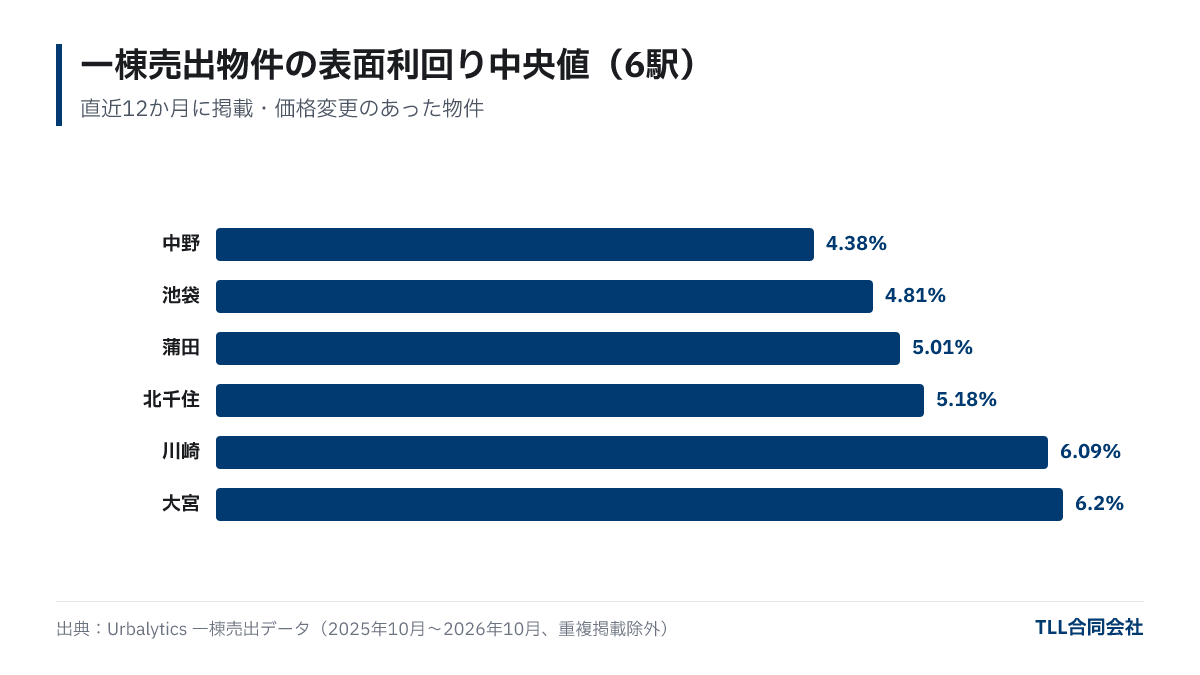
Even within the same station, yields vary by 1–2 points between lower 25% and upper 25%. Factors like building age, structure, distance from station, and vacancy determine where your property falls in this range. For how to research market prices, see How to Research Sale Prices Yourself, and for how valuation is determined, see How Apartment Building Valuation is Determined.
Criterion 4: Five-year ownership threshold and capital gains tax
Capital gains tax rates on property sold by individuals vary considerably depending on the period of ownership. Ownership period is counted as of January 1 of the year sold (National Tax Agency Tax Answer No.1440, confirmed October 2026).
- Long-term capital gains (ownership over five years as of January 1): Income tax 15%, special reconstruction income tax 0.315%, resident tax 5%, total 20.315%
- Short-term capital gains (ownership five years or less as of January 1): Income tax 30%, special reconstruction income tax 0.63%, resident tax 9%, total 39.63%
For example, if selling in 2026, a property acquired on or before December 31, 2020 qualifies as long-term capital gains. Properties acquired in 2021 will become long-term capital gains only if sold after January 1, 2027. For a capital gain of 20 million yen, tax differences amount to approximately 3.86 million yen. When deciding around the threshold, the timing of transfer registration may significantly alter net proceeds.
Also, capital gains increase as the building’s book value decreases due to depreciation. For detailed tax simulations, see Differences Between Long-Term and Short-Term Capital Gains and Depreciation and Taxes on Sale. Always confirm final tax amounts with a tax professional.

Steps to decide whether to sell or continue holding
Applying the above criteria in the following order makes comparison easier. The key is to compare "net proceeds at the same point in time" for both selling and continuing to hold.
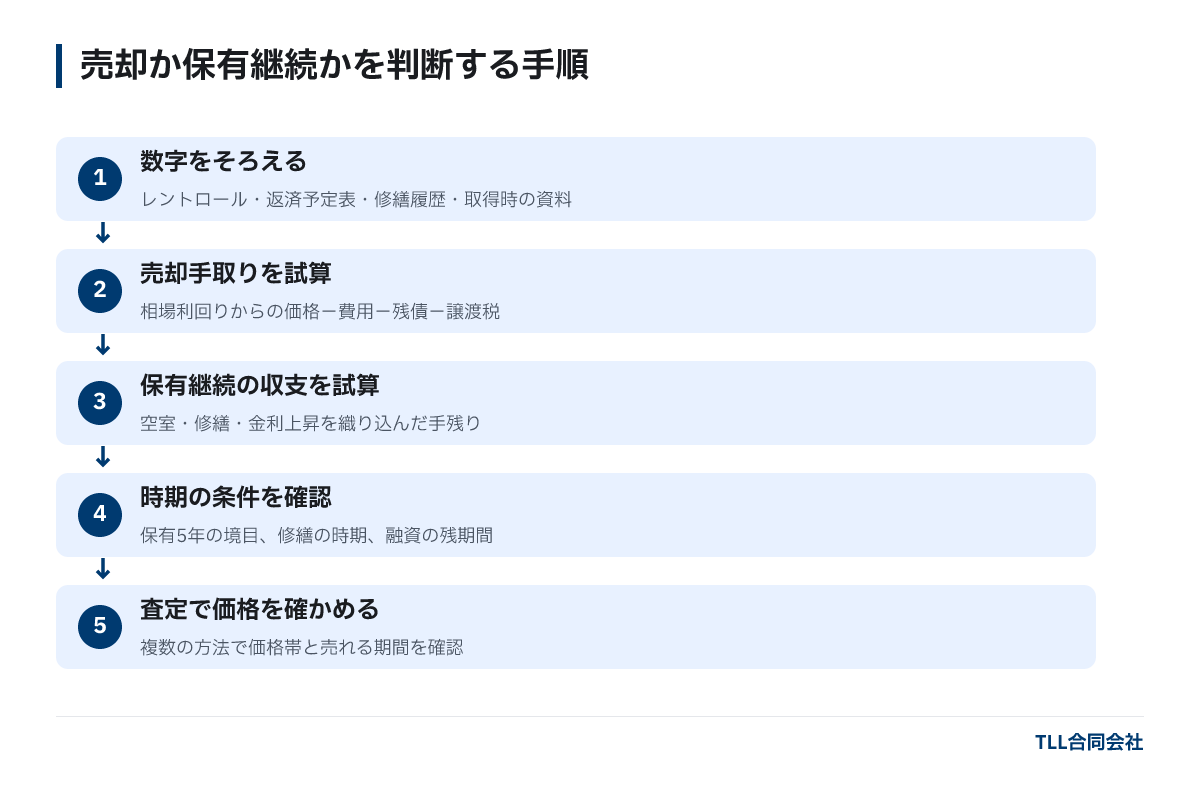
- Gather numbers: Prepare rent roll, repayment schedule, repair history, and acquisition documents.
- Estimate net proceeds from sale: Apply market yield to price, then subtract selling costs, loan balance, and capital gains tax.
- Estimate holding income: Calculate net income over the next 3–5 years including vacancy, repair, and interest rate changes, then add estimated net proceeds from sale at that time.
- Check timing conditions: Review five-year ownership threshold, scheduled repairs, and remaining loan period.
- Confirm prices by appraisal: Verify if assumed yields are realistic and check price ranges and expected selling periods with multiple appraisals.
Sometimes the result is that holding yields higher net proceeds but repair costs and management burden are heavy. In such cases, consider changing management to reduce burden while continuing ownership. For the sales process, see Flow of Selling Income Properties, and for timing strategies, see Best Timing to Sell Apartments.
Frequently Asked Questions
Q. Are there alternatives to selling if I want to quit real estate investment?
You can reduce management burden by changing management companies or switching to management outsourcing, lower repayment by refinancing, or reconsider tax burdens by transferring to a corporation. The choice depends on whether your motivation is management effort or cash flow.
Q. Can I sell if the loan balance exceeds the sale price?
Yes, but you must provide your own funds to cover the difference at settlement to release the mortgage. If the shortfall is large, consider holding until repayment advances or consult your lender before proceeding.
Q. When is the five-year ownership judged?
It is based on ownership period as of January 1 of the year sold (National Tax Agency Tax Answer No.1440). For sales in 2026, acquisition on or before December 31, 2020 qualifies as long-term capital gains.
Q. How should I research market yields?
Check the yield distribution of comparable whole-building listings at the same station and property type. Listing prices tend to be higher than transaction prices, so finally verify with appraisals.
Summary
- Decide whether to sell or hold by comparing net proceeds from sale with the sum of holding net income plus future sale net proceeds using a consistent metric.
- The median gross yields of whole-building listings at six stations ranged from 4.38% to 6.20%, with estimated prices for 10 million yen annual rent ranging from about 161 million to 228 million yen (Urbalytics, Oct 2025–Oct 2026).
- Capital gains tax rate is 20.315% if ownership exceeds five years as of January 1, and 39.63% if five years or less. Adjusting sale timing near this threshold can be beneficial.
- Repair timing and interest rate revisions affect both net income and sale price. After gathering numbers, checking your price range with free appraisals is a shortcut to a sound decision.
Featured image (image): Photo: Jakub Żerdzicki / Unsplash
About this article
- Author
- Eiichi Suto(Real Estate Brokerage / Renovation)Qualifications: Real Estate Transaction Specialist, General Insurance Solicitor Qualification, Assistant Commercial Facilities Planner, Level 2 Assistant Landscape Construction Management Engineer, Level 1 Assistant Civil Engineering Construction Management Engineer
Handles sourcing, acquisition and resale planning for income-producing and commercial properties across Greater Tokyo. He has more than 25 years of real estate experience, including sales and purchase work at Nomura Real Estate Solutions and Daikyo Anabuki Real Estate. He uses his industry network across central Tokyo and the wider metropolitan area to source off-market properties and assets with repositioning potential. He holds Japan's Real Estate Transaction Specialist qualification. When assessing an acquisition, he reviews tenancy, the building and property rights, then considers refurbishment costs and the expected resale price as part of the project economics. His approach connects the purchase negotiation with what can be improved and how the property can be sold. His articles explain sales of tenanted properties and options for older buildings, leasehold interests and other challenging conditions.
View profile → - Publisher
- TLL合同会社宅地建物取引業 東京都知事(1)第108202号住宅宿泊管理業 国土交通大臣(01)第F03424号
Data in this article cite their source and as-of date. Market conditions and regulations change, so check the latest information and consult a professional before deciding. Translated from the Japanese original.