Points to Note in Sublease (Master Lease) Contracts – Rent Reduction, Exemption Periods, Early Termination, and Differences from Rent Guarantee Companies
Xiao Li (licensed real estate broker, 宅地建物取引士)Sales & Property Management Lead
21 min read
Some property owners may be considering sublease (master lease) contracts based on explanations like "a fixed rent every month even if there are vacancies." On the other hand, there are also reports that after several years of contract, rent reduction demands were made by sublease companies, or that early termination was difficult even when desired.
This article organizes the mechanism of sublease contracts, the rules on advertising and solicitation set by the Act on Proper Management of Rental Housing (Rental Housing Management Act), rent reduction based on Article 32 of the Act on Land and Building Leases (Land and Building Lease Act), exemption periods, and how to interpret termination clauses. Because the system differs completely from rent guarantee companies that ensure tenants’ rent payment, we also compare these differences.
Key points of this article
- Since in sublease the sublease company becomes the lessee, even if the contract states "rent fixed for ◯ years," a rent reduction claim is possible according to Article 32, Paragraph 1 of the Act on Land and Building Leases (Ministry of Land, Infrastructure, Transport and Tourism guidelines, revised March 31, 2023).
- Estimation using eight 1K units in Nakano (each 103,000 JPY) shows annual net income approximately 8.72 million JPY for management consignment, about 8.23 million JPY with sublease rent at 85% of full rent, and approximately 7.41 million JPY if sublease rent decreases by 10% (Urbalytics rent data, October 2026).
- For sublease contracts signed as ordinary lease contracts, landlords must have just cause under Article 28 of the Act on Land and Building Leases to refuse renewal or terminate, whereas early termination by the sublease company may be possible depending on contractual terms.
What is Sublease (Master Lease): Relationship Between Owner and Operator
Sublease means the sublease company leases the entire building from the owner and then sublets it to tenants. The contract between owner and company is called a "master lease contract (specified lease contract)," and the contract between company and tenants is called a "sublease contract."
The main advantage for owners is that recruitment of tenants, rent collection, and complaint handling are entrusted to the company, and rent specified in the lease contract is received even if there are vacancies. In return, the sublease rent is set lower than the rent tenants pay, and the owner contracts with the company, which is the "lessee." This point that the "company as lessee is legally protected" is connected to issues of rent reduction and termination explained later.
Difference from Rent Guarantee Companies
Although the names are similar, rent guarantee companies serve as joint guarantors for tenants and have a completely different mechanism from sublease companies.
| Item | Sublease (Master Lease) | Rent Guarantee Company |
|---|---|---|
| Owner's contract partner | Sublease company (lessee) | Tenant enters guarantee contract with guarantee company |
| What is guaranteed | Payment of sublease rent specified in contract | Tenant's rent arrears and restoration costs |
| If vacant | Sublease rent paid except during exemption period | Not covered as no tenant present |
| Level of rent received | Sublease rent lower than tenant rent | Tenant's rent as paid |
| Main laws | Rental Housing Management Act, Act on Land and Building Leases | Civil Code (guarantee), each company’s terms |
Source: Created by TLL based on Ministry of Land, Infrastructure, Transport and Tourism "Guidelines for Proper Business Practices for Sublease Business" (amended March 31, 2023).

Prohibited Exaggerated Advertising and Unfair Solicitation under the Rental Housing Management Act
Due to frequent troubles related to sublease, the Rental Housing Management Act enforced on December 15, 2020, stipulates prohibitions on exaggerated advertising (Article 28), unfair solicitation (Article 29), and delivery of important matters explanation before contract conclusion (Article 30) for sublease companies and solicitors. Construction companies or real estate companies collaborating with sublease companies for solicitation are also subject to regulations.
The MLIT guidelines list problematic examples such as:
- Advertising “rent guarantee” or “vacancy guarantee” without disclosing nearby that rent review regularly happens or rent may be reduced under Article 32 of the Act on Land and Building Leases
- Displaying "◯ years rent guarantee" without noting the company may terminate even during that period
- Explaining only benefits without explaining future rent reduction risk, possibility of company termination, or landlord’s repair/restoration cost obligations
- Failing to disclose exemption periods without rent payment for a few months initially after new construction
- Definitively stating “rent income guaranteed for the future,” implying no reductions
Before contract signing, the sublease company must provide a written explanation of important matters (Specified Lease Contract Important Matters Explanation Document). Confirm that this explanation matches advertising materials and what the sales representative said.
Article 32 of the Act on Land and Building Leases: Rent Reduction Can Occur Even if “Rent Fixed”
Even if a sublease contract provides conditions such as "rent will not be reduced for 10 years" or "rent revision requires mutual agreement," according to Article 32 Paragraph 1 of the Act on Land and Building Leases, the sublease company can claim rent reduction. The 2003 Supreme Court ruling also confirmed Article 32 applies to sublease contracts.
However, rent reduction claims are possible only if rent becomes unreasonable due to (1) changes in land/building taxes or burdens, (2) fluctuations in land/building prices or other economic situations, or (3) comparison with rents for similar nearby buildings. The guidelines clarify that rent reduction under Article 32 cannot be based solely on increased vacancies or deterioration of the sublease company’s business. Moreover, the owner is not forced to accept the claim; the parties negotiate a reasonable rent, and if they cannot agree, the court makes the final decision.
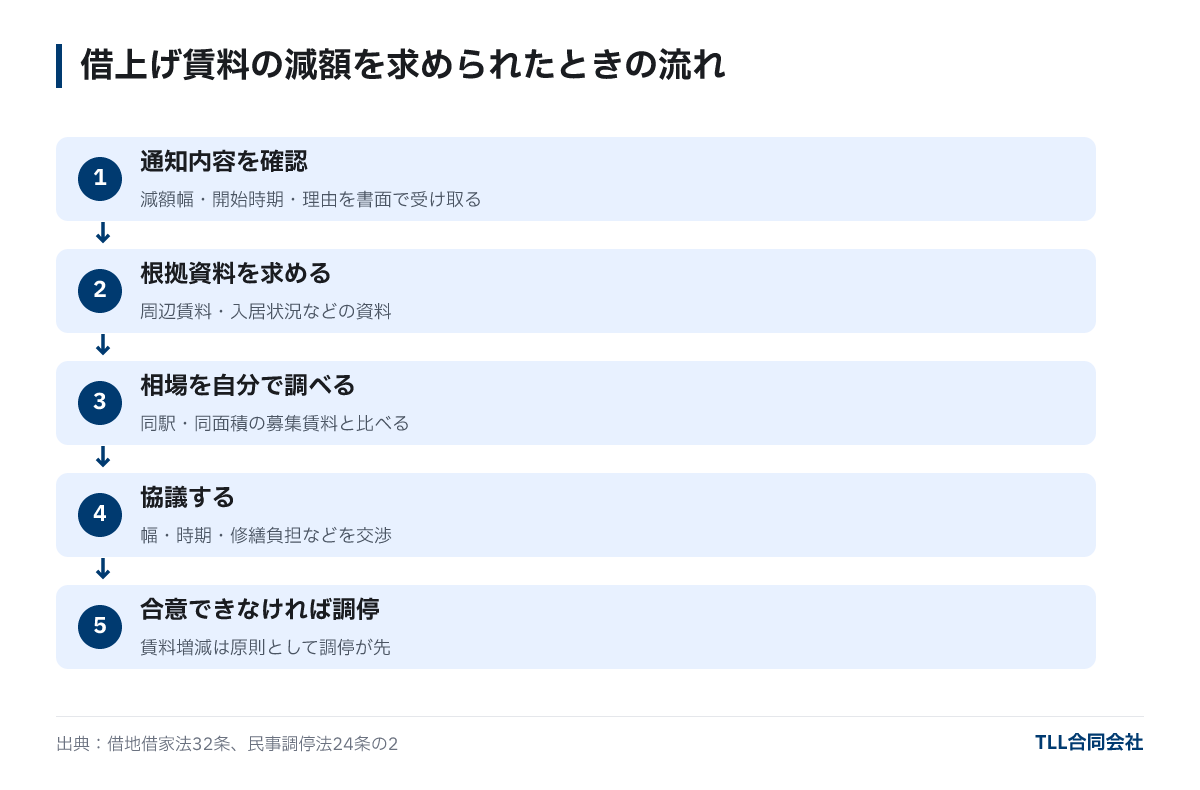
Disputes over rent adjustments are generally first submitted for civil mediation (Civil Mediation Act Article 24-2). Owners can verify "rents of similar nearby buildings" by researching advertised rents at the same station and size. Note that if the contract is a fixed-term lease with a "no rent reduction" provision, Article 32 does not apply, and treatment differs depending on contract form.
What to Confirm in Clauses on Exemption Period, Early Termination, and Refusal to Renew
Besides the rent amount, the following clauses significantly affect income and exit strategies.
- Exemption period: Period during which the sublease company does not pay rent, such as at new construction or when recruiting after tenant move-out. Confirm the length and if it applies every time a vacancy occurs.
- Rent review timing: How often is rent reviewed, and is there a clause that terminates the contract if revision cannot be agreed?
- Early termination by the sublease company: Confirm whether the company can terminate during the contract period and how many months’ notice is required.
- Termination/refusal to renew by the owner: For ordinary leases, owners need just cause under Article 28 of the Act on Land and Building Leases to refuse renewal or terminate. Assuming "termination at any time" may cause unexpected constraints when selling or changing management.
- Repair and restoration costs: Who bears costs for large repairs or equipment replacement? Are there conditions to use company-designated contractors?
- Handling at contract end: Upon termination, it is common for the owner to take over the lease with tenants and the obligation to return deposits.

Estimating Net Income of Management Consignment vs. Sublease
We compared annual net income when entrusting management to a management company versus using sublease for the same building. We assumed an 8-unit 1K apartment (20–30 sqm) within 10 minutes’ walk from Nakano Station with median advertised rent of 103,000 JPY.
| Method | Assumptions | Annual Net Income |
|---|---|---|
| Management consignment | Occupancy rate 95%, management fee 5% | Approx. 8.92 million JPY |
| Management consignment (considering advertising fees) | Plus one-month advertising fee for two unit turnovers per year | Approx. 8.72 million JPY |
| Sublease | Sublease rent at 85% of full rent assumption | Approx. 8.4 million JPY |
| Sublease (considering exemption period) | One-month exemption per two unit turnovers per year | Approx. 8.23 million JPY |
| Sublease (after 10% rent reduction) | Rent reduced 10% from above | Approx. 7.41 million JPY |
Source: Calculated by TLL based on Urbalytics rent data (within 10 minutes’ walk from Nakano Station, 20–30 sqm, Oct 2, 2025 to Oct 2, 2026, deduplicated 221 samples, median 103,000 JPY). Sublease rent ratio, occupancy, and exemption periods are assumptions; actual conditions vary by contract. Repairs and taxes are not included. Data as of October 2, 2026.
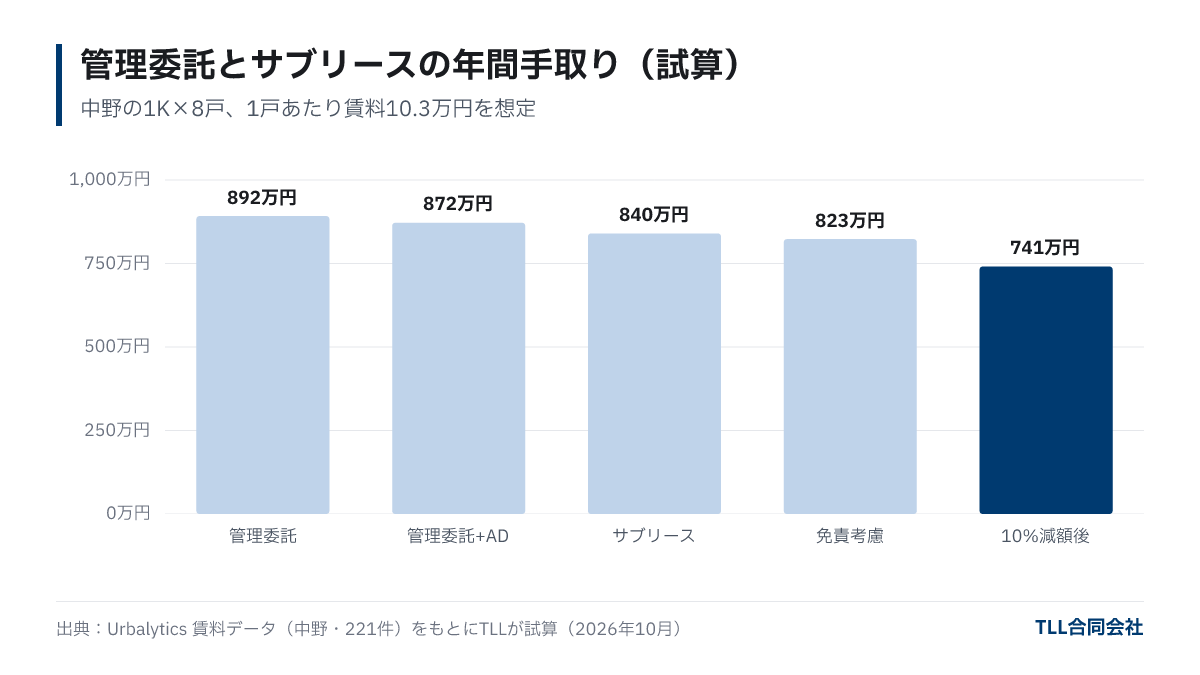
Under these assumptions, management consignment leaves about 500,000 JPY more annually, showing that sublease involves paying part of rent in exchange for transferring vacancy risk to the operator. Sublease’s stability is meaningful in locations where occupancy rates significantly drop, but in such cases, rent reduction claims from the sublease company are more likely. Please also see our article comparing self-management and management consignment.
Frequently Asked Questions
Q. If a sublease contract states "30 years rent guarantee," is rent never reduced?
Even during the contract period, if requirements of Article 32, Paragraph 1 of the Act on Land and Building Leases are met, the sublease company can claim a rent reduction. Advertising "rent guarantee" requires stating the possibility of reduction somewhere nearby.
Q. Can the owner cancel a sublease contract?
For contracts signed as ordinary leases, just cause under Article 28 of the Act on Land and Building Leases is required for owners to refuse renewal or terminate, and this is not easily permitted. For fixed-term leases, contracts end at expiration, but early termination is generally not allowed.
Q. Must I accept if a rent reduction is demanded?
The owner is not obligated to accept; check the grounds and negotiate. If no agreement is reached, mediation is generally used first, and the court makes the final determination of reasonable rent.
Q. What is an exemption period?
The period after new construction or tenant move-out during which the operator does not pay sublease rent. Please confirm the length and timing in the contract and important matters explanation document.
Summary
- Sublease contracts make the operator the lessee, so despite "fixed rent" clauses, rent reduction claims under Article 32, Paragraph 1 of the Act on Land and Building Leases can occur.
- The Rental Housing Management Act (enforced Dec 15, 2020) prohibits advertising/solicitation that fails to disclose rent reduction risks or possible termination by the operator.
- In the Nakano 8-unit 1K estimate, annual net income is about 8.72 million JPY with management consignment, about 8.23 million JPY with sublease, and around 7.41 million JPY with a 10% rent reduction.
- Five points to confirm before contract: exemption periods, rent review timing, early termination, just cause for termination, and repair cost responsibilities.
TLL’s management agency and asset management services provide consultation for reviewing sublease contract conditions and income comparisons when considering switching to management consignment.
Featured image (image): Photo: Se. Tsuchiya / Unsplash
About this article
- Author
- Xiao Li(Sales & Property Management Lead)Qualifications: Real Estate Transaction Specialist, Building Management Specialist
Leads the practical work connecting investment property purchases and sales with property management after acquisition. At NTT Communications, he spent more than eight years managing digital transformation projects for major corporate clients, coordinating work from requirements through implementation and operation. He applies this experience in managing multiple stakeholders to real estate transactions and property management. He holds Japan's Real Estate Transaction Specialist and Building Management Specialist qualifications. At TLL, he oversees the property management business and handles sales strategy, investor proposals, contracts, settlement and handover. His property assessments consider rental income together with loan terms, repair costs and building age at exit, keeping purchase decisions connected to subsequent operations. His articles also cover decisions during ownership, including portfolio expansion, refinancing and management for owners living overseas.
View profile → - Publisher
- TLL合同会社宅地建物取引業 東京都知事(1)第108202号住宅宿泊管理業 国土交通大臣(01)第F03424号
Data in this article cite their source and as-of date. Market conditions and regulations change, so check the latest information and consult a professional before deciding. Translated from the Japanese original.