
Management of Japanese Rental Properties for Overseas Owners - Withholding Tax, Tax Agent, and Document Procedures for Overseas Assignments and Returns
Xiao Li (licensed real estate broker, 宅地建物取引士)Asset Management
24 min read
When assigned overseas, you may leave your Tokyo home or investment condominium rented out and depart Japan, or return to Japan after an overseas assignment. In either case, the rental property remains the same, but taxation, documents, and money flows undergo significant changes.
Particularly overlooked are three points: after leaving Japan, rent payments may have taxes withheld; you need to appoint a "tax payment agent" (納税管理人, nouzei kanri nin) to handle tax filing before departure; and you will no longer be able to obtain resident registration or seal certificates. This article organizes the necessary procedures for owners residing overseas who keep rental properties in Japan, and the scope of tasks management companies should handle, based on the National Tax Agency's public information and Urbalytics rent data.
Article Highlights
- Tenants paying rent to non-residents must withhold 20.42% of the rent, except when individuals rent for themselves or relatives as a residence, and remit it by the 10th of the following month in principle (National Tax Agency Tax Answer No.2884 & No.2885, as of April 1, 2026).
- Assuming a corporate tenant renting a 20–30㎡ condominium near four Tokyo stations, a calculation based on average asking rents in September 2026 (Urbalytics) estimates about 18,000–24,000 yen withheld each month. This amount is reconciled via tax filing.
- Non-residents must appoint a tax payment agent to file taxes from overseas. Leaving Japan mid-year without this appointment requires filing a "pre-final tax return" (準確定申告) by departure (National Tax Agency No.1926).
What Changes When You Become a "Non-Resident" Due to Overseas Assignment
If you are assigned abroad for over one year, you are presumed a "non-resident" under the Income Tax Act (National Tax Agency No.1926). Even as a non-resident, rent from Japanese real estate is considered domestic-sourced income subject to Japanese tax. What changes is how tax is paid and how procedures are conducted.
The following changes should be sorted before and after departure.
- How rent is received: Depending on the tenant, 20.42% may be deducted from rent payments (see next section).
- Tax filing: Since you are absent from Japan, you file and pay taxes via a tax payment agent.
- Certification documents: Deregistration from resident registration removes seal registration, changing documents used for contracts and registrations.
- Property registration: From April 1, 2024, overseas owners must provide a "domestic contact address" for registration (Ministry of Justice). From April 1, 2026, changing the registered address is mandatory.
If you rent out your owned home purchased with a mortgage, consult your lender before departure due to possible residency condition clauses.

Withholding Tax of 20.42% on Rent: Who Deducts, When, and How Much
Those paying rent on Japanese real estate to non-residents must withhold 20.42% as income tax and special reconstruction income tax, and remit it by the 10th of the following month in principle. Exceptions apply when individuals rent for themselves or relatives as residences, in which case withholding is not required (National Tax Agency No.2884, as of April 1, 2026).
In other words, if the tenant is a company (e.g., renting as company housing), or an individual renting for business use such as offices or shops, withholding applies. Since Tokyo condominiums are often rented to companies for employee housing, this may include renting your home due to overseas assignment.
Three practical points:
- Notification to tenant: Tenants are responsible for withholding. If the tenant is unaware the owner is a non-resident, withholding could be missed, causing tenant liability later. Notify tenants via your management company after departure decision.
- Who is the payer?: In subleasing (where the management company leases from owner and subleases), the management company pays the owner rent and withholds tax. If the company only collects rent, tenants are the payers. Confirm contract type.
- From 2027 onward: Defense special income tax will begin in January 2027, but the rate for reconstruction tax will decrease, so the total 20.42% rate is expected to remain unchanged.
Estimated Monthly Withholding Amount (Tokyo 4 Stations)
Using Urbalytics rental listing data for condominiums within 10 minutes' walk of each station, 20–30㎡ units, average asking rents in September 2026 are extracted and withholding amounts estimated assuming corporate tenants.
| Nearest Station | Average Asking Rent (Monthly) | Data Count | Withholding Amount (20.42%) | Net Payment After Deduction |
|---|---|---|---|---|
| Kinshicho | 115,600 yen | 55 cases | 23,605 yen | 91,995 yen |
| Kamata | 115,300 yen | 80 cases | 23,544 yen | 91,756 yen |
| Nakano | 113,100 yen | 41 cases | 23,095 yen | 90,005 yen |
| Nerima | 89,400 yen | 41 cases | 18,255 yen | 71,145 yen |
Source: Urbalytics rental listing data (condominiums, within 10 minutes’ walk of each station, exclusive area 20–30㎡, average for September 2026). Withholding calculated with National Tax Agency No.2884 rate 20.42%, rounded down to nearest yen, excluding management and communal fees and management commission. Aggregation date: October 2, 2026.
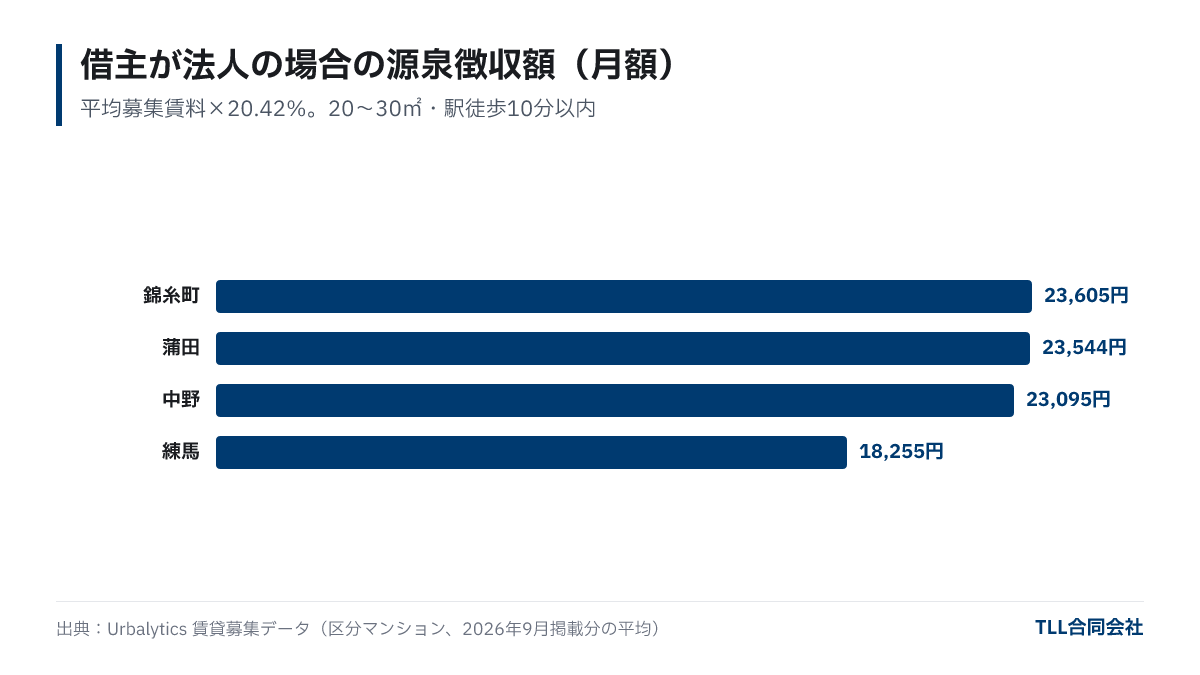
Annually, withholding totals about 280,000 yen in Kamata’s case. This is an advance payment. The final tax liability is calculated via tax filing by deducting expenses such as management fees, repairs, and depreciation from rental income, reconciling with withheld amounts, and paying or receiving refunds accordingly (National Tax Agency No.1926). Missing expense records makes recovering overpaid taxes difficult.
Tax Payment Agent and Tax Filing Procedures
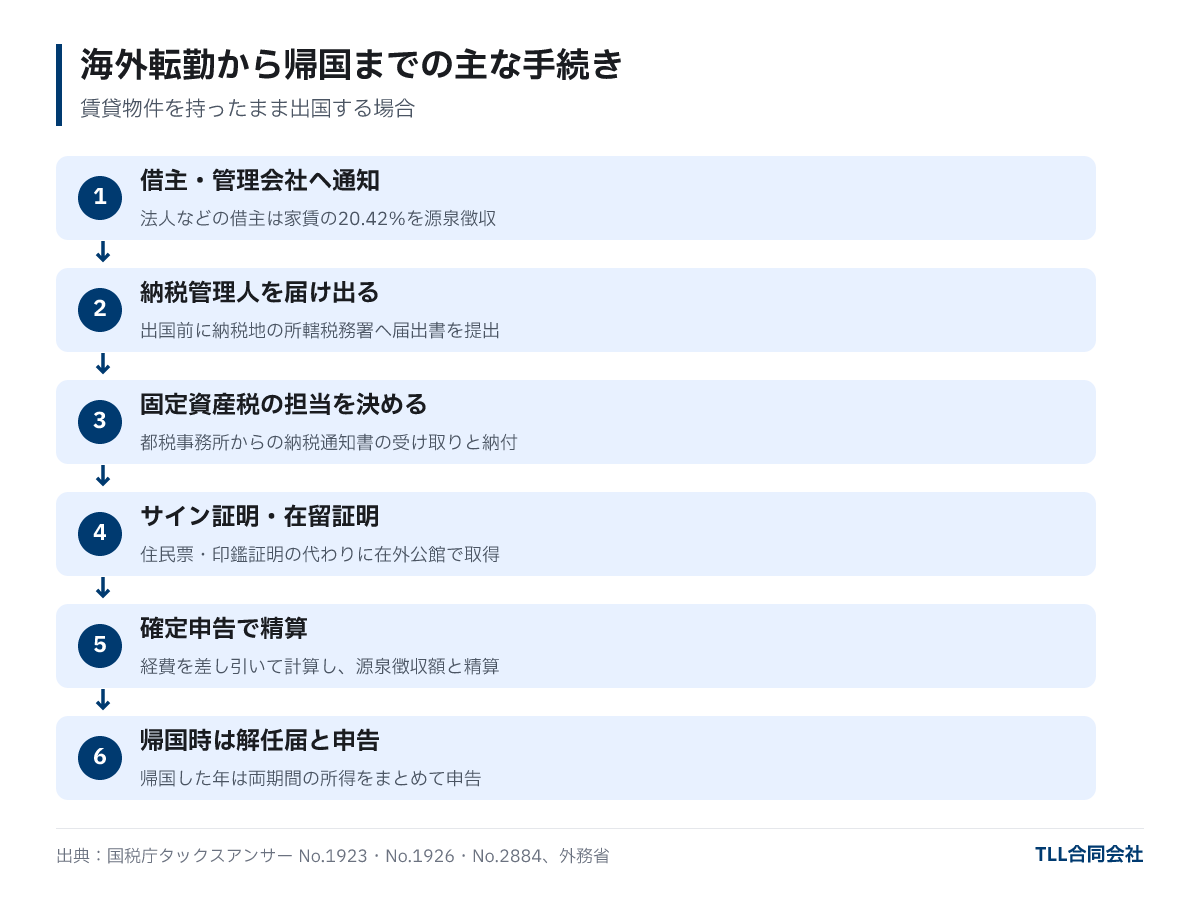
Non-residents submitting tax returns, receiving documents from tax offices, and handling tax payments or refunds must appoint a tax payment agent by submitting the "Notification of Appointment/Revocation of Tax Payment Agent for Income Tax and Consumption Tax" to the competent tax office of the tax location (National Tax Agency No.1923). The tax payment agent can be an individual or corporation, commonly a family member residing in Japan or a tax accountant hired for filing.
Timing affects outcomes:
- If appointed before departure: Income for the year of departure can be filed through the tax payment agent during the next year’s filing period.
- If no notification and departure during the year: You must file a pre-final tax return covering all income during your resident period by departure date (National Tax Agency No.1926).
Property tax and city planning tax are separate matters. In Tokyo 23 wards, tax notices come from the metropolitan tax office, so designate someone to receive and pay taxes during your absence. Formalize role divisions between tax payment agent and management company in writing before departure to avoid last-minute issues before filing deadlines.
Scope of Management Company Delegation: Rent Receipt, Remittance, Repair Approval, Online Reporting
Managing yourself from overseas is difficult due to time differences and distance preventing immediate judgment. Practically, entrust daily operations to the management company and focus as owner on decisions and approvals.
| Task | Challenges when living overseas | Points for delegation |
|---|---|---|
| Rent collection and reminders | Delayed noticing of late payments | Outsource confirmation and reminders, share monthly reports |
| Remittances | Monthly overseas remittances incur fees and are affected by exchange rates | Collect in domestic account, consolidate remittance frequency |
| Repair approvals | Unable to respond promptly if contacted at night | Set monetary thresholds: below set amount reported after, above requires estimate and prior approval |
| Move-in/out and renewals | Can't coordinate attendance or contract renewals remotely | Share recruitment conditions and rent revision policies in advance |
| Reporting | Cannot see property condition | Receive financial reports, photos, and estimates online |
| Tax documents | Expense receipts scattered | Prepare annual financial statements to provide tax payment agent or accountant |
The cost and effort differences between self-management and delegated management are detailed in the comparison article on self-management vs management company. For overseas owners, the key point is where to set boundaries between delegation and owner approvals rather than whether to delegate.
Remittance and Foreign Exchange Considerations
It is not necessary to remit rent overseas monthly. Since payments like repair costs, property tax, and management fees go out in Japanese yen, it is easier to reduce fees by keeping a sufficient yen balance domestically and remitting lump sums periodically. Exchange rate fluctuations are unpredictable, so rather than trying to time transfers for gains or losses, it is easier to decide in advance how much is needed for living expenses abroad and how much to keep in Japan.
Be aware some financial institutions may restrict account usage after you become a non-resident. Confirm with your bank before leaving whether you can maintain your rent receipt account.

Documents Used Instead of Resident Registration and Seal Certificates: Signature Certification and Certificate of Residency
When removing your resident registration and departing Japan, you cannot obtain a seal registration certificate or resident certificate copies. For contract renewals, management contracts, sales, and registration, these can be substituted with the following certificates issued by Japanese diplomatic missions (embassies or consulates) overseas (according to Ministry of Foreign Affairs and diplomatic mission guidelines).
- Signature Certification (サイン証明): Issued to overseas residents without resident registration in Japan in place of seal certificates. It certifies a signature made in front of a consul. The applicant must apply in person at the diplomatic mission. There are two formats: one certifies a set of signed documents (Format 1), and the other certifies only the signature alone (Format 2). Confirm in advance which format the recipient requires.
- Certificate of Residency (在留証明): Certifies where you reside abroad, used instead of a resident certificate for real estate registration and similar.
For foreign nationals owning properties, affidavit documents notarized in their home country are often used, so required documents differ. For purchase procedures and details, also refer to Important Points When Foreign Nationals Purchase Property in Japan.
Things to Decide Before Departure If You Plan to Return and Live in Japan
When you return and restore your address to Japan, you regain resident status and withholding tax is no longer required, regardless of tenant type. Notify tenants via the management company and file a revocation of tax payment agent with the tax office. Income from the non-resident period and the resident period in that year is filed together.
If you plan to live in the property upon returning, contract type chosen before departure is important. A standard lease protects tenants, so it is generally not easy to evict them at lease expiration for owner convenience. If return timing is foreseeable, consider a fixed-term lease contract limited by duration. Fixed-term leases tend to have lower rent than standard leases, so weigh your cash flow and return plans to decide.

Frequently Asked Questions
Q. Is withholding tax completely unnecessary if the tenant is an individual?
Withholding is unnecessary if the individual rents for personal or relative residence. However, if the individual rents for business use such as an office or shop, 20.42% withholding applies (National Tax Agency No.2884).
Q. If withholding tax has been deducted, is tax filing unnecessary?
Non-residents with Japanese real estate income are required to file a tax return. Withholding is a prepayment; final tax is calculated after deducting expenses, and excess tax withheld is refunded (National Tax Agency No.1926).
Q. Can the tax payment agent be a family member?
Both individuals and corporations can be appointed (National Tax Agency No.1923). If you want assistance preparing the tax return, you can appoint a tax accountant as the tax payment agent.
Q. Can I sell property while overseas?
Selling is possible, but you need a signature certification instead of a seal certificate and must file a tax return for the year of sale. Start procedures with the diplomatic mission and appoint your tax payment agent early, calculating backwards from the closing date.
Summary
- Rent paid to non-residents is subject to 20.42% withholding except when rented by individuals for residential use. For 20–30㎡ units near four Tokyo stations, this withholding is about 18,000–24,000 yen monthly (September 2026, Urbalytics).
- Since withholding is an advance payment, file a tax return through a tax payment agent to reconcile deductions including expenses. Leaving mid-year without notification requires a pre-final tax return.
- Entrust management companies with rent collection, remittances, and reporting; assign repair approvals with monetary limits to avoid delays despite time differences.
- Signature certification and certificate of residency replace resident certificates and seal certificates. If planning to return and live, consider fixed-term leases before departure.
For rent collection, repair arrangements, and online reporting during overseas residence, TLL’s Property Management (Management Agency) Service is available.
※Tax treatment is based on National Tax Agency Tax Answers (No.1923, No.1926, No.2884, No.2885) as of April 1, 2026. Please consult a tax accountant or tax office for individual cases.
Featured image (image): Photo: Dimitri Karastelev / Unsplash
About this article
- Author
- Xiao Li(Asset Management)Qualifications: Real Estate Transaction Specialist, Building Management Specialist
The operational lead for real estate sales and property management. At NTT Communications, he spent more than eight years managing DX projects for major enterprises, overseeing the full process from requirements definition through delivery and operations. At TLL, he handles the entire deal management cycle for income-producing properties, including sales strategy planning, investor sourcing, contract execution, settlement, and handover, providing well-matched opportunities and smooth transaction execution for domestic and international investors and operators.
View profile → - Publisher
- TLL合同会社宅地建物取引業 東京都知事(1)第108202号住宅宿泊管理業 国土交通大臣(01)第F03424号
Data in this article cite their source and as-of date. Market conditions and regulations change, so check the latest information and consult a professional before deciding. Translated from the Japanese original.