Utilizing Vacant Houses (Detached/Old): Comparing Selling, Renting, and Minpaku
Xingkai LuoNew Business
20 min read
What should you do with your inherited family home or an old detached house you no longer live in? Sell it, rent it out, or turn it into a minpaku (private lodging)? Although there are many options, which you choose greatly affects eligibility for tax exemptions, annual fixed asset tax, and the amount of effort required.
This article compares three ways to utilize vacant houses (detached/old) from four points of view: fixed asset tax, the 30 million yen special deduction, market rental rates for detached houses, and minpaku regulations. Rental rates are aggregated from Urbalytics listing data for four Tokyo stations.
Key Points of This Article
- The amended Vacant House Act effective December 13, 2023, newly defines “mismanaged vacant houses,” which lose the fixed asset tax residential land special exemption (such as 1/6 of the taxable base for areas up to 200㎡) once the municipal mayor issues a recommendation (Ministry of Land, Infrastructure, Transport and Tourism).
- The 30 million yen special deduction when selling an inherited vacant house requires the building to have been constructed on or before May 31, 1981, and sold by December 31, 2027, among other requirements; using the house for rental or minpaku after inheritance disqualifies it (National Tax Agency, law as of April 1, 2026).
- The median asking rent for detached houses at four Tokyo stations ranged from 165,000 yen to 260,000 yen (Urbalytics, listings from October 2025 to October 2026, with 23 to 42 listings each).
Costs of Leaving Vacant Houses Untended: Fixed Asset Tax and the Amended Vacant House Act
If you keep a vacant house unused, you continuously bear fixed asset tax and management burdens. Land with a residence qualifies for the “residential land special exemption,” reducing the taxable base for fixed asset tax: 1/6 for up to 200㎡ and 1/3 for the area beyond that (Article 349-3-2 of the Local Tax Act).
This exemption has expanded scenes where it can be removed since 2023. The law amended on June 14, 2023, effective December 13, 2023 — "Act for Partial Revision of the Act on Special Measures Concerning Promotion of Smooth Supply of Vacant Houses” — classifies neglected vacant houses prone to becoming “specified vacant houses” as “mismanaged vacant houses,” enabling municipal mayors to issue guidance or recommendations. Mismanaged vacant houses receiving recommendations lose eligibility for the residential land special exemption (MLIT Overview of Vacant House Law Amendments). Highly dangerous “specified vacant houses” also lose this exemption upon recommendation.
Indicators include broken windows, overgrown weeds, deteriorated exterior walls, etc. If managing remotely is difficult, arranging regular inspections and ventilation, even temporarily while deciding policy, can lower risk of official instructions.
Selling: Requirements and Deadlines for the 30 Million Yen Special Deduction
The first item to confirm when selling is the "Special Deduction on Capital Gains for Inherited Residential Property (Vacant House)." If requirements are met, up to 30 million yen can be deducted from capital gains (National Tax Agency Tax Answer No. 3306, as of April 1, 2026). The main requirements are:
- The building was constructed on or before May 31, 1981, and is not registered as a sectional ownership building
- No person other than the deceased occupant had lived there immediately before inheritance
- Neither business use, renting, nor residence has been utilized from inheritance until sale
- The sales price is 100 million yen or less
- The sale is completed by December 31 of the year three years after the inheritance date and by December 31, 2027 (Reiwa 9)
- Seismic retrofitting or demolition is performed (for sales on or after January 1, 2024, this may also be done by the buyer by February 15 of the year following the sale)
For sales on or after January 1, 2024, if there are three or more heirs, the deduction per person is 20 million yen. Because of the third requirement, using the property even once as rental or minpaku after inheritance negates this special deduction. Thus, choosing to "rent before selling" may be disadvantageous tax-wise. Confirm applicability with a tax office or tax accountant.
The sale methods for vacant houses that are difficult to sell — such as those not eligible for rebuilding or with leasehold rights — are explained in Our article on selling properties with no rebuilding rights, leasehold, or old buildings.

Renting: Rental Market Rates for Detached Houses
Renting offers monthly rental income and allows the property to maintain its qualification for the residential land special exemption as a dwelling. However, old houses often require renovation costs, and selling or rebuilding becomes difficult while tenants are in place.
As an indication of detached house rents, Urbalytics aggregated rental listings for detached houses from October 2025 to October 2026 by station below.
| Station | Listings | Median Asking Rent | 25th–75th Percentile | Average Area | Rent per ㎡ (Median) |
|---|---|---|---|---|---|
| Nakano | 42 | 260,000 yen | 181,000–340,000 yen | 73.6㎡ | 3,447 yen |
| Kamata | 25 | 185,000 yen | 150,000–270,000 yen | 72.4㎡ | 2,812 yen |
| Kita-Senju | 29 | 170,000 yen | 120,000–250,000 yen | 63.9㎡ | 2,670 yen |
| Akabane | 23 | 165,000 yen | 124,000–215,000 yen | 65.3㎡ | 2,472 yen |
Source: Urbalytics Rental Data (Detached Houses). Aggregated asking rents from October 2, 2025, to October 2, 2026. Duplicate listings at the same address, area, and rent were consolidated; outliers in rent per ㎡ excluded. These are asking rents, not concluded lease rents. Aggregation date: October 2, 2026.
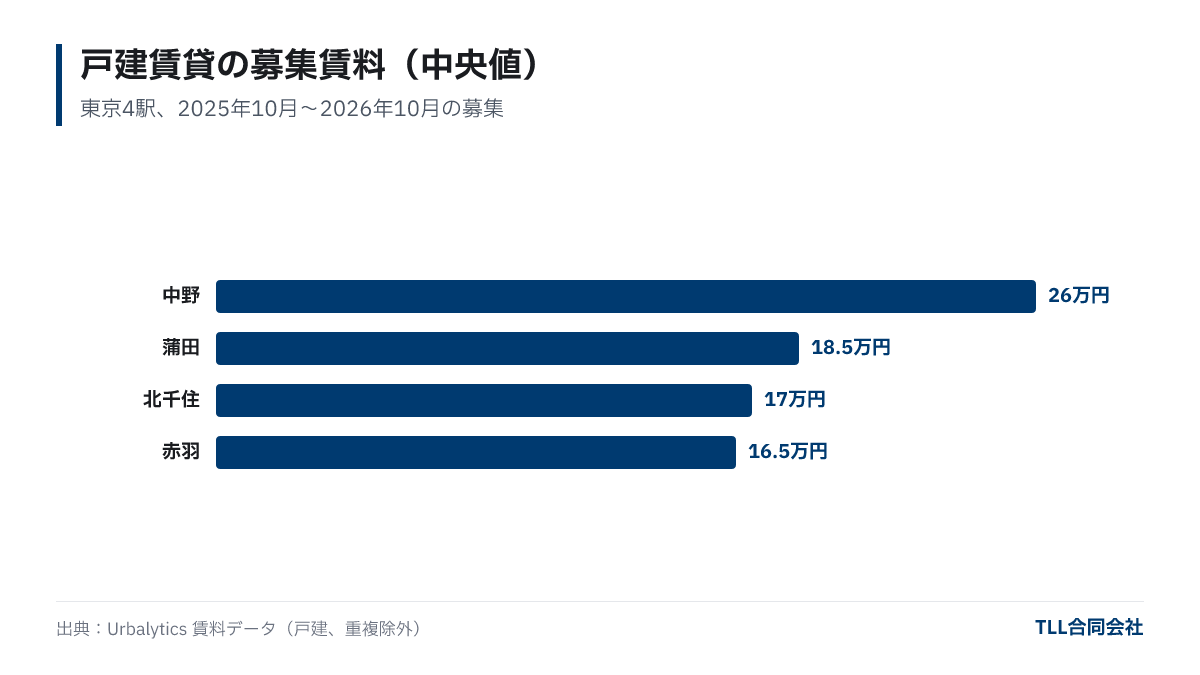
Even within the same station, there is a wide difference between the 25th and 75th percentile, showing that rent varies greatly by building age, size, and facilities. Nerima Station had only nine listings in the same period and was excluded due to insufficient sample size. For old houses, it is safest to assess rental levels post-renovation by comparing nearby listing and leasing examples before committing to renovation costs.
Using for Minpaku: 180-Day Limit and Ward Ordinance Restrictions
Minpaku can potentially generate higher income than renting, depending on location and building, but involves the greatest regulatory and operational burden. Three main systems apply, each with different conditions.
- Residential Accommodation Business Act (Minpaku New Law): Can start with notification but limited to 180 days of operation per year. Additionally, wards may impose location and weekday restrictions by ordinance.
- Hotels and Ryokan Business Act (Simple Lodging): No day limit but requires official permits and, due to building use restrictions under the Building Standards Act, is generally prohibited in residential-only zones.
- National Strategic Special Zone Minpaku: In Tokyo’s 23 wards, only Ota Ward is eligible and requires ward authorization.
Rules vary by ward in the 23 Tokyo wards. For example, some wards limit operations in residential-only areas to weekends only, and requirements for resident managers or on-call staff differ. A comparison by ward is available at List of Minpaku and Ryokan Regulations in Tokyo 23 Wards. As noted, using a property for minpaku disqualifies it from the 30 million yen special deduction, so if you may sell, compare taxes first.

Details on operational scope and profit calculation when outsourcing management are introduced on the Minpaku Operation Agency page.
Comparing Selling, Renting, and Minpaku and Choosing a Direction
Ranking the three options by tax, income, and effort produces the following:
| Item | Sell | Rent (Detached House) | Use as Minpaku |
|---|---|---|---|
| Income Type | Receive lump sum sale proceeds | Monthly rent | Lodging revenue (seasonal fluctuations) |
| Main Initial Costs | Surveying, removal of residual items, demolition, etc. | Renovation, equipment updates | Renovation, fire safety equipment, furniture/appliances, notification or permits |
| 30 million yen Special Deduction | Available if requirements are met | Not available | Not available |
| Fixed Asset Tax | Ends after sale | Residential land exemption easier to maintain | Varies by system and use; check with local government |
| Effort and Regulation | Focus on sale procedures | Tenant management and repairs | 180-day limit, ward ordinances, guest services, cleaning |
Source: National Tax Agency Tax Answer No. 3306, MLIT “Overview of Vacant House Act Amendments,” Residential Accommodation Business Act, created by TLL (as of October 2026).
Decide direction using the following steps to have sufficient information:
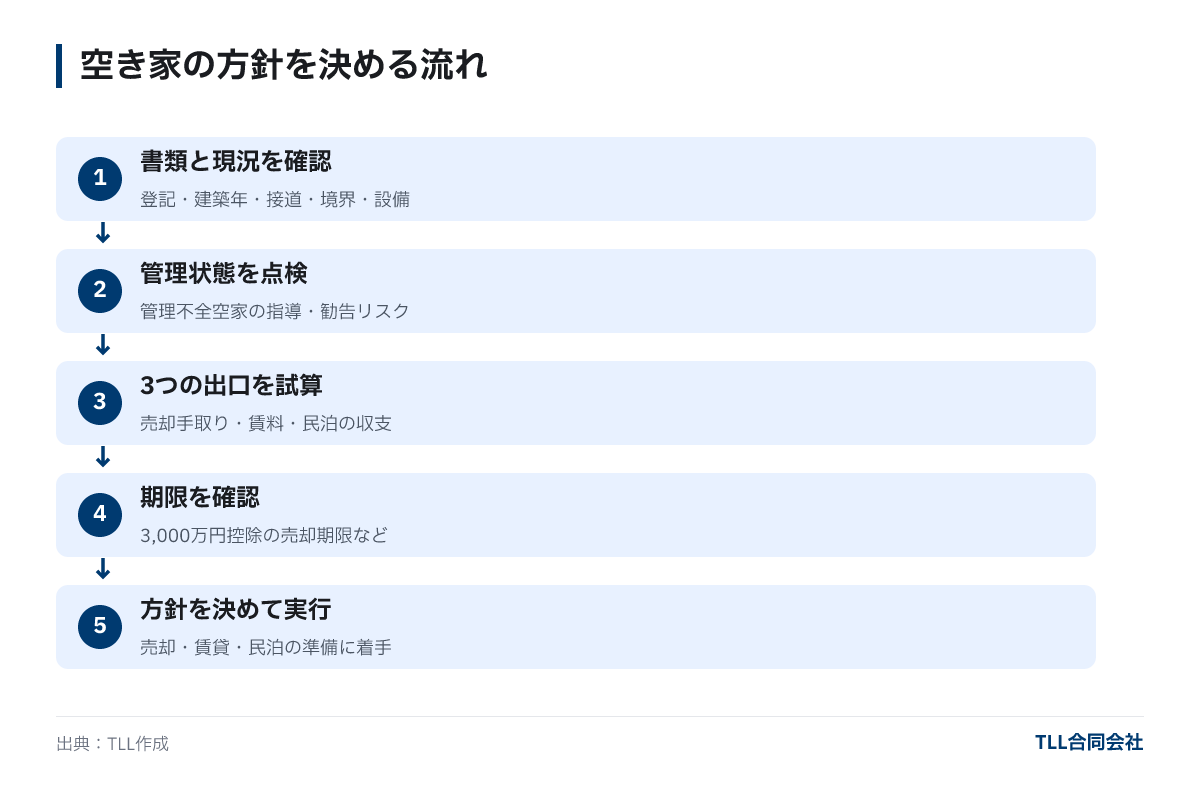
- Confirm documents and current status: Gather registration, construction year, road access, boundary, and equipment condition.
- Inspect management status: Check risk of receiving guidance as a mismanaged vacant house.
- Estimate three options: Compare net sale proceeds, rent income minus renovation cost, and minpaku income for the same period.
- Check deadlines: Calculate deadline for 30 million yen special deduction (end of the year three years after inheritance and December 31, 2027).
- Decide and execute: Begin preparations for sale, renting, or minpaku.
If you want to know the sale price first, please use our free appraisal.
Frequently Asked Questions
Q. Can I use the 30 million yen special deduction if I rent out a vacant house before selling?
No. One condition is that the property has not been used for business, renting, or residence from the time of inheritance until sale. Using it as rental or minpaku disqualifies eligibility (National Tax Agency No. 3306).
Q. What happens to fixed asset tax if designated a mismanaged vacant house?
If the municipal mayor issues a recommendation, the residential land special exemption is revoked, and the taxable base reduction for up to 200㎡ (1/6, etc.) is restored to the original level. Improvement at the guidance stage may prevent a recommendation.
Q. Can an old detached house be used for minpaku?
Yes, if it meets fire equipment and ward ordinance requirements. Under the Residential Accommodation Business Act, operation is limited to 180 days a year, and wards may add region or day-of-week restrictions. Confirm with the ward office before notification.
Q. What are typical rents for detached houses?
The median asking rents at the four Tokyo stations are Nakano 260,000 yen, Kamata 185,000 yen, Kita-Senju 170,000 yen, and Akabane 165,000 yen (Urbalytics, October 2025 to October 2026). There is a wide range by building age and size, so check nearby examples for individual properties.
Summary
- Under the amended Vacant House Act effective December 2023, mismanaged vacant houses receiving recommendations lose the residential land special exemption (such as 1/6 taxable base for up to 200㎡).
- The 30 million yen special deduction for inherited vacant houses requires buildings constructed by May 31, 1981, and sale by December 31, 2027; using the house for rental or minpaku disqualifies this.
- The median asking rent for detached houses at four Tokyo stations ranges from 165,000 yen to 260,000 yen, with large variation even within the same station.
- Minpaku has a 180-day limit and ward ordinances; comparing tax, income, and effort over the same period for selling, renting, and minpaku before making a decision is safest.
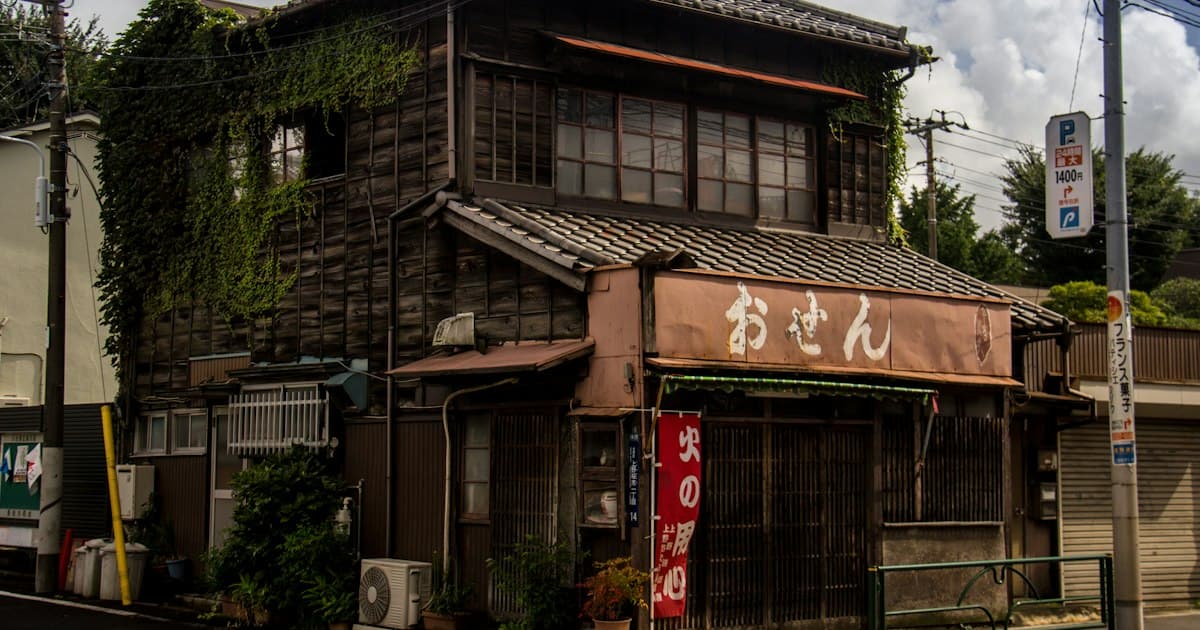
Featured image (illustration): Photo: Luke Paris / Unsplash
About this article
- Author
- Xingkai Luo(New Business)
Works on new business opportunities by assessing changes in local markets through his experience in urban development and infrastructure investment. He has more than ten years of experience in urban real estate development and infrastructure investment. At Alibaba and Honeywell, he worked on major redevelopment and smart-building projects, with experience across land acquisition, due diligence, project structuring and operations after completion. At TLL, he handles new business development and project structuring for overseas investors. When considering hotel, residential and other uses, he examines construction costs, nearby supply, transport access and operating requirements together. His redevelopment articles look beyond project scale to completion schedules, access during construction and the effects on existing rental properties.
View profile → - Publisher
- TLL合同会社宅地建物取引業 東京都知事(1)第108202号住宅宿泊管理業 国土交通大臣(01)第F03424号
Data in this article cite their source and as-of date. Market conditions and regulations change, so check the latest information and consult a professional before deciding. Translated from the Japanese original.