Differences Between Long-Term and Short-Term Capital Gains|Why Tax Rates Nearly Double After 5 Years of Ownership and Apartment Sale Timing Estimates
Emi Tokudomi (licensed real estate broker, 宅地建物取引士)Acquisition Staff
24 min read
When considering selling an apartment, taxes are often the next biggest concern after the price. Many hesitate about the timing of the sale upon hearing that the tax rate changes significantly after "5 years since purchase."
This article organizes the rules distinguishing long-term capital gains and short-term capital gains, the reasons why tax rates nearly double, and tax amount calculations based on different acquisition prices and holding periods. Finally, we consider whether the tax rate difference or market yield trends should weigh more heavily when deciding the timing to sell, using yield data from Tokyo's entire-building income properties.
Key points of this article
- For individuals selling land and buildings, if the ownership period as of January 1 of the sale year exceeds 5 years, the tax rate is 20.315% for long-term capital gains; if 5 years or less, the short-term tax rate is 39.63% (combined income tax, special reconstruction income tax, and resident tax, under laws effective for 2026).
- Properties acquired in 2021 will be classified as long-term when sold on or after January 1, 2027. Even if more than 5 calendar years have passed, if the ownership period as of January 1 of the sale year is less than 5 years, the short-term rate still applies.
- In a tax calculation on a wood-frame apartment purchased for 80 million yen and sold at the same price, the net proceeds differ by about 1.66 million yen between a short-term sale in 2026 and a long-term sale in 2027. Conversely, a 0.5 percentage point movement in the gross yield changes the property price by approximately 11.79 million yen, assuming annual rent is 6 million yen.
What is the difference between long-term and short-term capital gains?
The difference lies only in the ownership period: if ownership exceeds 5 years as of January 1 of the sale year, it is long-term capital gains; if 5 years or less, it is short-term capital gains. The National Tax Agency's Tax Answer (No.3208 and No.3211, statutes as of April 1, 2026) specifies this standard.
It is important to note that the reference date for this judgment is not the "date of sale" but "January 1 of the sale year." For example, if a property was transferred (handed over) in April 2021 and sold in October 2026, the actual holding period is 5 years and 6 months, but as of January 1, 2026, the ownership period is 4 years and 9 months, so short-term applies. If the same property is sold on or after January 1, 2027, the ownership as of January 1, 2027 is 5 years and 9 months, qualifying as long-term.
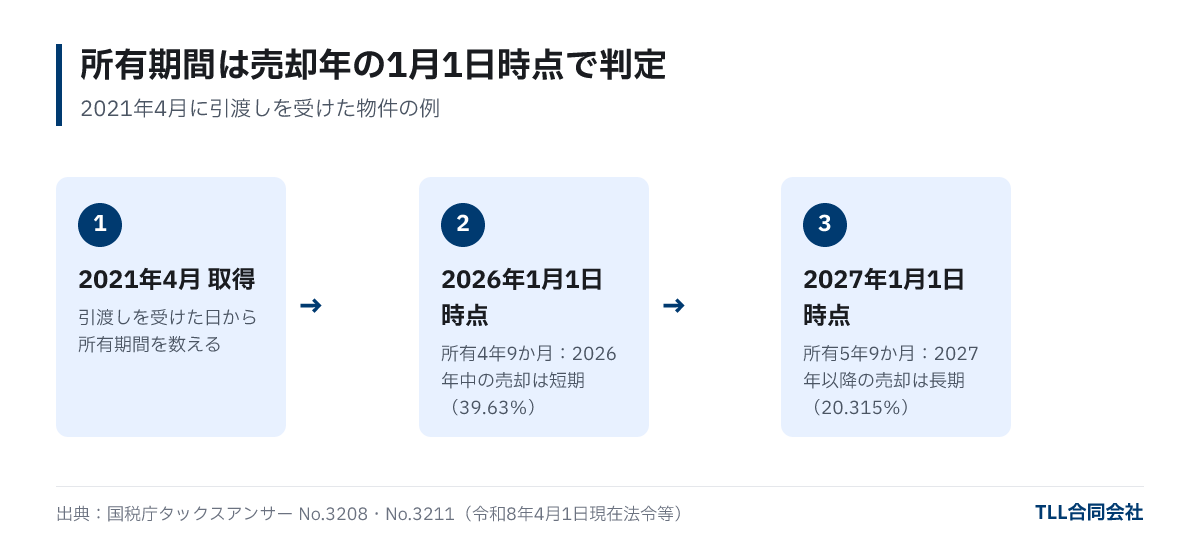
Practically, it is easier to remember that "selling on or after January 1 of the year obtained by adding 6 to the acquisition year results in long-term classification."
When is the acquisition date?
The acquisition date is basically the date the property was transferred (handed over), but you can choose to use the date the purchase contract took effect. If acquired through inheritance or gift, you inherit the acquisition date and acquisition cost of the decedent or donor. For an apartment inherited from a parent, the holding period is counted from when the parent purchased it, not from the date of inheritance.

Why are the tax rates nearly double?
The original rates are set about twice as high for short-term gains: income tax is 15% and resident tax 5% for long-term, versus income tax 30% and resident tax 9% for short-term. Additionally, the special reconstruction income tax of 2.1% on the income tax amount applies from 2013 through 2037.
| Category | Income Tax | Special Reconstruction Income Tax | Resident Tax | Total |
|---|---|---|---|---|
| Long-term (over 5 years) | 15% | 0.315% | 5% | 20.315% |
| Short-term (5 years or less) | 30% | 0.63% | 9% | 39.63% |
Source: National Tax Agency Tax Answer No.3208 & No.3211 (laws as of April 1, 2026).
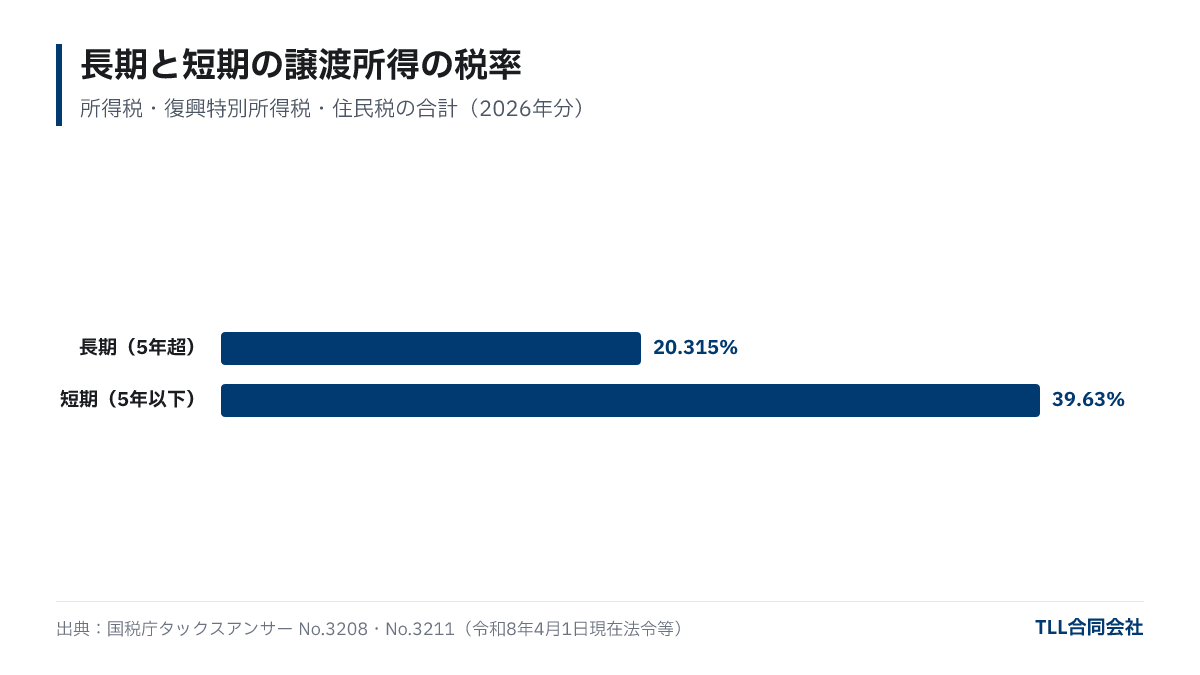
The higher short-term rate is generally explained as a policy to discourage quick resales. Since capital gains on land and buildings are subject to separate taxation from other income like salary or rental income, this tax rate applies as is regardless of whether other income is high or low.
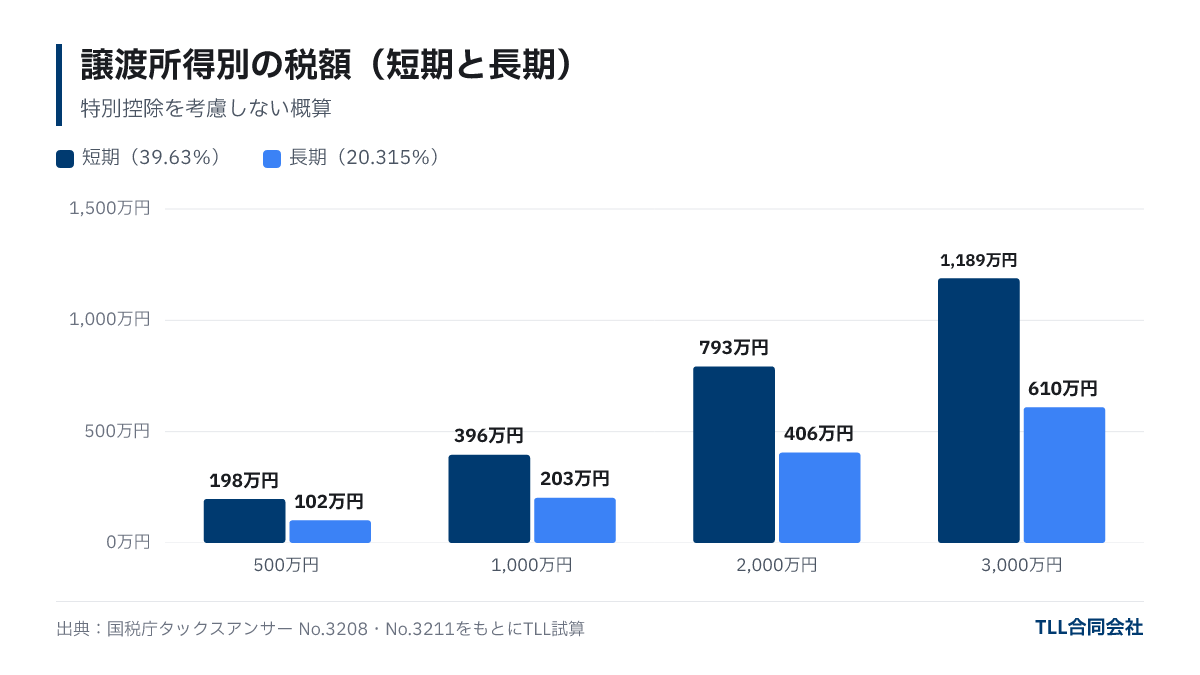
The tax difference becomes more significant in absolute terms as capital gains increase.
| Capital Gains | Short-term Tax (39.63%) | Long-term Tax (20.315%) | Difference |
|---|---|---|---|
| 5 million yen | Approx. 1.98 million yen | Approx. 1.02 million yen | Approx. 970,000 yen |
| 10 million yen | Approx. 3.96 million yen | Approx. 2.03 million yen | Approx. 1.93 million yen |
| 20 million yen | Approx. 7.93 million yen | Approx. 4.06 million yen | Approx. 3.86 million yen |
| 30 million yen | Approx. 11.89 million yen | Approx. 6.10 million yen | Approx. 5.79 million yen |
This is a rough estimate ignoring special deductions. Actual tax amounts are calculated by rounding for income tax and resident tax separately.
How to calculate capital gains
Capital gains are calculated as "sale price − (acquisition cost + selling expenses)." The tax rate applies to this difference, not the sale price itself.
- Acquisition Cost: The sum of the purchase price of the land and the purchase price of the building minus the cumulative depreciation amount. Brokerage fees at purchase are also included.
- Selling Expenses: Brokerage fees at sale, stamp tax for the sale contract, survey costs related to sale, and similar expenses.
For apartments, an easily overlooked point is that the acquisition cost of the building decreases annually over the holding period due to depreciation. Even if sold at the same price as purchase, capital gains arise from the accumulated depreciation amount. Detailed brokerage fee calculations are explained at How to calculate real estate sale brokerage fees.

Estimate: Tax amount comparison by acquisition price and holding period
We compared selling the same property in 2026 (short-term) versus waiting a year to sell in 2027 (long-term). The assumptions are as follows.
- A used wood-frame apartment acquired in April 2021. The building portion is 40% of acquisition cost.
- At acquisition, the building was 12 years old, so the simplified depreciation method sets useful life at 12 years (straight-line depreciation rate 0.084).
- Both are sold in June at the acquisition price (assuming a stable market). Depreciation is prorated monthly up to sale month.
- Selling expenses consist of brokerage fee at maximum limit (sale price × 3% + 60,000 yen, including 10% consumption tax) only.
| Acquisition Price | Year of Sale (Category) | Cumulative Depreciation | Capital Gains | Capital Gains Tax (Estimate) | After-tax Proceeds |
|---|---|---|---|---|---|
| 50 million yen | 2026 (short-term) | 8.82 million yen | 7.10 million yen | 2.82 million yen | 45.47 million yen |
| 50 million yen | 2027 (long-term) | 10.5 million yen | 8.78 million yen | 1.78 million yen | 46.50 million yen |
| 80 million yen | 2026 (short-term) | 14.11 million yen | 11.41 million yen | 4.52 million yen | 72.77 million yen |
| 80 million yen | 2027 (long-term) | 16.8 million yen | 14.09 million yen | 2.86 million yen | 74.43 million yen |
| 120 million yen | 2026 (short-term) | 21.17 million yen | 17.14 million yen | 6.79 million yen | 109.18 million yen |
| 120 million yen | 2027 (long-term) | 25.20 million yen | 21.17 million yen | 4.30 million yen | 111.67 million yen |
After-tax proceeds are sale price minus brokerage fees and capital gains tax, excluding loan balance repayment. Tax rates are calculated based on 2026 laws (20.315% for long-term; 39.63% for short-term) in the TLL estimate.
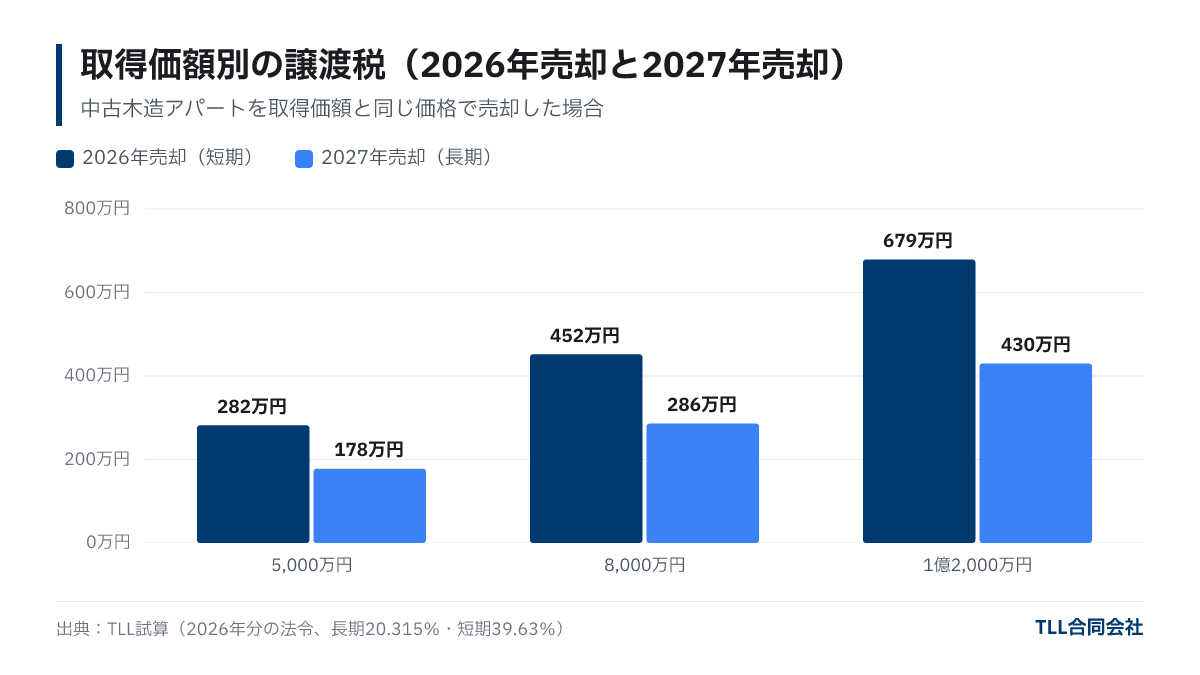
Waiting a year allows one more year of depreciation, which actually increases capital gains. However, the effect of the lower tax rate is greater, resulting in about 1.03 million yen more net proceeds for the 50 million yen property, 1.66 million yen more for the 80 million yen property, and 2.49 million yen more for the 120 million yen property. This also includes one year’s rental income.
Is deciding sale timing based on tax rate alone adequate?
If the threshold between short-term and long-term is just a few months away, waiting is definitely worthwhile. But if it’s over a year away, you should weigh potential price fluctuations during the wait, vacancy risks, and repair costs. The price of entire-building income properties is heavily dependent on yield, and even a small market yield movement can cause price changes exceeding the tax rate difference.
| Nearest Station | Number of Listings | Median Gross Yield |
|---|---|---|
| Nakano | 46 | 4.38% |
| Nerima | 25 | 4.64% |
| Kitasenju | 53 | 5.18% |
Source: Urbalytics, entire-building income property listing data (Tokyo, by nearest station, gross yield = annual rent ÷ listing price). Listings with price changes or posted between October 2, 2025, and October 2, 2026; duplicates across sites excluded (gross yields under 1% or over 25% excluded); as of October 2, 2026. Based on listing prices, not contract prices.
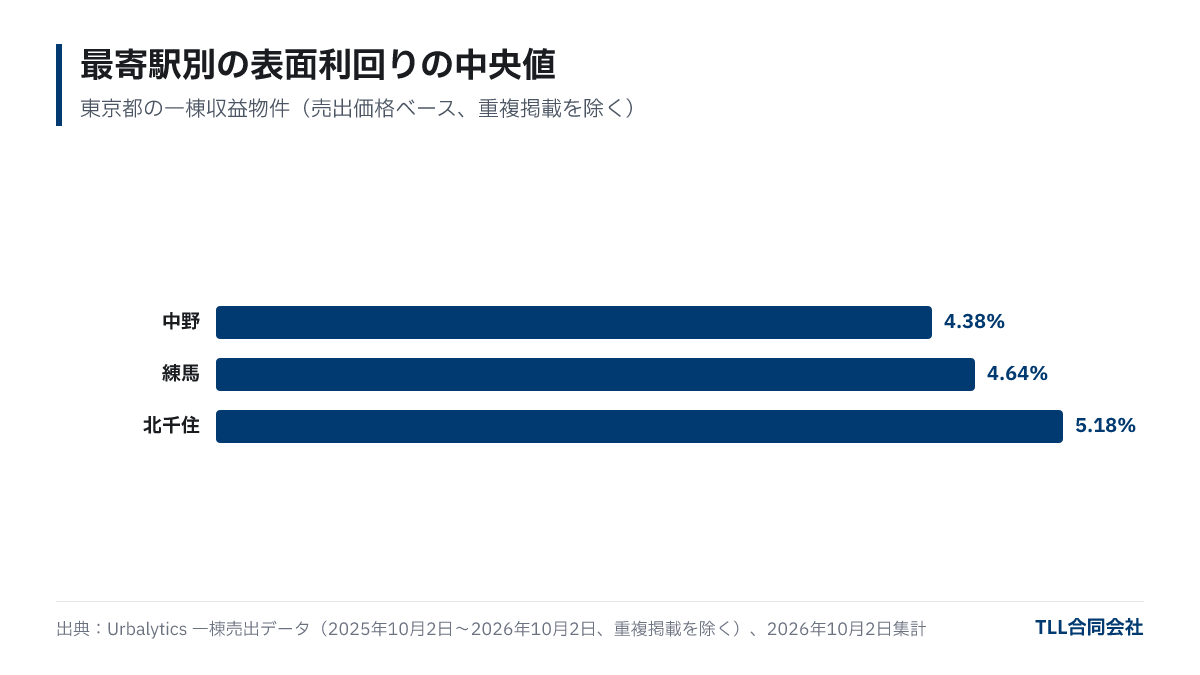
Even for a property with annual rent of 6 million yen, if assessed at a 4.8% gross yield, its price would be about 125 million yen; at 5.3%, about 113.21 million yen. The difference is about 11.79 million yen. As median yields vary by up to 0.8 percentage points depending on station, area, building age, and timing, delaying sale based only on tax rate differences (which in the above example range between 1 to 2.5 million yen) can result in bigger differences caused by market fluctuations.
The mechanism by which yields determine price and median prices by station are explained at How the appraisal value of entire-building apartments is determined.
What to consider if selling short-term
Sometimes selling within the short-term period is unavoidable due to inheritance, cash flow, loan repayment terms, etc. In such cases, confirming the following points can help better estimate net proceeds.
- Collect all acquisition and selling expenses without omission: Brokerage fees at purchase, survey fees for sale, and other deductible expenses reduce capital gains. Keep contracts and receipts from purchase until sale.
- Verify the transfer (handover) date: The classification into short-term or long-term depends on ownership as of January 1 of the sale year. If the contract is made near year-end but possession is delivered after New Year, clarify with a tax accountant which year’s sale it counts as.
- Compare sale methods: Whether to sell through brokerage to aim for a higher price over time, or sell by direct purchase to liquidate quickly affects both net proceeds and timing. Refer to Selling by direct purchase vs brokerage for comparison ideas.

The overall process from appraisal to settlement is summarized at The flow of income property sales. Those wanting to know a price estimate before deciding sale timing may also use our free appraisal.
Frequently Asked Questions
Q. Does owning for even one day over 5 years automatically qualify as long-term capital gains?
No. The classification is based on ownership as of January 1 of the sale year. Even if ownership exceeds 5 years by the sale date, if ownership was 5 years or less on January 1 of that year, the short-term rate applies. A good guideline: selling on or after January 1 of the year obtained by adding 6 to the acquisition year usually means long-term.
Q. From when is the ownership period counted for an inherited apartment?
It is counted from the date the decedent acquired the property. You also inherit the acquisition cost, so an apartment long held by a parent will generally qualify as long-term even if sold immediately after inheritance.
Q. Are long-term and short-term distinctions applied for properties owned by corporations?
No. Corporations have no tax rate difference between long-term and short-term capital gains. Profit from sales is combined with other gains or losses and subject to corporate tax. We compare tax burdens between individuals and corporations at Incorporating your apartment business.
Q. Can capital losses from sales be offset against salary income?
Generally, capital losses on land and buildings cannot be offset against other income such as salary or rental income. Except for special cases like selling your own home, losses can only be offset against capital gains from land and buildings in the same year.
Summary
- If owned more than 5 years as of January 1 of the sale year, long-term capital gains tax rate applies at 20.315%; if 5 years or less, the short-term rate of 39.63% applies—a near doubling of rates (2026 laws).
- A good rule of thumb is that selling on or after January 1 of the year obtained by adding 6 to the acquisition year generally qualifies as long-term. For inherited properties, the ownership period starts from the decedent’s acquisition date.
- In a calculation for an 80 million yen acquisition, net proceeds differed by approximately 1.66 million yen between short-term and long-term. Although depreciation increases capital gains, the tax rate effect is greater.
- However, a 0.5-percentage-point shift in gross yield results in a price difference of approximately 11.79 million yen for a property with 6 million yen annual rent. Sales timing should be judged by considering market conditions and property status in addition to tax rates.
*This article is a general explanation based on laws as of October 2026 (statutes as of April 1, 2026). For specific tax amounts, please consult a tax accountant or your local tax office.
Featured image (image): Photo: Kelly Sikkema / Unsplash
About this article
- Author
- Emi Tokudomi(Acquisition Staff)Qualifications: Real Estate Transaction Agent
After working in real estate sales support, rental property management, and brokerage, now engages in acquisition operations. Holds a Real Estate Transaction Agent license and bookkeeping qualifications, and supports property value with extensive hands-on experience and specialized expertise.
View profile → - Publisher
- TLL合同会社宅地建物取引業 東京都知事(1)第108202号住宅宿泊管理業 国土交通大臣(01)第F03424号
Data in this article cite their source and as-of date. Market conditions and regulations change, so check the latest information and consult a professional before deciding. Translated from the Japanese original.