
Selling an Apartment with Owner Change (With Tenants): How Prices Are Determined and What to Prepare
Eiichi Suto (licensed real estate broker, 宅地建物取引士)Real Estate Brokerage / Renovation
19 min read
When selling an entire apartment building, it is not necessary for tenants to move out. Selling a property while tenants remain and transferring rental agreements to the buyer is known as an "owner change" (オーナーチェンジ) and is a common method for selling income properties.
However, when selling with tenants, the price tends to rely heavily on "current rental income." Whether the building is fully occupied or has vacancies, how the rent compares to market rates, and whether there are delinquent payments—all these aspects are reviewed by the buyer through documentation. This article explains how prices are determined in owner change sales and what sellers should prepare, with estimates based on Urbalytics yield data.
Article Highlights
- In an owner change sale, the position of the lessor and the obligation to return security deposits transfer to the buyer (Civil Code Articles 605-2 and 605-3, e-Gov, confirmed October 2026). Tenant consent is not required, but after settlement, tenants are notified of the new lessor and rent payment destination.
- For a 10-unit apartment with an assumed full occupancy annual rent of 10 million yen but currently 2 vacancies (8 million yen actual revenue), discounting by median gross yields of listed entire-building properties shows a price difference of about 42 million yen in Akabane (4.80% yield): approx. 208.3 million yen based on full occupancy versus approx. 166.7 million yen based on current occupancy (Urbalytics, October 2025–October 2026, 34 cases).
- Buyers check consistency between rent rolls and lease contracts, presence of rent arrears, rent versus market comparisons, renewal and termination notice terms, and security deposit amounts. Having these ready before listing reduces appraisal variation and shortens negotiation time.
What Is Owner Change: What Is Transferred When Selling with Tenants
Owner change (オーナーチェンジ) means selling a leased building while continuing existing lease agreements with tenants. When transferring real estate with leases meeting opposability requirements, the position of lessor transfers to the buyer (Civil Code Article 605-2). The parties can also mutually agree on transferring the position without tenant consent (Civil Code Article 605-3).
The main items transferred to the buyer include:
- Contents of lease agreements: rent, common service fees, contract term, renewal fees, special conditions
- Security deposit return obligation: obligation to return security deposits at tenant move-out becomes the buyer's responsibility (Civil Code Article 605-2, paragraph 4 and Article 622-2)
- Repayment obligation for necessary and useful expenses: obligation to reimburse tenants for repairs and related costs they paid
Practically, sellers often transfer held security deposits to buyers by deducting the equivalent amount from the sale price during settlement. The method is clearly stated in the sales contract.

How Prices Are Determined: Appraisals Vary by Full Occupancy Assumptions and Current Status
Owner change properties are mainly priced based on income capitalization. The basic formula is "annual rent ÷ buyer’s required capitalization rate." The question is whether to use the "assumed full occupancy" annual rent or the "current actual rent."
The following table estimates prices by discounting the median gross yields of entire-building listings at three stations, assuming an apartment with 10 units, full occupancy annual rent of 10 million yen, and 2 vacancies reducing current rent to 8 million yen.
| Station (Number of Listings) | Median Gross Yield | Price Based on Full Occupancy 10 million yen | Price Based on Current 8 million yen | Difference |
|---|---|---|---|---|
| Akabane (34 listings) | 4.80% | Approx. 208.3 million yen | Approx. 166.7 million yen | Approx. 41.7 million yen |
| Funabashi (44 listings) | 6.00% | Approx. 166.7 million yen | Approx. 133.3 million yen | Approx. 33.3 million yen |
| Machida (40 listings) | 6.19% | Approx. 161.5 million yen | Approx. 129.2 million yen | Approx. 32.3 million yen |
Source: Urbalytics listing data. Based on entire-building listings published or price-changed from October 2, 2025 to October 2, 2026 (excluding duplicated listings on multiple sites, gross yields below 1% or above 25%). Prices estimated by TLL using median gross yields. Annual rent, unit count, and vacancy numbers are hypothetical. Prices are listing-based, not final transaction prices. Data compiled on October 2, 2026.
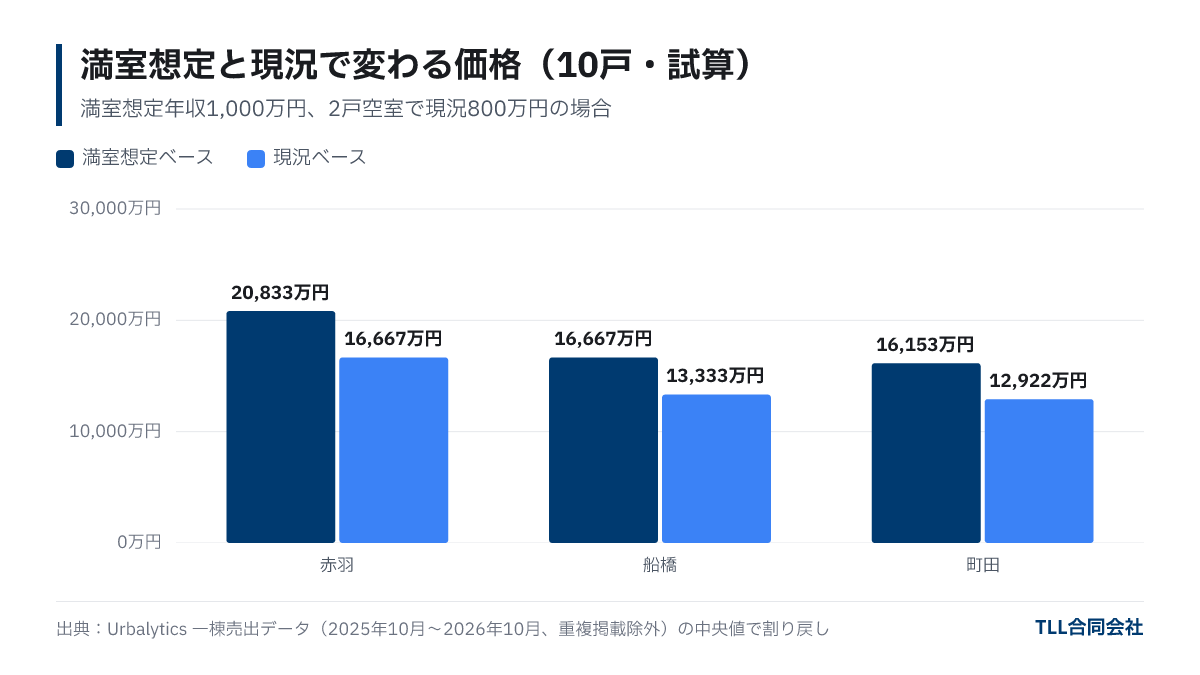
Viewing based on current rent results in around a 20% price drop if rental income drops by 20%. Another approach is to value at full occupancy then subtract estimated costs to fill vacancies. For example, assuming 300,000 yen per unit for restoration, 2 months’ rent advertising fees, and 4 months’ vacancy period totaling approx. 800,000 yen per unit, 2 units would cost about 1.6 million yen. Using this method in Akabane, subtracting 1.6 million yen from the full occupancy price yields approx. 206.7 million yen, narrowing the gap with the current rent-based price.
In practice, many buyers consider both current rent and the ease of filling vacancies and price somewhere in between. Properties with many vacancies tend to be valued closer to current rent. Therefore, prior to listing, it impacts pricing whether vacancies are filled or evidence such as nearby listing rents and average vacancy filling periods is provided. The relationship between yield and appraisal is also explained in How Entire-Building Apartment Appraisals Are Determined.
Key Points Buyers Examine
Buyers of properties with tenants verify not only gross yield numbers but also the likely continuity of rent income. Common checks include:
- Rent versus market rates: If current rent is higher than nearby listing rents, there is risk of rent decrease upon tenant turnover. If lower, it may be valued as potential for rent increase. For example, median listing rent for 18–30㎡ near Akabane station was 89,000 yen (Urbalytics rental listing data, Oct 2025–Oct 2026, 209 unique listings).
- Arrears and guarantor companies: Whether there are rent arrears, their duration, and whether the tenant is covered by a rent guarantee company.
- Contract terms: Whether leases are ordinary or fixed-term, renewal dates, notice periods for termination, free rent or rent reduction clauses.
- Tenancy duration and tenant type: Percentage of long-term tenants, corporate leases, personal information anonymized.
- Repair status: Records of exterior walls, rooftop waterproofing, water supply and drainage maintenance, and planned upcoming works.
Mismatches between rent rolls and lease contracts, or undocumented verbal rent reductions, can undermine buyer trust and become negotiation points.

What to Prepare (Owner Change Sales Process)
Before requesting an appraisal, assembling the following documents enables more accurate assessments and quick responses to buyer inquiries.
- Rent roll (unit number, rent, common service fees, security deposit, contract start and renewal dates, vacancy status)
- Lease contracts and important explanatory documents for each unit, renewal agreements
- List of held security and guarantee deposits
- Management outsourcing contract, rent guarantee company contract details
- Records of payments and arrears for the past 1–2 years
- Repair history, building diagrams, confirmation and inspection certificates
- Fixed asset tax and city planning tax payment notices
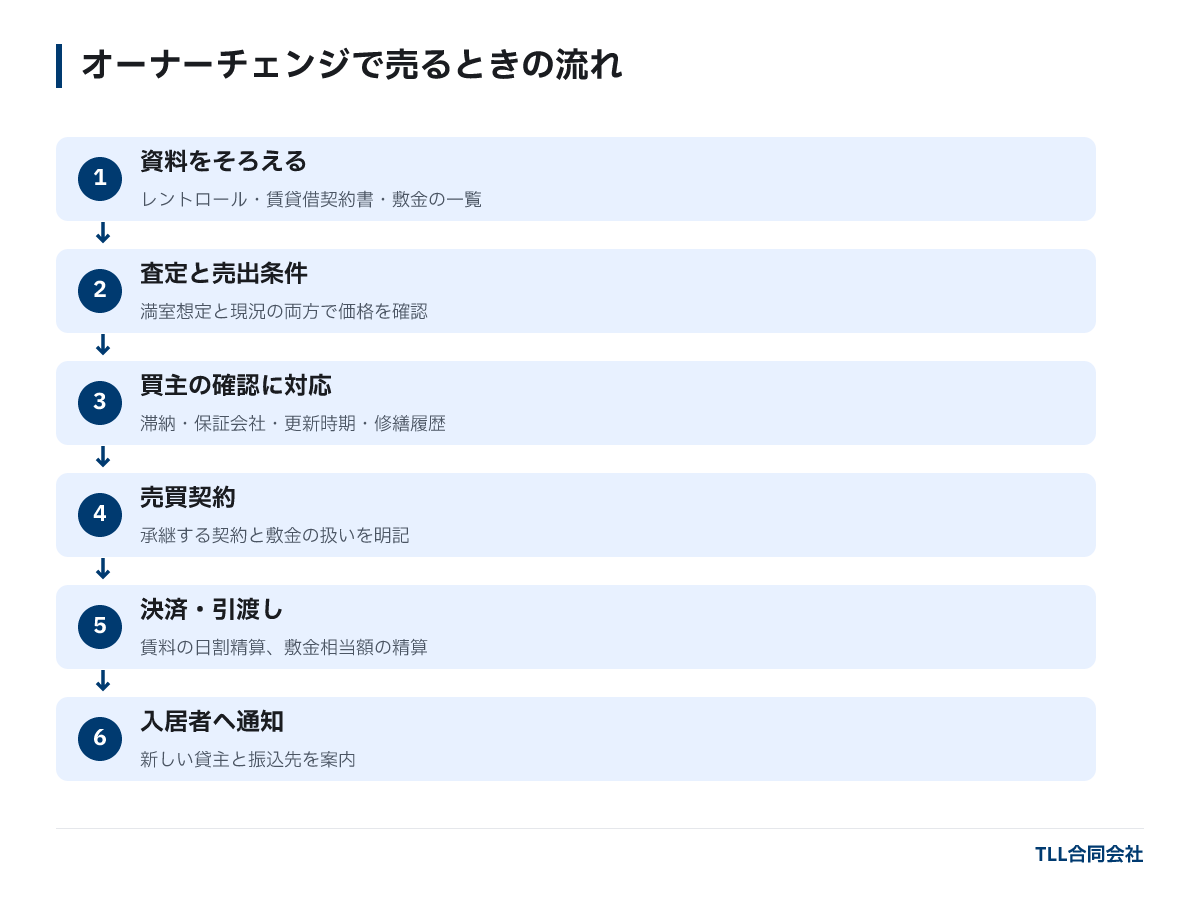
The overall process from appraisal to settlement is summarized in Process of Selling Income Properties.
Settlement Adjustments and Notification to Tenants
Settlement for owner change sales includes rent-related adjustments in addition to standard transaction settlements.
- Pro-rata rent adjustment: Rent for the transfer month is divided between seller and buyer based on the handover date. If rent for the following month was received before month-end, the amount after the handover date is paid to the buyer.
- Security deposit settlement: Handling of security deposits either transferred to the buyer or deducted from the sale price is processed according to contractual terms.
- Fixed asset and city planning tax settlement: Typically allocated pro-rata from a set start date.
- Coordination with management and guarantee companies: Whether to continue with the current property manager or transfer to buyer’s management company is confirmed.
After settlement, seller and buyer jointly notify tenants of the new lessor and rent payment destination. Delayed notifications may cause tenants to mistakenly pay rent into old accounts, increasing settlement complexity.
If unsure whether to sell with tenants or create vacancies first, consider whether to spend more time finding buyers through brokerage or to sell quickly via purchase offers. A comparison is provided in Comparison of Direct Purchase and Brokerage.

Frequently Asked Questions
Q. Is tenant consent required when selling with owner change?
No. The lessor’s position transfers to the buyer by agreement between seller and buyer or by ownership transfer (Civil Code Articles 605-2 and 605-3). Tenants are notified of the new lessor and payment destination after settlement.
Q. Who returns the security deposits?
When the lessor’s position transfers, the security deposit return obligation also transfers to the buyer. The seller and buyer settle by deducting deposit amounts from the sale price or other agreed methods.
Q. Is it better to fill vacancies before selling to get a higher price?
If the property is likely to be valued based on current rent, filling vacancies before selling tends to increase the price. However, since costs and time for tenant recruitment and effects of renting at below-market rates matter, both approaches should be estimated before deciding.
Q. Can I sell even if some tenants have rent arrears?
Yes, but you must disclose arrears amounts and details to buyers. This affects price and conditions. The settlement method for arrears should also be agreed upon in the contract.
Summary
- In owner change sales, the lessor position and security deposit return obligation transfer to the buyer. Tenant consent is not required, and notification is made after settlement.
- For a 10-unit apartment with full occupancy rent of 10 million yen and current rent of 8 million yen, a 42 million yen price difference occurs at Akabane’s median 4.80% yield. Ability to provide evidence that vacancies can be filled influences pricing.
- Prepare consistent rent rolls and contracts, information on arrears, guarantor companies, renewal terms, and security deposits before listing.
- If you want to check prices based on both full occupancy assumptions and current conditions, please use the free appraisal service.
Featured image (illustration): Photo: Ryan Rivers / Unsplash
About this article
- Author
- Eiichi Suto(Real Estate Brokerage / Renovation)Qualifications: Real Estate Transaction Specialist, General Insurance Solicitor Qualification, Assistant Commercial Facilities Planner, Level 2 Assistant Landscape Construction Management Engineer, Level 1 Assistant Civil Engineering Construction Management Engineer
Brings over 20 years of experience in the real estate industry, working across central Tokyo and the broader Greater Tokyo area on acquisitions and sales of income-producing and commercial properties. Leverages an inter-broker network to uncover off-market opportunities, assess asset quality, and evaluate project profitability, while developing diverse sourcing channels ranging from whole-building investment assets to value-add opportunities. Has consistently led the process from acquisition decisions through resale strategy and renovation planning, building high-conviction deals with strong execution potential.
View profile → - Publisher
- TLL合同会社宅地建物取引業 東京都知事(1)第108202号住宅宿泊管理業 国土交通大臣(01)第F03424号
Data in this article cite their source and as-of date. Market conditions and regulations change, so check the latest information and consult a professional before deciding. Translated from the Japanese original.