When and How Much to Budget for Major Apartment Repairs? Cycles and Costs for Exterior Walls, Rooftop Waterproofing, Metal Parts, and Plumbing, Savings and Impact on Resale Price
Kurihara (licensed real estate broker, 宅地建物取引士)PM Business
26 min read
From around 10 years after construction, visible signs such as cracks in exterior walls, rust on metal parts, and deterioration of rooftop waterproofing become apparent. If you postpone repairs without knowing "when, what, and how much to fix," you may end up rushing repairs after issues like leaks appear—resulting in increased costs and vacancy rates.
This article organizes the major repairs for apartments (entire rental buildings) by repair cycle and approximate costs for each type of work—exterior walls, rooftop waterproofing, metal painting, plumbing, etc.—how to save for repairs, and how repairs impact rent and resale prices, using materials from the Ministry of Land, Infrastructure, Transport and Tourism and TLL's estimate records.
Article Highlights
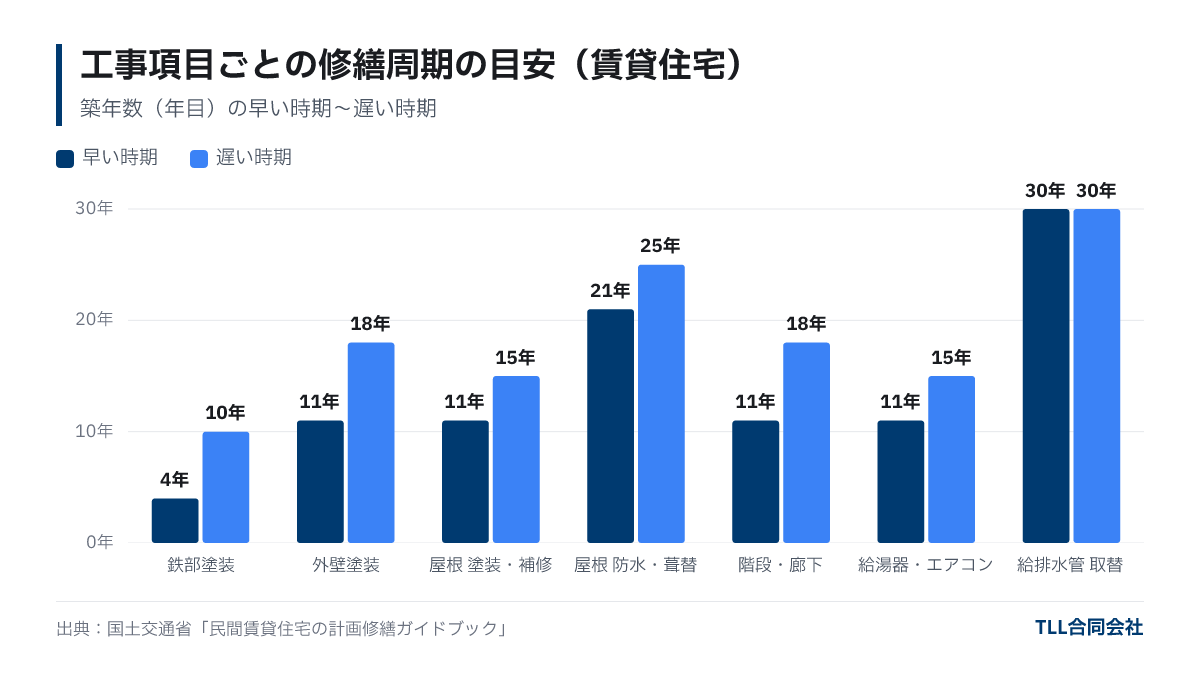
- The Ministry of Land, Infrastructure, Transport and Tourism's "Private Rental Housing Planned Repair Guidebook" suggests exterior painting around years 11 to 18, metal coatings around years 4 to 10, and plumbing replacement around year 30 as repair benchmarks.
- According to the guidebook's estimate, 30-year repair costs amount to approximately 1.74 to 2.25 million yen per unit, which translates to about 4,800 to 6,300 yen monthly savings per unit (varies by structure and layout).
- The median gross yield of one-building income properties near five Tokyo stations ranges from 4.3% to 5.2%. A repair delay causing a 600,000 yen annual rental decline could reduce property prices by approximately 11.6 to 14 million yen (based on Urbalytics sales data as of October 2026).
What Is a Major Apartment Repair?
Major apartment repairs involve setting up scaffolding and repairing exterior walls, roofs (including rooftops), shared corridors, stairs, and similar elements all at once. Commonly, the first major repair occurs around 11 to 15 years after construction, and the second around 21 to 25 years.

Unlike condominium management associations that collect repair reserves, apartment owners decide the timing and budget themselves. Therefore, if you accumulate years without a plan, insufficient funds often lead to deferred repairs, worsening deterioration and higher costs. The ministry’s guidebook notes that many landlords who neglect repairs cite "lack of financial capacity" as a main reason.
Repair Cycles and Cost Estimates by Work Category
The timing of repairs differs by work category: metal painting every 5 years or so, exterior walls and rooftop waterproofing roughly every 12 to 15 years, and plumbing replacement around 30 years. The main repair cycles and unit prices from TLL’s received estimates are summarized below.
| Work Item | Repair Cycle (Rental Housing) | Reference: Condominium Cycle | Approximate Cost (Excl. Tax) |
|---|---|---|---|
| Scaffolding (common with exterior wall & waterproofing) | With exterior wall repairs | 12–15 years | Wedge type 800–1,150 yen/㎡ + debris protection mesh 100–250 yen/㎡ |
| Exterior Painting | Years 11–18 | 12–15 years (repainting) | Primer 600–1,000 yen/㎡ + mid/top coats 1,200–1,700 yen/㎡ |
| Sealant Replacement | With exterior wall repairs | 12–15 years | Modified silicone 800–1,500 yen/m |
| Roof/Rooftop Waterproofing | Painting/repair at years 11–15; waterproofing/replacement at 21–25 years | Repair/maintenance 12–15 years; removal/new installation 24–30 years | Urethane waterproofing (adhesive, flat) 4,500–5,800 yen/㎡, top coat 2,000–2,700 yen/㎡ |
| Metal Part Painting (stairs, handrails, doors) | Years 4–10 | 5–7 years | Handrails/gutters 1,000–1,100 yen/m, metal doors 10,500–12,000 yen/location |
| Stairs and Corridors (painting & waterproofing) | Years 11–18 | 12–15 years (floor waterproofing) | Long-sheet flooring 4,800–6,000 yen/㎡ |
| Plumbing | High-pressure cleaning regularly from year 5; replacement at year 30 | Rehabilitation 19–23 years; replacement 30–40 years | Drain pipe high-pressure cleaning approximately 5,500 yen/unit (guidebook estimate) |
| Water heaters & Air conditioners | Replacement at years 11–15 | — | Replacement about 110,000 yen each per unit (guidebook estimate) |
Source: Repair cycles (rental housing) and amounts for plumbing, water heaters, and air conditioners are from the Ministry of Land, Infrastructure, Transport and Tourism’s "Private Rental Housing Planned Repair Guidebook" (example for 20-unit RC structure with 1LDK–2DK layouts). The condominium cycles are from the Ministry’s "Long-Term Repair Planning Guidelines" (revised June 2024). Other unit prices are from TLL’s received construction estimates (134 cases from Tokyo 23 wards, Tama, and southern Saitama, 2021–2026), aggregated as of September 2026. Since specifications, quantities, and timing vary, please confirm with individual estimate for your property. Confirmation date: October 2, 2026.
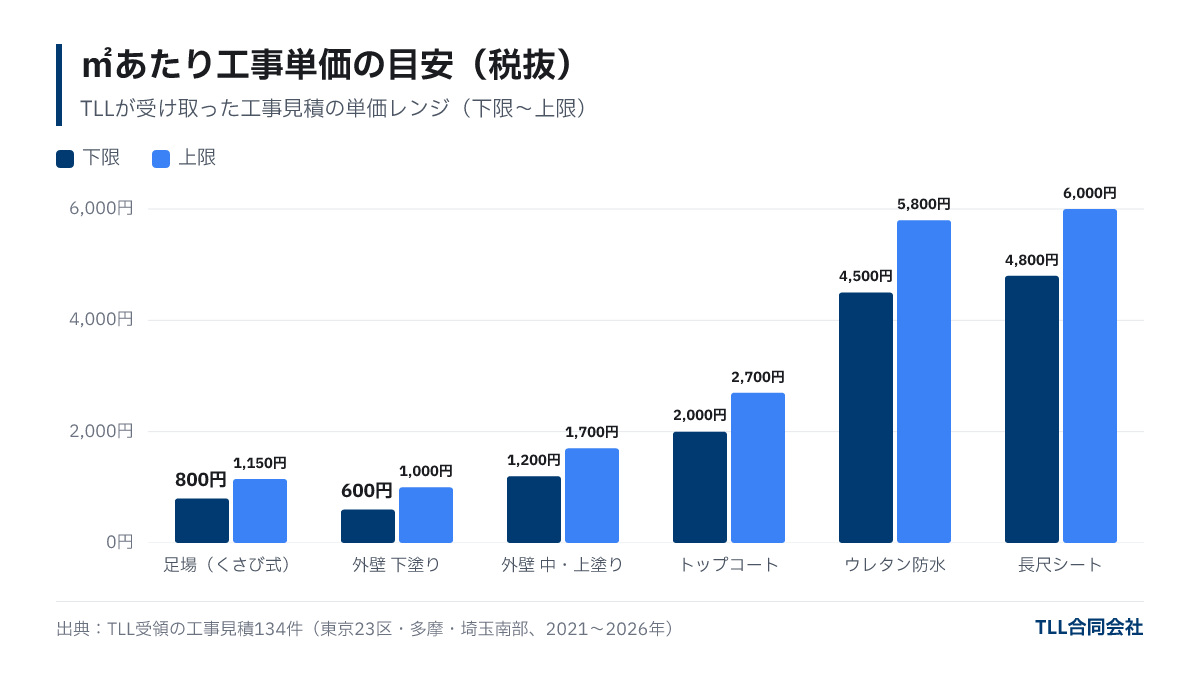
In total amounts per building, TLL’s estimate records show that repairs combining exterior painting, sealant, rooftop waterproofing, and metal painting for 3- to 5-story buildings with around 10 units fall between approximately 2.5 and 5 million yen (including tax). Scaffolding costs tens of thousands of yen each time, so exterior, sealant, waterproofing, and metal painting are typically done together using the same scaffolding.
Notes When Comparing Estimates
- Align quantities: In TLL's received estimates, scaffolding area differed by about 1.8 times among vendors for the same building. Compare scaffolding area, painting coverage, and sealant length, not just total cost.
- Request itemized breakdowns for many "lump sum" items: Having most of the work budgeted as "lump sum" makes it hard to judge if high cost is due to price or quantity.
- Check coverage for unusually low estimates: Extremely low estimates may mean limited repair scope (e.g., covering only part of the surface, excluding waterproofing).

How Much Does It Cost per Building? A 30-Year Repair Cost Overview
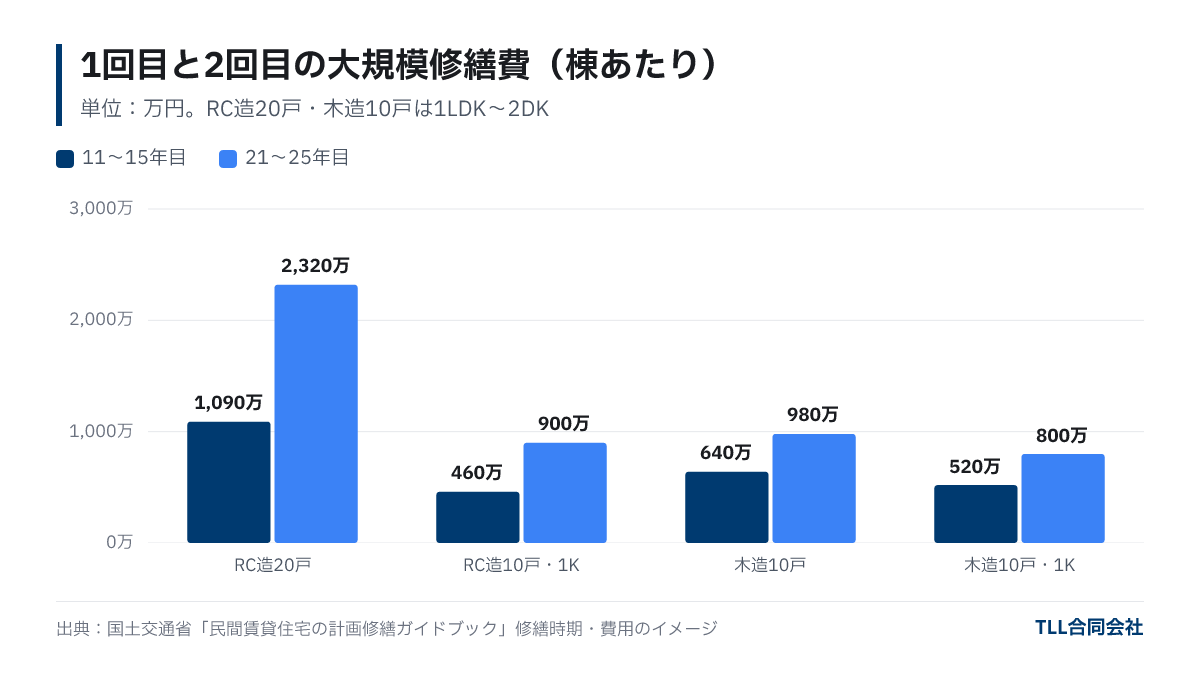
The Ministry's guidebook provides 30-year repair cost estimates broken down by building structure and layout. Note that the second major repair (around years 21 to 25), which includes roof and waterproofing renovation and bathroom equipment replacement, often costs more than the first major repair (years 11 to 15).
| Building | Years 11–15 (per building) | Years 21–25 (per building) | Total over 30 years (per building / per unit) | Monthly savings estimate (per unit) |
|---|---|---|---|---|
| 20-unit RC structure (1LDK–2DK) | Approx. 10.9 million yen | Approx. 23.2 million yen | Approx. 44.9 million yen / approx. 2.25 million yen | Approx. 6,300 yen |
| 10-unit RC structure (1K) | Approx. 4.6 million yen | Approx. 9.0 million yen | Approx. 17.7 million yen / approx. 1.77 million yen | Approx. 4,900 yen |
| 10-unit wooden structure (1LDK–2DK) | Approx. 6.4 million yen | Approx. 9.8 million yen | Approx. 21.6 million yen / approx. 2.16 million yen | Approx. 6,000 yen |
| 10-unit wooden structure (1K) | Approx. 5.2 million yen | Approx. 8.0 million yen | Approx. 17.4 million yen / approx. 1.74 million yen | Approx. 4,800 yen |
Source: Ministry of Land, Infrastructure, Transport and Tourism "Private Rental Housing Planned Repair Guidebook" repair timing and cost estimates. The monthly savings estimates are a simple division of the 30-year total per unit by 360 months (TLL calculation). The guidebook’s pricing assumptions are from its publication time and do not reflect subsequent increases in materials and labor costs. Confirmation date: October 2, 2026.
How to Think About Repair Savings
Apartment repair costs are typically covered by setting aside a certain amount monthly from rental income and using it when repairs are needed. The guidebook estimates that for a 20-unit RC building, about 7,000 yen per unit per month must be saved to cover repairs through year 25.
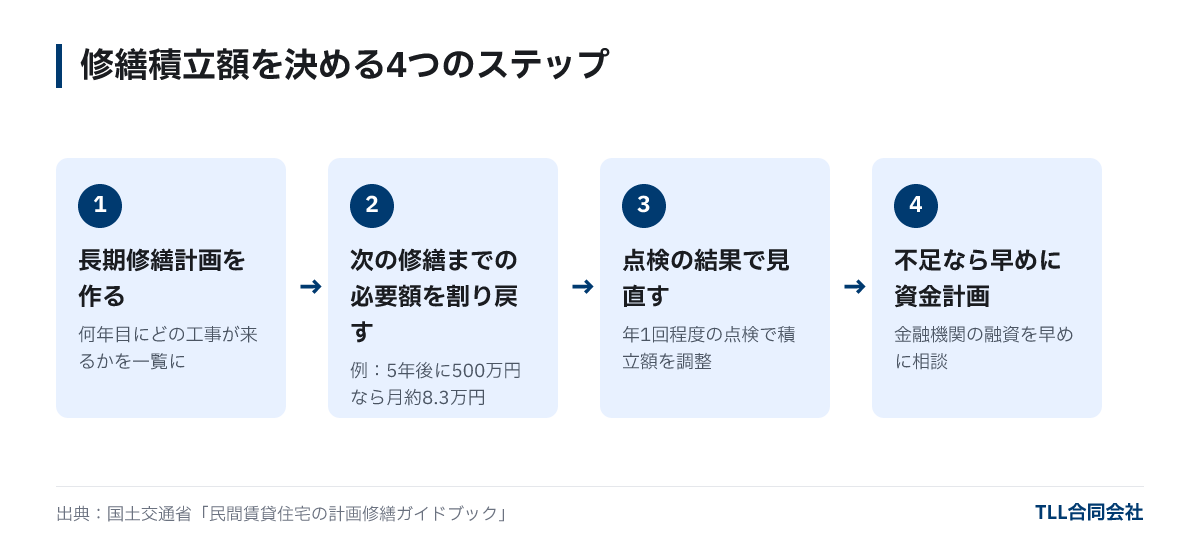
It’s reasonable to decide savings amounts in the following order:
- Create a long-term repair plan for the building: Apply the above cycles to your building and list which repairs will occur in which years. Confirm past repair history with the original contractor or management company.
- Calculate the required amount until the next major repair: For example, if a 5-million yen repair is expected in 5 years, set aside 1 million yen per year (~83,000 yen per month).
- Adjust based on inspection results: Annual inspections can check deterioration progress and allow you to advance or delay repairs, adjusting savings accordingly.
- If savings are insufficient, plan finances early: The guidebook also recommends consulting financial institutions early if savings fall short.
From a tax perspective, money reserved by apartment owners themselves is not deductible as an expense at the time of saving. Expenses are deductible only when repair work is actually carried out. Repairs restoring original conditions are treated as repair costs, while work that adds value to the building is treated as capital expenditure (depreciation). The criteria are summarized in the National Tax Agency’s Tax Answer “Criteria for Non-Deductible Repair Costs” (No. 1379). Large repair projects should be checked with a tax accountant in advance for certainty.
If you entrust management companies, check whether they handle long-term repair planning and coordinate multiple estimates, helping you not miss repair timing. If you’re considering whether to self-manage or outsource, see Self-Management vs Management Companies: Which is Better?.
Relationship of Repairs to Rent and Resale Price
Repairs are an investment to protect rent and resale value, not just expenses. If building appearance and common areas deteriorate, tenants are less likely to choose your property compared to nearby options, leading to vacancies and rent reductions. A survey by the Ministry in March 2016 showed that 67.2% of management companies listed “maintaining housing performance” as a benefit of planned repairs, 52.7% noted “ensuring high occupancy” and “gaining competitive advantage,” and 47.3% cited “maintaining rent levels.”
Income property prices are roughly calculated as "annual rent ÷ yield." Therefore, if delays in repairs cause rent to fall, at a 5% yield, the loss in price is about 20 times the reduced rent. We calculated this using yields of one-building income properties at five Tokyo stations.
| Station | Number of Properties | Median Gross Yield | Estimated Price Impact of 600,000 yen Annual Rent Drop |
|---|---|---|---|
| Kinshicho | 36 | 4.30% | Approx. 14 million yen |
| Akabane | 34 | 4.80% | Approx. 12.5 million yen |
| Ikebukuro | 75 | 4.81% | Approx. 12.5 million yen |
| Kamata | 52 | 5.01% | Approx. 12 million yen |
| Kita-Senju | 53 | 5.18% | Approx. 11.6 million yen |
Source: Urbalytics one-building income property sales data (properties near stations in Tokyo, excluding duplicate listings), from October 2, 2025 to October 2, 2026. Excludes properties with yields under 1% or over 25%. Gross yield = annual rent ÷ listing price, not contracted price. Price impact calculated as 600,000 yen ÷ median yield, assuming a 5,000 yen monthly rent drop per unit in a 10-unit building. Data as of October 2, 2026.
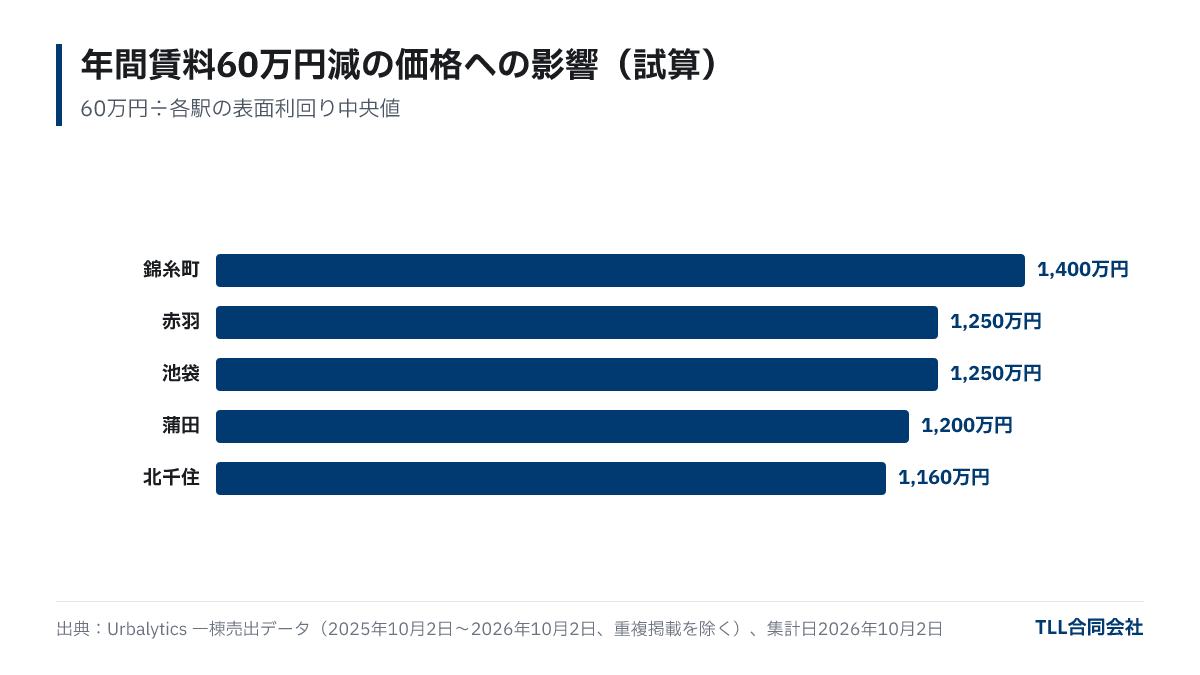
In a 10-unit apartment where rent drops 5,000 yen per unit monthly, the annual loss is 600,000 yen. Properties near Tokyo stations, generally evaluated with yields about 5%, could lose over 10 million yen in value. Compared with the repair costs seen earlier (a few million yen for 10-unit buildings), timely repairs significantly help protect asset value.
The repair history also affects sales valuation. Buyers anticipate upcoming repair costs and tend to discount price if exterior or waterproofing repairs are overdue. Conversely, properties with comprehensive repair records (plans, photos, warranties) are easier to explain regarding condition. Property appraisal mechanisms are explained in How is the Price of One-Building Apartments Determined?.

Additionally, repair timing is a good opportunity to combine vacancy measures and review income strategies. For ways to revise rental conditions when updating exterior and additional income sources beyond rent, please see Apartment Vacancy Measures and Ways to Increase Apartment Ancillary Income.
Frequently Asked Questions
Q. When is the benchmark timing for major apartment repairs?
The Ministry guidebook indicates exterior painting at 11–18 years and roof painting/repair at 11–15 years, with the first major repair generally around 11–15 years. The second major repair, including waterproofing and roof replacement, typically occurs around 21–25 years.
Q. How much do major repairs cost for a 10-unit apartment?
TLL’s estimate records range from 2.5 to 5 million yen (including tax) for combined exterior painting, sealant, rooftop waterproofing, and metal painting on 3- to 5-story buildings with around 10 units. The Ministry guidebook estimates about 4.6 million yen per building for repairs at years 11–15 for 10-unit RC (1K) buildings.
Q. How much should I save monthly for repairs?
Diving the guidebook’s 30-year estimate monthly results in about 4,800 to 6,300 yen per unit per month. In reality, you estimate the cost and timing of your building’s next major repair and calculate backwards to set savings.
Q. What if I postpone repairs?
Deterioration worsens, requiring more extensive and expensive repairs. Visual degradation makes tenants less likely to choose your building, leading to rent reductions. For properties evaluated around 5% yield, a 600,000 yen annual rent loss can translate to a price difference exceeding 10 million yen.
Summary
- Repair cycle benchmarks: metal painting 4–10 years, exterior painting 11–18 years, roof/rooftop waterproofing and replacement 21–25 years, plumbing replacement 30 years (Ministry guidebook).
- Major repair costs for 3- to 5-story, approx. 10-unit buildings range from 2.5 to 5 million yen including tax (TLL estimates). Exterior, sealant, waterproofing, and metal repair should be done using the same scaffolding.
- Thirty-year repair costs total about 1.74 to 2.25 million yen per unit, equivalent to monthly savings of about 4,800 to 6,300 yen. The second major repair tends to be more expensive than the first.
- Using median gross yield of 4.3–5.2% for 5 Tokyo stations, a 600,000 yen annual rent drop corresponds to a price difference of approximately 11.6 to 14 million yen (October 2026, Urbalytics).
TLL’s property management services cover leasing, tenant response, income and expense monitoring, rent correction and cost reduction proposals, and monthly reporting. We also consult on repair timing and estimate details. Please refer to Asset Management and Operation Services for details.
Featured image (image): Photo: Perry Merrity II / Unsplash
About this article
- Author
- Kurihara(PM Business)Qualifications: Real Estate Transaction Specialist, FP Level 2, Chief Property Manager, Rental Real Estate Management Specialist
Has more than 10 years of experience in the property management field. Across both rental management and condominium management, has handled a wide range of responsibilities including owner relations, tenant relations, contract administration, repair coordination, and the operation of board and general meetings.
View profile → - Publisher
- TLL合同会社宅地建物取引業 東京都知事(1)第108202号住宅宿泊管理業 国土交通大臣(01)第F03424号
Data in this article cite their source and as-of date. Market conditions and regulations change, so check the latest information and consult a professional before deciding. Translated from the Japanese original.