Rent and Sales Trends in Tokyo Minpaku Areas [September 2026] Taito, Sumida, Shinjuku, Toshima, Ota
Xingkai LuoNew Business
21 min read
For those looking to start minpaku (private lodging) operations in Tokyo or investors seeking minpaku-suitable properties, area selection depends on more than just accommodation demand. If you operate by renting a property, rent is a key factor; if you buy a property to operate, listing price and yield form the financial foundation.
This article organizes Urbalytics data on one-building income properties in the five wards known for high minpaku demand: Taito, Sumida, Shinjuku, Toshima, and Ota, as of September 2026. It covers gross yields, building price per tsubo, number of listings for sale, and rental listings for representative stations' apartments and houses. Links to TLL’s ward-specific articles on minpaku and ryokan operations regulations are also provided.
Key Points of This Article
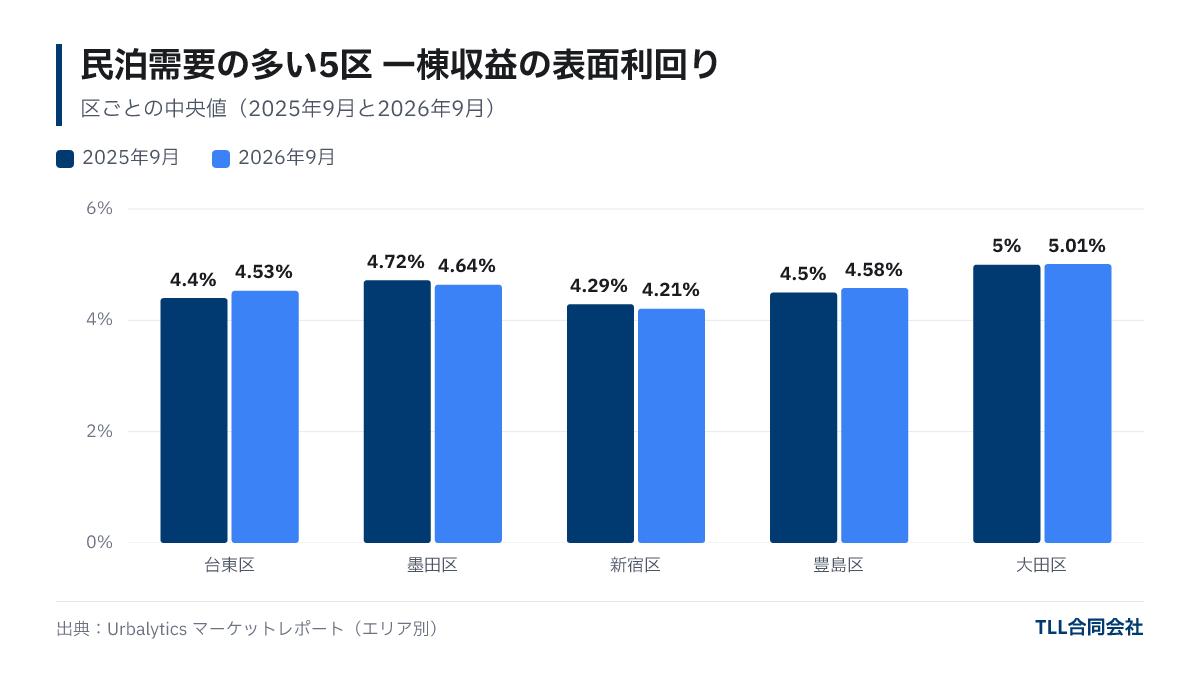
- The gross yields for one-building income properties in September 2026 were 4.21% in Shinjuku, 4.53% in Taito, 4.58% in Toshima, 4.64% in Sumida, and 5.01% in Ota, all moving within ±13 basis points compared to the same month last year (Urbalytics Market Report by area).
- Building price per tsubo increased notably in the eastern two wards: Sumida +19.3% (3.223 million yen/tsubo), Taito +18.0% (3.683 million yen/tsubo) compared to the same month last year.
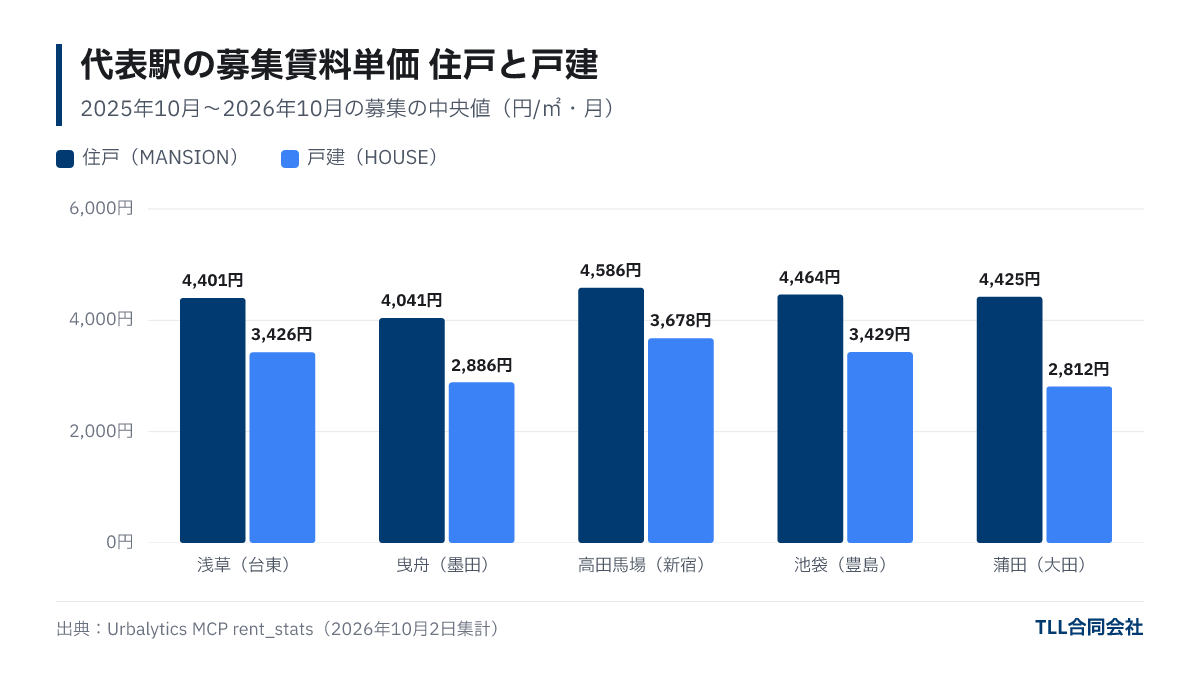
- The median rental listing price per square meter from October 2025 to October 2026 at representative stations ranged from 4,041 to 4,586 yen/㎡ for apartments and 2,812 to 3,678 yen/㎡ for houses, with houses roughly 20–40% lower per square meter than apartments (Urbalytics rent data).
One-Building Income Properties in Five Ward Minpaku Demand Areas: Yield, Price per Tsubo, and Number of Listings
Gross yields for one-building income properties in the five wards stayed within 4.2–5.0%, showing almost no change from the same month last year. Meanwhile, the building price per tsubo rose nearly 20% in Taito and Sumida.
| Ward | Listings (Sep 2025 → Sep 2026) | Gross Yield (Sep 2025 → Sep 2026) | Building Price per Tsubo (Sep 2025 → Sep 2026) | Price Reductions in August 2026 (One-building / House) |
|---|---|---|---|---|
| Taito Ward | 76 → 90 | 4.40% → 4.53% (+13bps) | 3.121M yen → 3.683M yen (+18.0%) | 13 listings -3.2% / 13 listings -7.2% |
| Sumida Ward | 59 → 77 | 4.72% → 4.64% (−8bps) | 2.701M yen → 3.223M yen (+19.3%) | 27 listings -5.6% / 30 listings -4.5% |
| Shinjuku Ward | 89 → 127 | 4.29% → 4.21% (−8bps) | 3.904M yen → 4.228M yen (+8.3%) | 29 listings -5.7% / 34 listings -5.4% |
| Toshima Ward | 105 → 108 | 4.50% → 4.58% (+8bps) | 3.207M yen → 3.180M yen (−0.8%) | 31 listings -5.8% / 33 listings -5.0% |
| Ota Ward | 99 → 121 | 5.00% → 5.01% (+1bps) | 2.588M yen → 2.645M yen (+2.2%) | 34 listings -5.5% / 59 listings -3.9% |
Source: Urbalytics Market Report (by area; pages for each ward's income properties, September 2025 and September 2026). Click ward names to visit the ward-specific pages. Listing counts include properties for sale and under contract, not completed transactions. Gross yield (expected yield) = annual income ÷ listing price. Building price per tsubo = listing price ÷ building area (10,000 yen/tsubo), both medians. Price reductions shown are from each ward page’s price reduction watch for August 2026 (median counts and reduction rates). Data confirmed on October 2, 2026.
The gross yield of one-building income properties across all Tokyo wards was 5.00% as of September 2026. Ota Ward is roughly on par with the metropolitan average, while Shinjuku Ward is 79 basis points lower.
Representative Station Rent: Apartment and House Rental Listings
If you operate minpaku by renting a property, monthly rent is a major fixed cost. We selected one representative station per ward and surveyed rental listings for apartments (unit condominiums, apartments) and houses posted during the last 12 months.

| Representative Station (Ward) | Apartments: Count / Median Rent / Unit Price | Houses: Count / Median Rent / Unit Price | Average House Area |
|---|---|---|---|
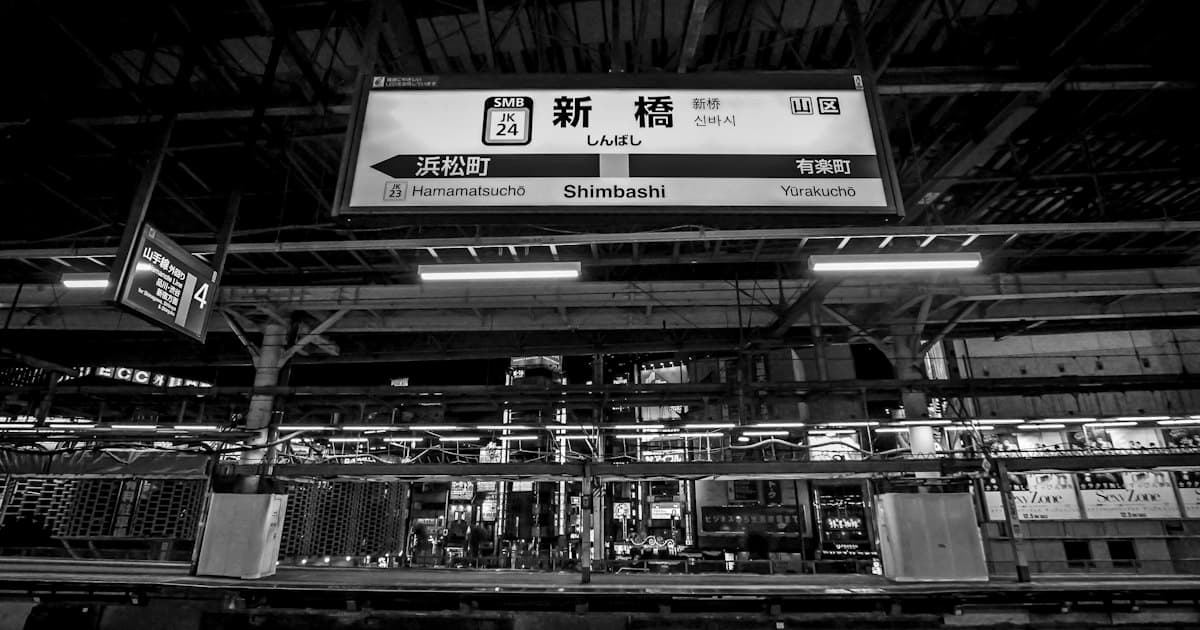
| Asakusa (Taito Ward) | 979 listings / 135,000 yen / 4,401 yen/㎡ | 12 listings / 205,000 yen / 3,426 yen/㎡ | 78.8㎡ |
| Hikifune (Sumida Ward) | 213 listings / 120,000 yen / 4,041 yen/㎡ | 19 listings / 150,000 yen / 2,886 yen/㎡ | 53.2㎡ |
| Takadanobaba (Shinjuku Ward) | 686 listings / 138,500 yen / 4,586 yen/㎡ | 20 listings / 280,000 yen / 3,678 yen/㎡ | 94.0㎡ |
| Ikebukuro (Toshima Ward) | 1,103 listings / 124,000 yen / 4,464 yen/㎡ | 20 listings / 337,500 yen / 3,429 yen/㎡ | 85.6㎡ |
| Kamata (Ota Ward) | 978 listings / 119,000 yen / 4,425 yen/㎡ | 25 listings / 185,000 yen / 2,812 yen/㎡ | 72.4㎡ |
Source: Urbalytics Rent Data (rent_stats, Apartments = MANSION, Houses = HOUSE). Listings with these stations as nearest station between October 2, 2025 and October 2, 2026. Duplicate listings with identical building, area, and rent consolidated into one. Outliers excluded. Unit price is median yen/㎡/month. Representative stations selected by TLL and do not represent entire ward averages. Sample size for houses small (12–25 listings). Data compiled on October 2, 2026.
The rent unit price for apartments at all five stations is roughly in the 4,000 yen/㎡ range without large differences. Houses have larger total area, so monthly rental amounts are 130% to 270% compared to apartments, but unit prices per square meter are 20–40% lower. Older houses tend to be included, which likely lowers unit prices. While houses offer more space suitable for groups at a relatively lower unit price, the small sample size and unpredictable timing for suitable listings require caution.
What Moved and Possible Reasons
Compared to the same month last year, the notable changes are building price per tsubo increases in Taito (+18.0%) and Sumida (+19.3%) and an increase in listings in Shinjuku (89 → 127). Gross yields in all five wards moved within ±13bps, showing little change.
- Price per tsubo rose while yields remained flat: In Taito Ward, building price per tsubo increased while median land and building areas shrank (median building area dropped from 77.5 tsubo in September 2025 to 53.8 tsubo in September 2026). More smaller properties hitting the market can raise price per tsubo without increasing total price, suggesting changing composition of listings as a factor.
- Expectation for lodging demand: Areas around Asakusa and Oshiage have strong inbound visitor lodging demand. Buyers anticipating conversion to minpaku or simple lodging (kanii shukusho) may be supporting prices. However, ratio of such buyers can’t be confirmed from the data.
- Regulation changes: Sumida introduced rules regarding onsite management in April 2026; Toshima announced amendments related to operating days. Stricter regulations may suppress minpaku demand (see ward-specific articles in next section for details).
- Many price reductions: In August 2026, 134 one-building income properties among the five wards were reduced in price, with the median reduction range between −3.2% and −5.8%. Listing prices reflect seller hopes and are often revised before contracts, so interpret accordingly.
Where to Check Minpaku and Ryokan Operations Regulations by Ward
Minpaku operations in Tokyo fall under several systems: notification under the Residential Accommodation Business Act (住宅宿泊事業法, minpaku new law, limiting operation days to 180 per year), permission under the Inns and Hotels Act (旅館業法) for simple lodging (kanii shukusho), and national strategic special zones’ special minpaku (特区民泊), applicable in Ota Ward within the 23 wards. Additional ward ordinances further restrict operation areas, days, and onsite manager requirements. Since conditions vary significantly between wards, confirm regulations before deciding on a property.
- Taito Ward: Can you operate minpaku or ryokan in Taito Ward? Summary of onsite/face-to-face service principles and absentee-owner operation days
- Sumida Ward: Can you operate minpaku or ryokan in Sumida Ward? Frequently updated onsite management rules from April 2026 and operating day limits
- Shinjuku Ward: Can you operate minpaku or ryokan in Shinjuku Ward? 14-day signposting, front desk size, and weekday restrictions in residential zones
- Toshima Ward: Can you operate minpaku or ryokan in Toshima Ward? Planned change to 120-day minpaku, simple lodging rules on face-to-face key handovers
- Ota Ward: Can you operate minpaku or ryokan in Ota Ward? Three systems: special zone minpaku, minpaku new law, and simple lodging, plus application flows
- Tokyo 23 Wards overall: Minpaku and ryokan regulations in Tokyo 23 wards [2026 edition]
Because ordinances may change, always verify the latest details with the ward’s health center or responsible office.

What Owners and Investors Should Confirm
Minpaku properties tend to have larger income fluctuations than regular rentals, and regulations and management affect profitability. After reviewing market data, confirm the following to reduce risk of overlooking key points.
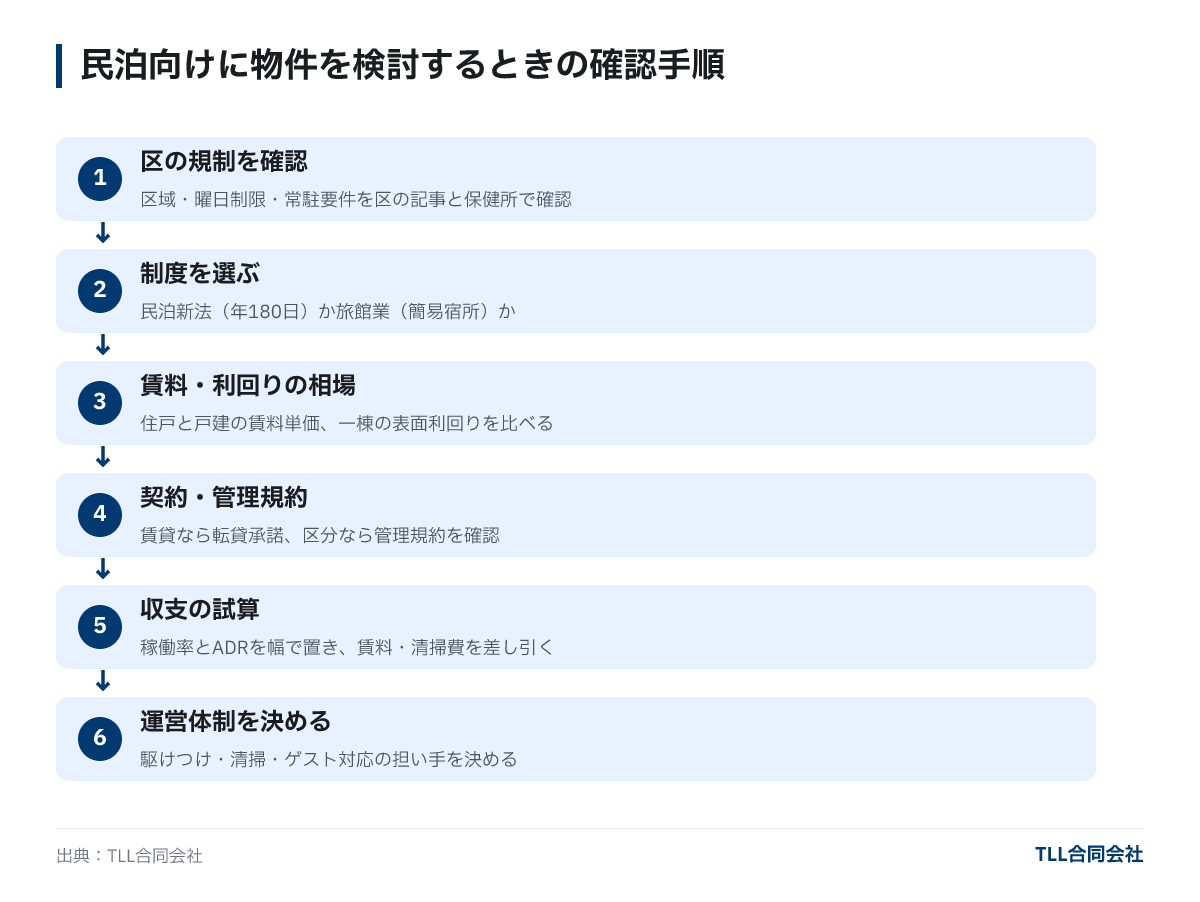
- Compare rent and lodging revenue: If operating by renting, for example if a house’s rent is 200,000 yen/month (2.4 million yen/year), lodging income must exceed this plus cleaning, linen, management fees, and utilities. Estimate occupancy rate and average daily rate (ADR) under both optimistic and pessimistic scenarios.
- Subleasing and management rules: Minpaku in rented properties requires landlord’s sublease consent, and in condominiums must not be prohibited by management regulations.
- Yields when purchasing: When buying a whole building and operating minpaku in part, first check gross yield compared to ward averages (4.2–5.0%), assuming normal rental operation. Consider minpaku as an added option to reduce impact of regulatory changes.
- Vacant houses and detached homes: Comparison of using, renting, or selling vacant houses is summarized here.
TLL offers minpaku management services covering everything from regulation confirmation and notification/permission preparation to cleaning, guest support, and pricing adjustments. If you have candidate properties, please consult us to check if operations are possible under that ward’s rules.
Frequently Asked Questions
Q. Which Tokyo wards have the highest minpaku demand?
Generally, wards such as Taito (home to Asakusa), Sumida (around Skytree), Shinjuku (including Shinjuku and Shin-Okubo), Toshima (around Ikebukuro), and Ota (close to Haneda Airport) are frequently cited. However, regulation varies widely between wards, so consider both demand and regulations.
Q. What is the typical rent estimate when renting a house for minpaku?
Median asking rents from October 2025 to October 2026 were 205,000 yen in Asakusa, 150,000 yen in Hikifune, 280,000 yen in Takadanobaba, 337,500 yen in Ikebukuro, and 185,000 yen in Kamata. These samples are small (12–25 listings) and vary greatly with size and age.
Q. Does the Residential Accommodation Business Act’s 180-day limit become shorter due to ward ordinances?
Some wards restrict operating days or days available in residential zones (e.g., weekends only). Conditions differ by ward, so check respective ward articles and health centers.
Q. Are wards with higher one-building yields more suitable for minpaku?
Gross yields are based on standard rental assumptions and don’t directly indicate minpaku profitability. Each property requires a calculation including lodging demand, regulations, and operating costs.
Summary
- Gross yields for one-building income properties in the five wards with high minpaku demand ranged from 4.21% to 5.01% in September 2026, moving within ±13bps from the previous year.
- Building price per tsubo rose notably in Sumida (+19.3%) and Taito (+18.0%), possibly influenced by changing property compositions.
- Median rental unit prices at representative stations were 4,041–4,586 yen/㎡ for apartments and 2,812–3,678 yen/㎡ for houses, with houses about 20–40% lower per square meter.
- Minpaku conditions vary greatly due to systems and ward ordinances. Check ward regulations before deciding and estimate profitability considering rent and operating costs.
Featured image (concept): Photo: Frank Okay / Unsplash
About this article
- Author
- Xingkai Luo(New Business)
Works on new business opportunities by assessing changes in local markets through his experience in urban development and infrastructure investment. He has more than ten years of experience in urban real estate development and infrastructure investment. At Alibaba and Honeywell, he worked on major redevelopment and smart-building projects, with experience across land acquisition, due diligence, project structuring and operations after completion. At TLL, he handles new business development and project structuring for overseas investors. When considering hotel, residential and other uses, he examines construction costs, nearby supply, transport access and operating requirements together. His redevelopment articles look beyond project scale to completion schedules, access during construction and the effects on existing rental properties.
View profile → - Publisher
- TLL合同会社宅地建物取引業 東京都知事(1)第108202号住宅宿泊管理業 国土交通大臣(01)第F03424号
Data in this article cite their source and as-of date. Market conditions and regulations change, so check the latest information and consult a professional before deciding. Translated from the Japanese original.