Tax Reporting for Rental Income: Expense Deductions, Depreciation, Blue Return Deduction, and Business Scale (5 Buildings/10 Rooms)
Emi Tokudomi (licensed real estate broker, 宅地建物取引士)Acquisitions
24 min read
Those earning rental income from apartments or condominium units must file tax returns listing that income as "real estate income." For salaried employees who own a property for the first time or have inherited rental properties, it can be unclear what qualifies as deductible expenses, how to calculate depreciation, and what changes when filing a blue return (blue form tax return) (青色申告).
This article organizes the calculation method for real estate income, a list of deductible and nondeductible expenses, business scale (based on 5 buildings or 10 rooms), special blue return deductions, and filing deadlines according to information published by the National Tax Agency (Tax Answer, as of April 1, 2026). In the latter half, using Urbalytics rental listings data, we estimate income for one condominium unit and for an apartment building with 10 units.
Key Points of This Article
- Real estate income is calculated as "total revenue minus necessary expenses," including fixed asset tax, fire and earthquake insurance premiums, depreciation, repairs, and loan interest. Loan principal repayments and income taxes or resident taxes cannot be deducted (National Tax Agency, laws as of April 1, 2026).
- The special blue return deduction of 650,000 yen (conditional on e-Tax electronic filing, etc.) applies if the rental operation meets "business scale" standards — roughly 10 or more rental rooms or 5 or more independent buildings. Below that scale, the deduction limit is 100,000 yen.
- For an example of 10 rooms (1K apartments) in Kitasenju (annual rental income approx. 11.29 million yen), the difference between the 650,000 yen and 100,000 yen deduction results in about a 170,000 yen annual tax difference for someone in a roughly 30% tax bracket (Urbalytics data, October 2026).
Calculation Method for Real Estate Income
The amount of real estate income is calculated by the following formula:
Real Estate Income = Total Revenue − Necessary Expenses (− Special Blue Return Deduction)
Total revenue includes rent, common service fees, key money and renewal fees, parking fees, and security or deposit money confirmed as non-refundable. Rent is recognized in the year of the payment date stipulated in the contract. For example, even if December rent is received in January, if the payment date is December, it is recorded in that year.
The calculated real estate income is combined with other income such as salary income to determine income tax. If the real estate income is negative, it can be offset against other income (loss offset), but note that losses attributable to loan interest on land acquisition loans cannot be offset.
List of Deductible and Nondeductible Expenses
Deductible expenses are those directly necessary to earn rental income and clearly distinguishable from personal household expenses. The main items are listed below.
| Category | Main Items | Notes |
|---|---|---|
| Taxes and Public Dues | Fixed asset tax, city planning tax, real estate acquisition tax, stamp duties | Income tax and resident tax are not deductible |
| Insurance Premiums | Fire insurance and earthquake insurance premiums | If multiple years are paid in lump sum, only the portion for the current year is deductible |
| Depreciation | Buildings, building attached equipment (water heaters, air conditioners, etc.) | Land is not depreciable |
| Repairs | Restoration to original condition, minor repairs | Work that increases value is capital expenditure and must be amortized |
| Loan Interest | Interest on property purchase loans | Loan principal repayments are not deductible |
| Management Fees | Management contract fees, condominium management fees and repair reserve fund contributions | Verify that repair reserve fund is non-refundable |
| Advertising Costs | Advertisement fees (AD), brokerage commissions for tenant recruitment | Brokerage fees paid upon property acquisition are included in acquisition cost |
| Others | Tax accountant fees, transportation expenses for property visits, communication costs | Only the portion related to rental activity if shared with home use |
Source: National Tax Agency Tax Answer No.1370 "When Receiving Real Estate Income (Real Estate Income)" and other laws as of April 1, 2026, compiled by TLL. Please confirm individual matters with your tax office or tax accountant.
The distinction between repair expenses and capital expenditures often varies depending on the amount and nature of the work. Keeping detailed statements for renovations involving equipment replacement can facilitate consultation with your tax accountant.

Depreciation Basics: Useful Life and Calculation for Used Properties
Building purchase costs are not expensed in full the year of purchase but instead depreciated gradually over their useful life. This is depreciation. Buildings are depreciated using the straight-line method; from April 1, 2016 onwards, building equipment and structures are also depreciated using the straight-line method.
The statutory useful life for residential buildings is 22 years for wooden structures, 27 years for steel frames with structural member thickness over 3 mm and up to 4 mm, 34 years for steel frames over 4 mm, and 47 years for reinforced concrete structures. For used buildings, a simplified calculation for remaining useful life is allowed: (Statutory useful life − elapsed years) + (elapsed years × 20%), rounding down fractional years less than 1. The minimum useful life is 2 years if below that. If the total statutory useful life has been exceeded, the useful life is 20% of the statutory useful life.
For example, a 15-year-old wooden apartment’s useful life is (22−15) + 15×20% = 10 years; a 20-year-old reinforced concrete condominium unit’s useful life is (47−20) + 20×20% = 31 years. The shorter the useful life, the higher the annual depreciation expense, but acquisition costs decline faster, potentially increasing capital gains tax on sale. This relationship is detailed in our article on apartment sales tax and depreciation.
Items with acquisition costs under 100,000 yen (including those with usable periods under 1 year) may be expensed fully in that year. Those costing between 100,000 yen and 200,000 yen can opt for spreading the expense evenly over 3 years (special depreciation assets).
Business Scale (5 Buildings/10 Rooms Standard) and the 650,000 Yen Blue Return Deduction
Whether real estate leasing qualifies as "business scale" affects the limits of the special blue return deduction and other benefits. The National Tax Agency states that it is judged by common social standards whether the scale is business-like, and considers rental operations as a business if one of the following applies:
- Rental rooms such as apartments: approximately 10 or more independent rooms available for lease
- Independent houses: approximately 5 or more buildings
| Item | Business Scale | Below Business Scale |
|---|---|---|
| Special Blue Return Deduction | Up to 550,000 yen (up to 650,000 yen if filing by e-Tax or electronic book storage) | Up to 100,000 yen |
| Blue Business Owner's Salary (family employee salary) | Applicable | Not applicable |
| Asset Loss from Demolition or Removal | Fully deductible as necessary expenses | Deductible only up to amount of real estate income before loss deduction |
| Bad Debt Loss on Rent | Included as necessary expenses in the year rendered uncollectible | Recalculate income retroactively to the year rent was recorded |
Source: National Tax Agency Tax Answer No.1373 "Distinction between Business and Other Real Estate Leasing" (laws as of April 1, 2026).
To receive the 650,000 yen deduction, you must keep double-entry bookkeeping records and submit a balance sheet and income statement attached to your tax return filed by the deadline, and file via e-Tax or store accounting books electronically. Generally, the "Application for Approval of Blue Return" must be submitted to the tax office by March 15 of the year you want to apply for (within 2 months if starting business from January 16 onward). For the 2027 tax year (Reiwa 9), the deadline is March 15, 2027.
Revisions from 2027 Tax Year
Due to the 2024 tax reform, from the 2027 tax year onwards, the special blue return deduction will be revised. According to guidance by the National Tax Agency, the maximum deduction will increase to 750,000 yen if certain conditions are met, including double-entry bookkeeping, e-Tax filing, and preparation/storage of high-quality electronic books. However, those who use simplified bookkeeping but meet business scale criteria and have income exceeding 10 million yen in the year before last will no longer be eligible for the 100,000 yen deduction. Those under business scale remain eligible for up to 100,000 yen after revision.
Estimation: Real Estate Income for One Condominium Unit and an Apartment with 10 Rooms
Using Urbalytics rental listing data, we estimated the real estate income for two cases. All amounts other than rent are hypothetical.
| Item | One Condominium Unit (Nakano) | Apartment 10 Units (Kitasenju) |
|---|---|---|
| Assumed Monthly Rent | 103,000 yen (Nakano median) | 99,000 yen × 10 rooms (Kitasenju median) |
| Annual Rental Revenue | 1,236,000 yen (full occupancy) | 11,286,000 yen (95% occupancy) |
| Total Necessary Expenses | 1,098,000 yen | 8,164,000 yen |
| Of Which Depreciation | 330,000 yen (building 10 million yen, useful life 31 years) | 4,000,000 yen (building 40 million yen, useful life 10 years) |
| Of Which Loan Interest | 400,000 yen | 2,000,000 yen |
| Income Before Blue Return Deduction | 138,000 yen | 3,122,000 yen |
| Scale and Deduction Limit | Below Business Scale - 100,000 yen limit | Business Scale - 650,000 yen limit |
Source: Urbalytics rental data (within 10 minutes walk to each station, 20–30㎡, listings published between October 2, 2025 and October 2, 2026, duplicates removed. Nakano 221 listings, median 103,000 yen; Kitasenju 177 listings, median 99,000 yen), calculated by TLL. Condominium expenses include management fees and repair reserve fund 216,000 yen, management contract fees 62,000 yen, fixed asset tax etc. 80,000 yen, insurance 10,000 yen, etc. Aggregation date: October 2, 2026.
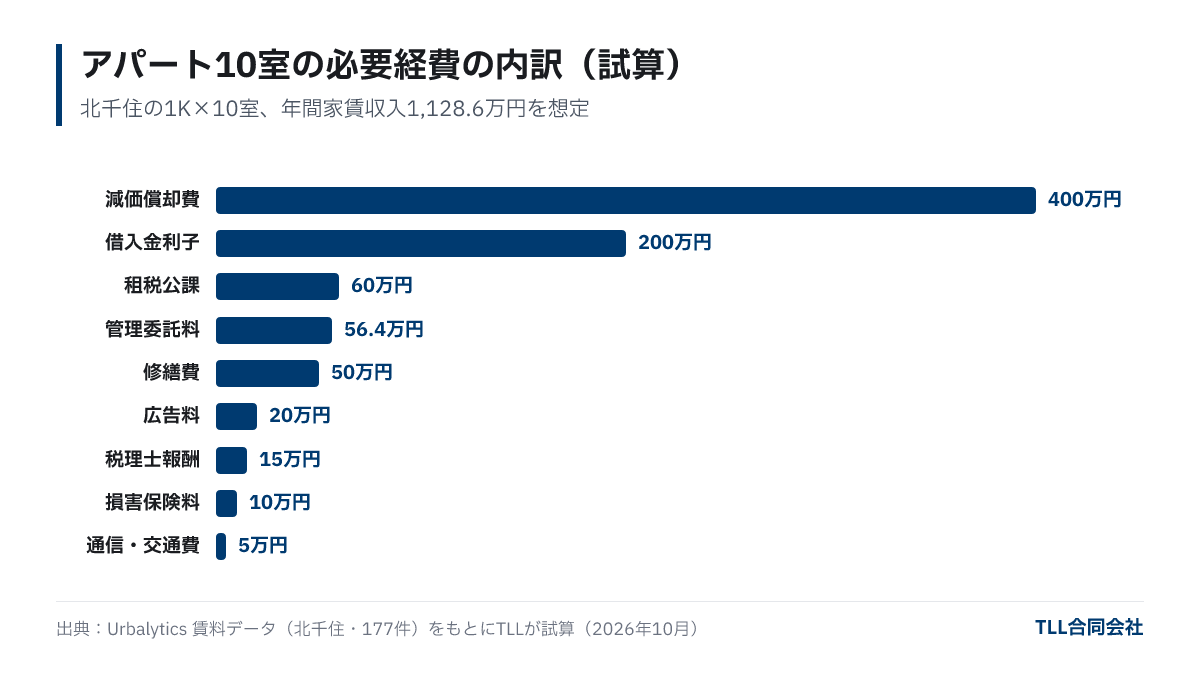
For the 10-unit apartment case, income is 2,472,000 yen with the 650,000 yen deduction and 3,022,000 yen with the 100,000 yen deduction. The 550,000 yen difference corresponds to an approximately 170,000 yen annual tax difference for someone with a 20% income tax rate (taxable income 3.3 million to 6.95 million yen) combined with 10% resident and reconstruction special income tax. For the single unit case, income is under 200,000 yen and if receiving year-end adjustment as a salary earner with no other income, income tax filing may not be required, but resident tax filing is still necessary.

Tax Filing Process and Deadlines
The income tax filing period is generally from February 16 to March 15 of the following year (if these dates fall on weekends or holidays, the deadline moves to the next weekday). For the 2025 tax year, the deadline was March 16, 2026. Confirm the official schedule for the 2026 tax year (Reiwa 8) on the National Tax Agency website.
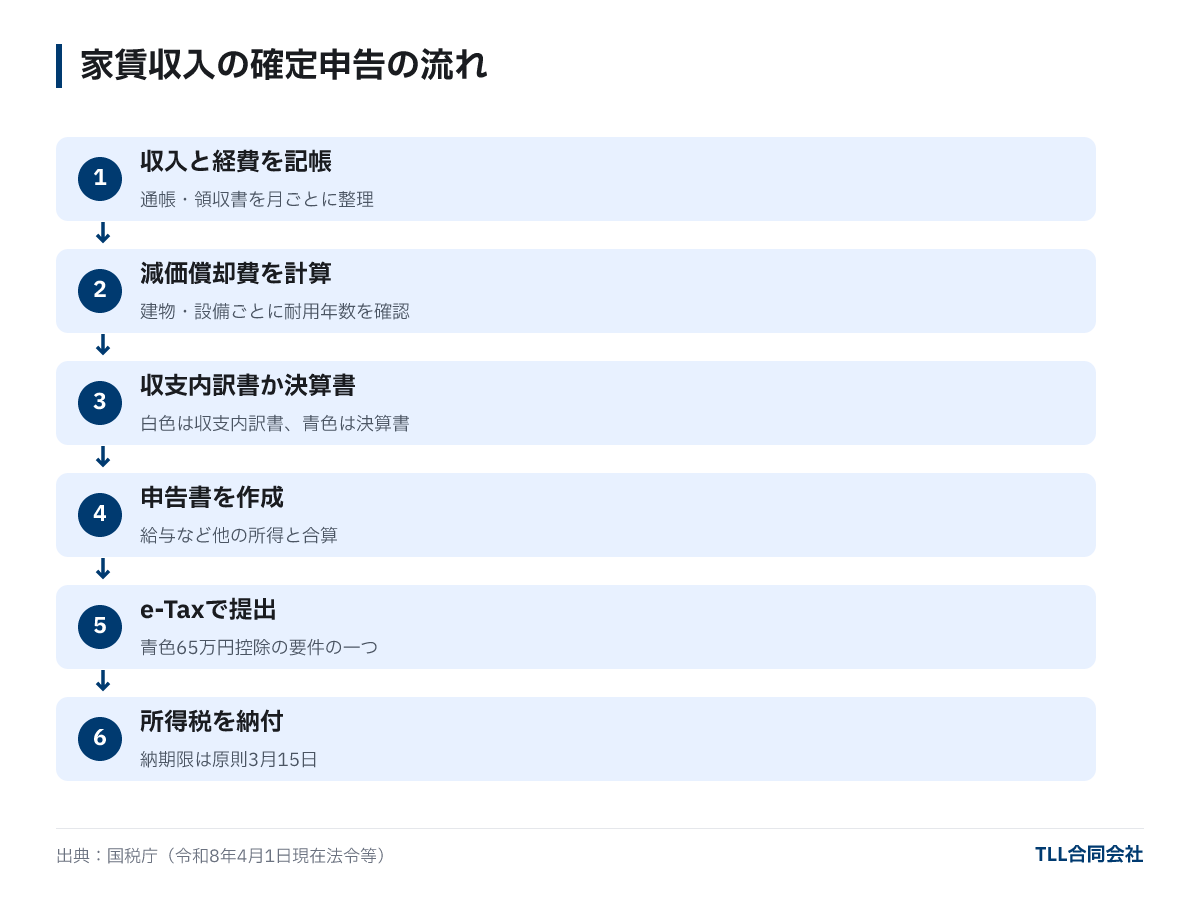
- Record Income and Expenses: Organize monthly bank statements and receipts, keep statements from the management company.
- Calculate Depreciation: Confirm acquisition cost and useful life for buildings and equipment.
- Prepare Income and Expenditure Statement or Financial Statements: White return filers prepare an income and expenditure statement; blue return filers prepare a blue return financial statement (balance sheet and income statement).
- Prepare Tax Return: Combine with other income such as salary and calculate tax.
- File via e-Tax: Required to qualify for 650,000 yen blue return deduction.
- Pay Income Tax: Deadline generally matches the filing deadline.
If property holdings increase approaching business scale, consider whether to continue blue return filing individually or incorporate ownership. See also our article on Incorporating Apartment Management.
Frequently Asked Questions
Q. From how much rental income is tax reporting required?
The criterion is income (revenue minus expenses), not revenue alone. For salaried employees receiving year-end adjustment, filing is required if total non-salary income exceeds 200,000 yen. Even below 200,000 yen, resident tax filing is necessary.
Q. Can I file a blue return for just one condominium unit?
Yes. However, since it is below business scale, the special blue return deduction limit is 100,000 yen. The 650,000 yen deduction requires approximately 10 or more rental rooms or 5 or more independent buildings (business scale).
Q. Are loan repayments deductible expenses?
Only the interest portion is deductible. Principal repayments are not expenses. Losses related to loan interest on land acquisition loans are not offsettable if real estate income is negative.
Q. Are management fees paid to property management companies deductible?
Yes. Advertising fees for tenant recruitment and tax accountant fees for preparing tax returns are also deductible.
Summary
- Real estate income is calculated by deducting necessary expenses from total revenue. Loan principal repayments and income/resident taxes are not deductible (National Tax Agency, laws as of April 1, 2026).
- The blue return 650,000 yen deduction requires business scale of roughly 10 rental rooms or 5 independent buildings, with revisions raising the maximum deduction to 750,000 yen from the 2027 tax year.
- For 10 rooms in Kitasenju, the difference between the 650,000 yen and 100,000 yen deduction equals about a 170,000 yen annual tax benefit for tax rates around 30%.
- The filing period is generally February 16 to March 15; the deadline for the 2025 tax year was March 16, 2026.
TLL’s Management and Asset Management service supports daily income and expense management including rental income collection and repair arrangements, providing a foundation for smooth tax filing.
Featured image (illustration): Photo: Kelly Sikkema / Unsplash
About this article
- Author
- Emi Tokudomi(Acquisitions)Qualifications: Real Estate Transaction Agent
Handles investment property acquisitions and the review of documents and operating figures, drawing on experience in rental management, brokerage and sales support. She has more than 18 years of practical real estate experience and now works on acquisitions at TLL. With Japan's Real Estate Transaction Specialist qualification and bookkeeping knowledge, she considers management and repair costs alongside property income, as well as the documents needed for a transaction. Her articles explain gross versus net yield, purchase costs, financing fundamentals and purchase procedures for foreign nationals. She emphasizes distinguishing advertised yields from the cash left after expenses and identifying what to verify before buying. Her management and brokerage experience informs acquisition assessments that also consider operations after purchase.
View profile → - Publisher
- TLL合同会社宅地建物取引業 東京都知事(1)第108202号住宅宿泊管理業 国土交通大臣(01)第F03424号
Data in this article cite their source and as-of date. Market conditions and regulations change, so check the latest information and consult a professional before deciding. Translated from the Japanese original.