Proper Loans and Apartment Loans in Japan|Underwriting, Rates, Terms and Whole-Building Investment
Emi Tokudomi (licensed real estate broker, 宅地建物取引士)Acquisitions
15 min read
Whole-building investors may hear that a “proper loan” is cheaper or that an apartment loan offers a longer term. The name does not determine either. Check the guarantee structure, eligible borrower and permitted use of funds.
The two labels classify lending in different ways. This article explains underwriting and contract terms, with repayment illustrations. Official information was checked on 9 October 2026.
Key points
- “Proper” describes a lending structure contrasted with guaranteed lending; “apartment loan” describes a rental-housing purpose or product.
- For a hypothetical JPY 80 million loan, annual payments are JPY 4.069 million at 2.0% over 25 years, versus JPY 3.432 million at 2.5% over 35 years.
- Compare guarantees, fees, security, prepayment terms and cash after vacancy and repairs as well as interest rates.
The names use different classifications
In Japan, “proper lending” generally refers to lending where the financial institution takes the credit risk itself. The Financial Services Agency's credit-guarantee-association supervisory guidance uses the term for credit without such guarantees, distinguishing it from guaranteed lending.
An apartment loan is a product for rental-housing construction, purchase or similar purposes. Some use a guarantee company; others involve direct bank underwriting. The name alone does not identify the structure. It is inaccurate to assume all apartment loans are guaranteed or that the labels always represent mutually exclusive choices.
For example, SMBC's direct-security apartment-loan disclosure sets out rental-housing uses and eligibility. Confirm terminology with each lender and distinguish guarantee associations, private guarantee companies and personal guarantees.
| Item | Proper-lending discussion | Apartment-loan discussion |
|---|---|---|
| Classification | Structure contrasted with guaranteed lending | Rental-housing purpose or product |
| Terms | Individual business, credit and security review | Product rules and individual underwriting |
| Guarantees | Check personal guarantees separately | Check guarantee-company arrangements |
| Common checks | Repayment, security and use of funds | Repayment, security and use of funds |

What do lenders review?
Income and assets alone may not secure the requested amount if the property fails security or income tests. Prepare borrower and property records together.
Individuals should set out income stability, financial assets, existing debt and repayments, and investment experience. Companies should also explain accounts, cash flow, operating-business profit and financial relationships with the director. Confirm whether a newly formed asset-management company qualifies.
Property checks include location, age, structure, compliance, collateral value, actual rent, vacancy and repair history. Use leases and receipts rather than full-occupancy brochure assumptions alone. See investment-loan basics and bank valuation.
Shinkin banks and credit cooperatives may also have geographic eligibility rules for the borrower and property. Do not select lenders solely from labels such as older building, foreign nationality or company borrower; verify current acceptance criteria.
Compare rates, terms and costs
Compare written terms for the same amount and purpose. There is no universal rule that proper lending is cheaper or apartment loans are longer.
Check fixed or variable rates, the reference rate and margin, review dates and treatment after a fixed-rate period ends. Understand how payments can change during ownership.
Terms depend on structure, building age, borrower age, repayment capacity and product rules. Tax depreciation life and a bank's loan term are different criteria. Include the remaining balance at sale even if a long term is available.
Review guarantee charges, arrangement fees, security registration, valuation and prepayment costs. A personal guarantee is a separate question from the product name (FSA request on management guarantees).
Compare repayments on JPY 80 million
A lower rate with a shorter term can produce higher annual payments. These illustrations assume equal monthly principal-and-interest payments and a constant rate throughout. They are not lender quotations or standard terms for either category.
| Assumed annual rate | Assumed term | Annual repayment |
|---|---|---|
| 2.0% | 25 years | JPY 4,069,000 |
| 2.5% | 35 years | JPY 3,432,000 |
| 3.5% | 35 years | JPY 3,967,600 |
Source and calculation: TLL illustration, 9 October 2026. Principal JPY 80 million; monthly rate r=annual rate/12; months n=years×12; monthly payment=principal×r/[1−(1+r)^−n]. Annual amounts are monthly payments×12, rounded to two decimals in JPY 10,000 units. Guarantee charges, fees and taxes are excluded.
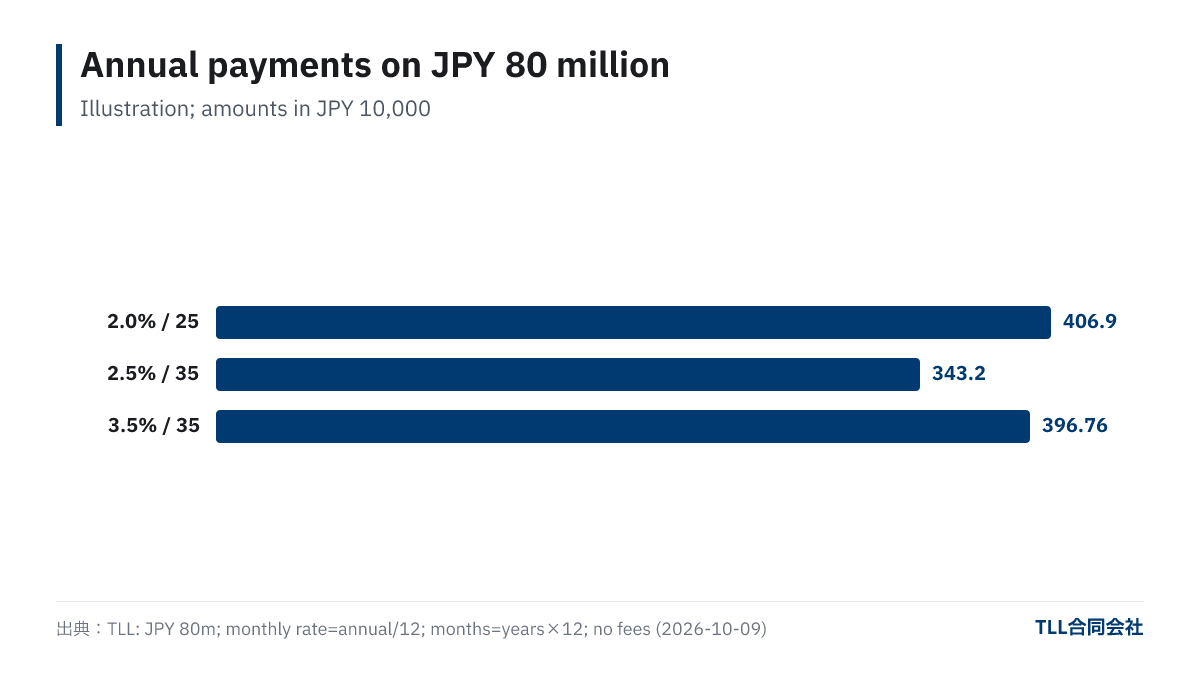
The 2.5%/35-year case has JPY 637,000 less annual debt service than the 2.0%/25-year case. Principal reduction, total interest and debt on exit also differ. Do not choose on annual cash remaining alone.
The 3.5%/35-year case raises annual payments from JPY 3.432 million to JPY 3.9676 million, a JPY 535,600 difference. This recalculates from origination under two constant-rate assumptions; it is not the actual increase following a mid-loan rate change.

Use property yields and debt service to assess suitability
Check repayment capacity after operating costs rather than relying on the loan label. A listed gross yield is not profit after repairs and expenses.
| Station | Buildings | Median gross yield |
|---|---|---|
| Akabane | 9 | 4.80% |
| Takadanobaba | 6 | 4.04% |
| Nerima | 4 | 5.21% |
Source: Urbalytics BUILDING listings in Tokyo with a listing or price update during 1–30 September 2026; retrieved 9 October 2026. Duplicates, completed sales, unpublished appraisals and defined outliers are excluded. Listed annual income may be actual or full-occupancy income. Age, structure and walking distance are not matched; samples are small and are not limited to lodging facilities.
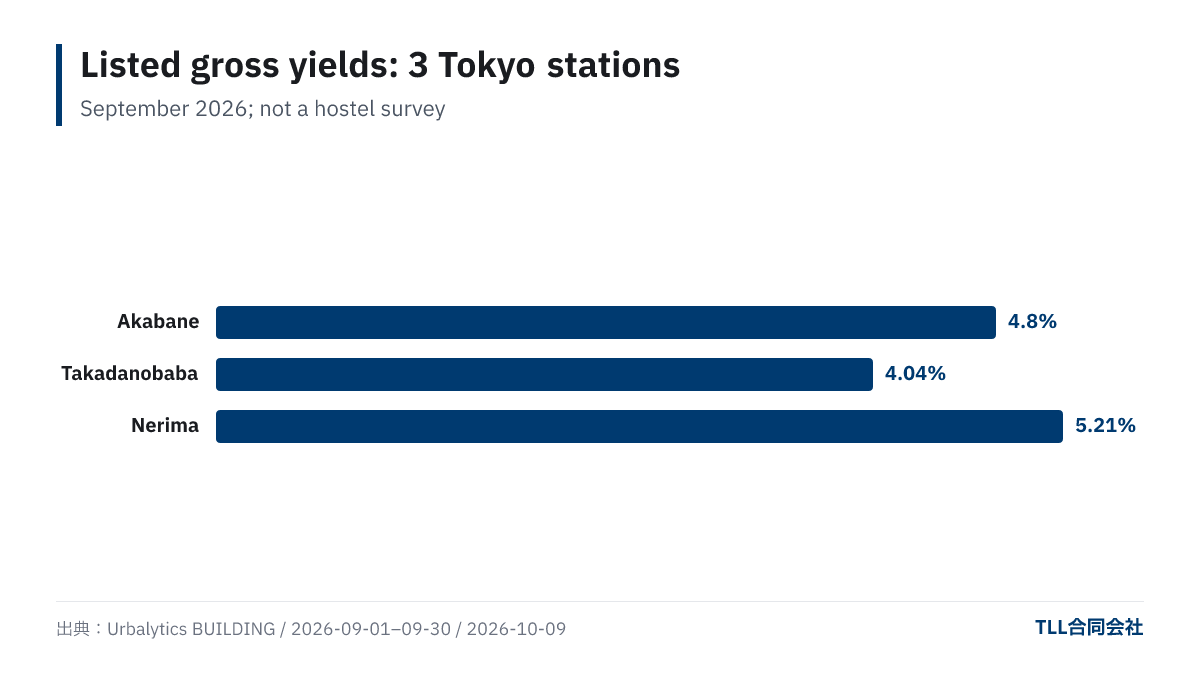
For illustration, assume a JPY 100 million purchase, JPY 4.8 million annual rent and JPY 80 million debt at 2.5% over 35 years. Rent less annual debt service leaves JPY 1.368 million for expenses (4.8 million−3.432 million). Price and rent are assumptions; Akabane's 4.80% median does not guarantee that income for a specific building.
The difference must absorb vacancy, management, taxes, insurance and repairs. Loan approval does not establish operating stability. See gross and net yields.
An apartment-loan product may fit where eligibility is met and written terms are readily comparable. Bespoke lending may merit discussion for corporate business plans or multi-property funding needs outside standard products. Neither route guarantees requested terms; consider equity and purchase-price adjustments too.
Prepare before approaching lenders
Use consistent records and comparison tables to understand differences between lenders. Do not finalise purchase funding from informal indications alone.
- List income or accounts, financial assets, existing debt and annual repayments.
- Prepare rent rolls, title, building records, repair history and estimates.
- Record rates, terms, fees, security, guarantees, prepayment and drawdown conditions in one table.
- Test vacancy, rate and repair stress, debt on sale and reserves remaining after purchase.
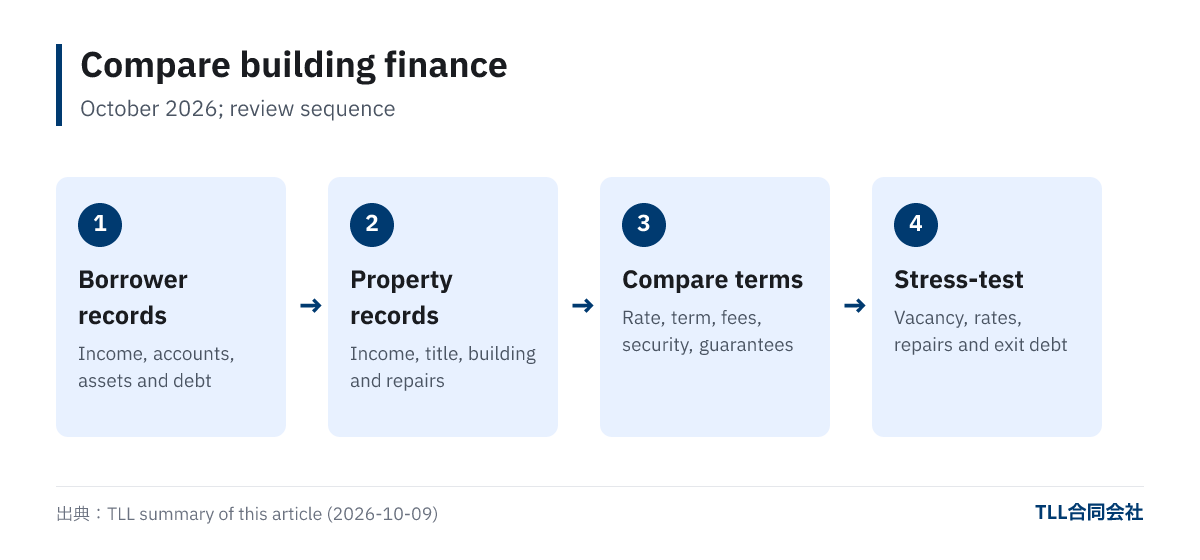
Keep operating-business and property funds distinct, and assess borrowing capacity for later purchases. State location, age and borrower type at the outset to avoid repeated applications for ineligible products.
Frequently asked questions
Q. Are proper loans cheaper?
Not universally. Guarantees, credit, collateral and the banking relationship affect terms; compare written offers.
Q. Do all apartment loans use a guarantee company?
No. Check guarantee-company, guarantee-association and personal-guarantee arrangements separately.
Q. Can companies or older properties qualify?
It depends on the product and lender. Explain company type, structure, age and location and verify current eligibility.
Q. Is a longer term always better?
It reduces annual payments, but at the same rate increases total interest and slows principal repayment. Consider debt on exit.
Summary
- Distinguish lending structure from product purpose.
- The JPY 80 million illustration gives annual payments of JPY 3.432–4.069 million; compare rate and term together.
- Include guarantees, fees, security and debt on exit.
- Subtract operating costs from rent and assess repayment under vacancy and repairs.
References: FSA and SMBC public guidance, original Urbalytics aggregation and TLL hypothetical calculations. Checked 9 October 2026. No confidential lender terms are included.
Cover image (illustrative): Photo: Aaron Lefler / Unsplash
About this article
- Author
- Emi Tokudomi(Acquisitions)Qualifications: Real Estate Transaction Agent
Handles investment property acquisitions and the review of documents and operating figures, drawing on experience in rental management, brokerage and sales support. She has more than 18 years of practical real estate experience and now works on acquisitions at TLL. With Japan's Real Estate Transaction Specialist qualification and bookkeeping knowledge, she considers management and repair costs alongside property income, as well as the documents needed for a transaction. Her articles explain gross versus net yield, purchase costs, financing fundamentals and purchase procedures for foreign nationals. She emphasizes distinguishing advertised yields from the cash left after expenses and identifying what to verify before buying. Her management and brokerage experience informs acquisition assessments that also consider operations after purchase.
View profile → - Publisher
- TLL合同会社宅地建物取引業 東京都知事(1)第108202号住宅宿泊管理業 国土交通大臣(01)第F03424号
Data in this article cite their source and as-of date. Market conditions and regulations change, so check the latest information and consult a professional before deciding. Translated from the Japanese original.