Should You Buy Income Properties with Cash or a Loan?|Calculating Leverage Effects and Risks Using Yield in Kitasenju
Emi Tokudomi (licensed real estate broker, 宅地建物取引士)Acquisitions
17 min read
We often receive questions from those with substantial funds wondering whether they should buy income properties with cash or use loans. While using loans allows owning larger properties with less equity, it also adds repayment and interest burdens, and losses when prices drop become larger relative to the equity.
In this article, we estimate equity yields and net income after debt service when buying the same property with "100% cash," "30% equity," and "10% equity," based on Urbalytics’ sale data. We compare how these figures change when interest rates rise, vacancies occur, or prices decline.
Key points of this article
- The median gross yield of whole-building sale properties near Kitasenju Station is 5.18% (October 2025 to October 2026, 53 properties excluding duplicates, Urbalytics). For a property priced at 150 million yen at this level, buying with 100% cash yields an equity yield of 3.89% (TLL calculation).
- Buying the same property with 30% equity, interest rate 2.5%, and loan term 30 years results in a net income yield of 2.27% and an equity yield including principal repayment of 6.56%. At 3.5% interest, the net income yield drops to 1.05%.
- If the property price drops 10%, the loss relative to equity becomes 9.3% for 100% cash, 27.0% for 30% equity, and 58.8% for 10% equity.
When Does Leverage Work Effectively?
Leverage increases equity yield through borrowing only when the property’s net yield (net operating income before debt service ÷ total investment) exceeds the cost of borrowing. There are two ways to view "cost of borrowing" here.
- Viewing from net income (cash flow): Compare to the loan constant, which is annual debt service ÷ loan amount. For a 2.5% interest rate and 30-year loan, the loan constant is about 4.74%, higher than the interest rate because it includes principal repayment.
- Including principal repayment: Principal repayment increases owner equity as the loan balance decreases. This is compared directly to the interest rate itself (2.5%).
If the net yield is below the loan constant, increasing borrowing reduces annual net income yield. If net yield is above the interest rate, including principal repayment raises the total yield. Properties in the 23 wards with gross yields in the 4-5% range often find themselves in this “disadvantageous for net income but advantageous when including principal repayment” zone at about 2.5% interest.
Assumptions for Calculation: Property Near Kitasenju at Median Yield
Whole-building sale properties near Kitasenju Station (Adachi Ward) that were listed or had price changes between October 2, 2025, and October 2, 2026, numbered 53 (excluding 10 duplicates). The median gross yield was 5.18% and the median price was 151.7 million yen (Urbalytics, data as of October 2, 2026). We assume the following property:
- Property price 150 million yen, gross yield 5.2% (assuming full occupancy rental income of 7.8 million yen per year).
- Vacancy loss and operating expenses are assumed to be 20% of full occupancy rental income, with net operating income (NOI) before debt service of 6.24 million yen annually. The net yield is 4.16% relative to property price.
- Ancillary costs are 7% of property price (10.5 million yen) paid entirely as equity. Total investment is 160.5 million yen.
- Loans assumed as 30-year equal principal and interest payments, interest rates of 2.5%, 3.5%, and 4.5%. Taxes are not considered.
The difference between gross yield and net yield is explained in the “Difference Between Gross Yield and Net Yield” article. Breakdown of ancillary costs is detailed in “Ancillary Costs When Buying Income Properties”.

Comparing 100% Cash, 30% Equity, and 10% Equity
The ratio of borrowing and interest rates significantly affect equity yield for the same property.
| Item | 100% Cash | 30% Equity | 10% Equity |
|---|---|---|---|
| Loan amount | 0 yen | 105 million yen | 135 million yen |
| Equity (including ancillary costs) | 160.5 million yen | 55.5 million yen | 25.5 million yen |
| Annual debt service (2.5% interest) | 0 yen | Approx. 4.98 million yen | Approx. 6.4 million yen |
| Net income after debt service (2.5% interest) | 6.24 million yen | Approx. 1.26 million yen | Approx. -0.16 million yen |
| Equity yield, net income basis (2.5%) | 3.89% | 2.27% | -0.63% |
| Principal repayment in year 1 (2.5%) | 0 yen | Approx. 2.38 million yen | Approx. 3.06 million yen |
| Equity yield including principal repayment (2.5%) | 3.89% | 6.56% | 11.37% |
| Equity yield, net income basis (3.5%) | 3.89% | 1.05% | -4.06% |
| Equity yield including principal repayment (3.5%) | 3.89% | 4.68% | 6.10% |
| Equity yield, net income basis (4.5%) | 3.89% | -0.26% | -7.72% |
| Equity yield including principal repayment (4.5%) | 3.89% | 2.79% | 0.82% |
Source: TLL calculation based on Urbalytics whole-building sale data (Kitasenju, Oct 2025 to Oct 2026, 53 properties) median yield. Calculation date: October 2, 2026.
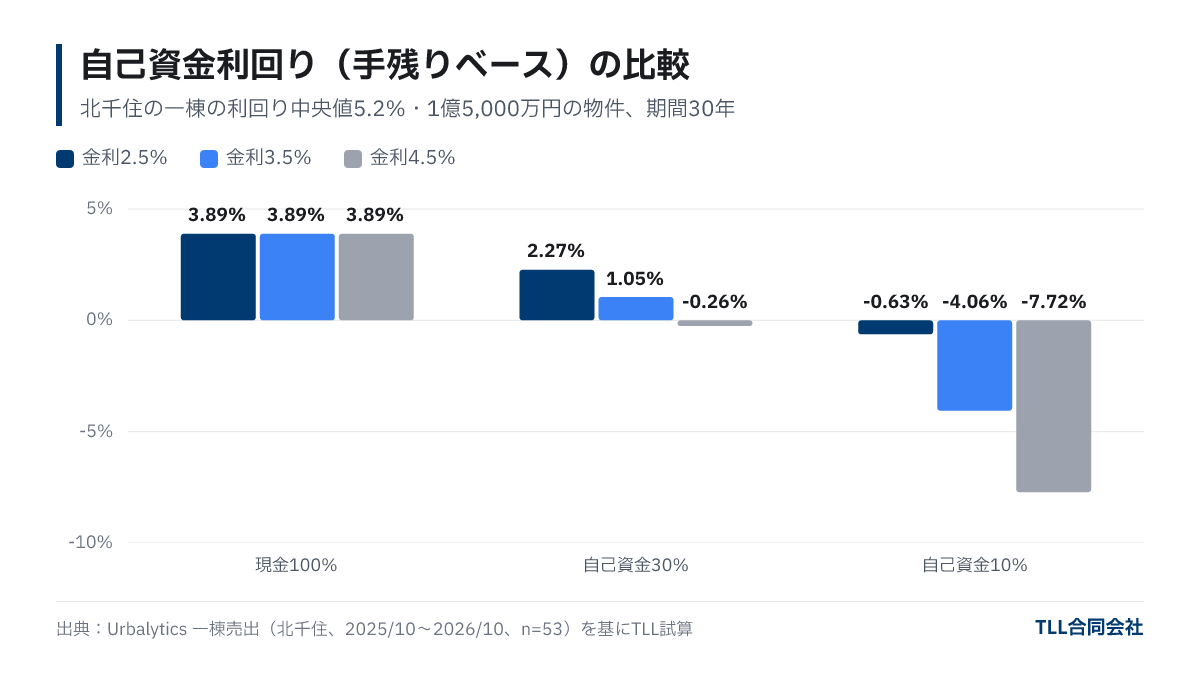
At this yield level, the highest net income yield is with 100% cash, and the yield decreases as borrowing increases. This is because the net yield (3.89% relative to total investment) is below the loan constant of 4.74% for 2.5% interest and 30 years.
However, including principal repayment increases yields for 30% and 10% equity to 6.56% and 11.37% respectively at 2.5% interest, exceeding cash. But this difference is not in annual cash flow but in equity realized only at sale or full repayment. If interest rises to 4.5%, even including principal repayment, the yield for 10% equity falls to 0.82%, below cash.
Comparison in Downturn: Vacancies and Price Decline
Leverage magnifies downside impacts just as it boosts positive returns. We compare the impact of a 10% decrease in NOI from vacancies and a 10% drop in property price, assuming 3.5% interest.
| Item | 100% Cash | 30% Equity | 10% Equity |
|---|---|---|---|
| Net income after debt service with 10% NOI decrease (3.5% interest) | Approx. 5.62 million yen | Approx. -0.04 million yen | Approx. -1.66 million yen |
| Corresponding equity yield | 3.50% | -0.08% | -6.50% |
| Loss relative to equity with 10% (15 million yen) price drop | 9.3% | 27.0% | 58.8% |
Source: TLL calculation (same assumptions as previous table; price drop loss is simple calculation ignoring sales costs and loan balance reduction). Calculation date: October 2, 2026.
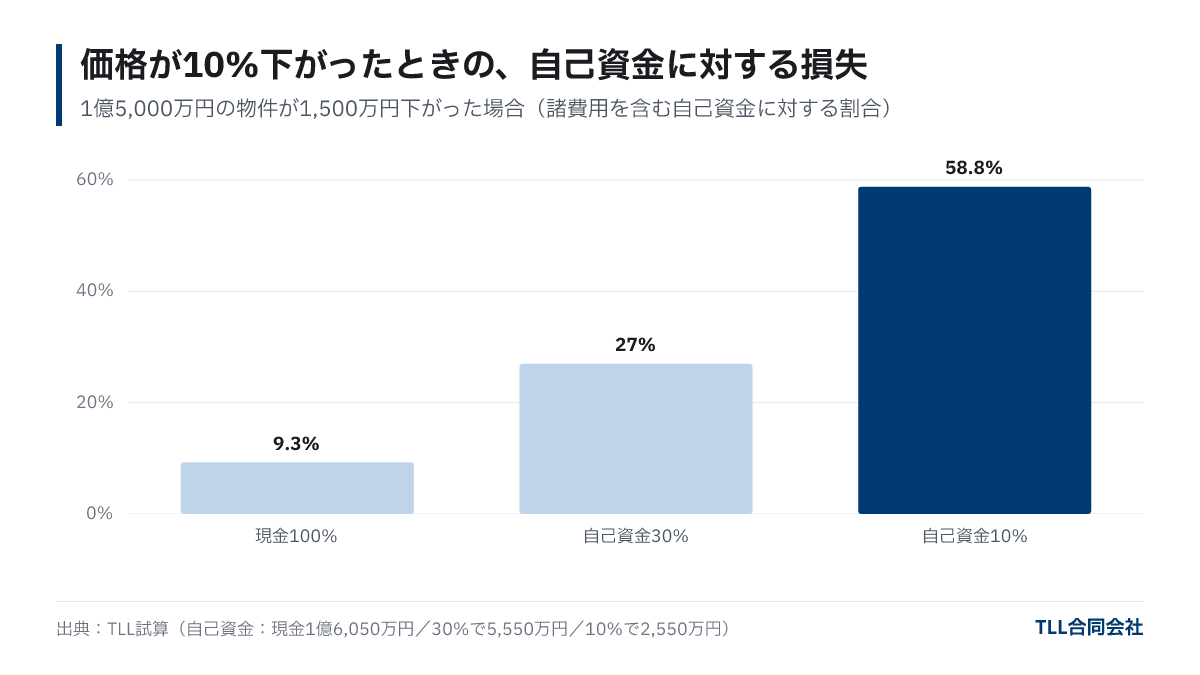
With 10% equity, a 10% price drop causes a loss of nearly 60% of equity. If the net income is negative and vacancies increase, yearly out-of-pocket expenses also rise. Buying with cash minimizes impact of downturns but fixes over 160 million yen in one property.

Cash or Loan: Points to Consider
Which is better depends on available funds, investment goals, and risk tolerance. The benchmarks from this calculation are as follows.
When Cash (or Low Leverage) Is Suitable
- You prioritize stable net income annually and want to avoid interest rate risk.
- You maintain sufficient liquid reserves besides the property.
- You prefer to hold for a long time emphasizing location and building quality, even if yields are lower.
When Using a Loan Is Suitable
- You want to avoid concentrating your equity in one property and keep reserves or invest elsewhere.
- You have income from your main job and can cover shortfalls due to vacancies or rate hikes.
- You focus on long-term holding, repaying principal, and increasing net assets.
For taxation, interest on loans is deductible as necessary expenses against real estate income. However, if you have a loss in real estate income, the portion of interest related to loans for land acquisition cannot be offset against employment income, etc. (National Tax Agency Tax Answer No. 2250, current as of April 1, 2026). Please consult a tax professional for tax-related decisions.
In practice, many investors choose an approach "borrowing enough so that equity comprises 30-50%, ensuring net income remains positive." The optimal loan-to-value ratio varies with property yield and price balance. On TLL’s member page (free registration), you can see our current listings along with their yields and prices.
Frequently Asked Questions
Q. Is it more profitable to buy income properties with cash?
Looking at annual net income yield for the property with 5.2% median gross yield near Kitasenju in this article’s calculation, 100% cash (3.89%) is highest. However, including principal repayment, borrowing at 2.5% interest yields higher returns. Which is better depends on the metric viewed and interest rates.
Q. Under what conditions does leverage have a positive effect?
From a net income perspective, the property’s net yield (NOI ÷ total investment) must exceed the loan constant (annual debt service ÷ loan amount). For a 2.5% interest, 30-year loan, the loan constant is about 4.74%. If net yield is below this, borrowing reduces net income yield.
Q. What equity ratio is typical for income properties?
There is no fixed standard; it depends on lender conditions and property yields. In our example, net income was positive at 30% equity and 3.5% interest, but negative at 10%. One way to choose is by ensuring net income stays positive even if interest rates rise.
Q. Can a property bought with cash be used later as collateral for a loan?
You can inquire about loans secured by the property. However, loans not used for the purchase may have different conditions and purposes, subject to lender approval.
Summary
- The median gross yield of whole-building properties near Kitasenju is 5.18% (Oct 2025–Oct 2026, 53 properties). Buying such a property with cash yields 3.89% equity return.
- With 30% equity and 2.5% interest, net income yield is 2.27%, and including principal repayment 6.56%. At 3.5% interest, net income yield drops to 1.05%, and at 4.5% it becomes negative.
- If price drops 10%, the loss relative to equity is 9.3% for cash, 27.0% for 30%, and 58.8% for 10% equity.
- Leverage amplifies both gains and losses. Confirm that borrowing leaves positive net income before deciding.
About this article
- Author
- Emi Tokudomi(Acquisitions)Qualifications: Real Estate Transaction Agent
Handles investment property acquisitions and the review of documents and operating figures, drawing on experience in rental management, brokerage and sales support. She has more than 18 years of practical real estate experience and now works on acquisitions at TLL. With Japan's Real Estate Transaction Specialist qualification and bookkeeping knowledge, she considers management and repair costs alongside property income, as well as the documents needed for a transaction. Her articles explain gross versus net yield, purchase costs, financing fundamentals and purchase procedures for foreign nationals. She emphasizes distinguishing advertised yields from the cash left after expenses and identifying what to verify before buying. Her management and brokerage experience informs acquisition assessments that also consider operations after purchase.
View profile → - Publisher
- TLL合同会社宅地建物取引業 東京都知事(1)第108202号住宅宿泊管理業 国土交通大臣(01)第F03424号
Data in this article cite their source and as-of date. Market conditions and regulations change, so check the latest information and consult a professional before deciding. Translated from the Japanese original.