Renovation as a Vacancy Countermeasure: Costs, Payback Periods, and Rent Estimates for Tokyo’s 3 Stations by Construction Type
Kurihara (licensed real estate broker, 宅地建物取引士)PM Business
19 min read
When vacancies drag on after tenant move-outs, many owners think, "If we renovate, the unit will lease quickly." However, construction costs range from hundreds of thousands to several million yen, and if the rent doesn’t increase, it can take a very long time to recover those expenses.
We organized rent revision, advertising fees (AD), and ways to widen tenant criteria in our article on apartment vacancy measures. This article continues that discussion, focusing specifically on the investment decision: "How much to spend on construction, and how many years to recover it." Costs are estimated from unit prices in construction estimates received by TLL, and rents are estimated from Urbalytics listing data.
Key points of this article
- For 1K 25㎡ units, surface refreshes like wallpaper and flooring cost around 250,000 to 350,000 yen including tax, while replacements including unit baths and kitchens cost roughly 1.5 to 2 million yen (based on TLL received estimate standard unit prices, October 2026).
- At Nakano, Kitasenju, and Kamata stations, 1K (20–30㎡, within 10 minutes walking) listing rents differ widely between the bottom 25% and top 25%: 45,000 yen difference at Nakano and 23,000 yen at Kitasenju, demonstrating significant variance by station (Urbalytics, October 2025 to October 2026, duplicates excluded).
- At Nakano, calculations show surface and equipment renovations recover in about 4 years, while plumbing replacements or more extensive renovations take 6–7 years; the larger the construction cost, the longer the payback relative to rent increases.
Vacancy Countermeasure Renovation Recovers Costs Through “Rent Increase” and “Vacancy Reduction”
The effectiveness of renovation can be divided into two main factors: (1) ability to raise the rent, and (2) shortening vacancy periods. Dividing the construction cost by the sum of these two factors gives a rough payback period.
Simple payback period (months) = Construction cost ÷ (Monthly rent increase + Average monthly income gain from shorter vacancies)
The effect of vacancy reduction varies with tenant turnover frequency. For example, if an average unit turns over every 4 years (48 months), and the vacancy shortens from 3 months to 1 month each time, the income from 2 months’ rent spread over 48 months divides into a monthly increase. Calculating only by rent increase underestimates the effect, but overestimating vacancy reduction risks too optimistic a plan; separating these two components is important.
Note that tenant move-out restorative work such as wallpaper replacement occurs regardless of renovation and is a recurring cost. When comparing, consider the incremental difference over “restoration only” to clearly see the value of additional investment.
Cost Estimates by Construction Contents (For 1K 25㎡ Units)
Applying standard unit prices compiled from 134 construction estimates received by TLL between 2021–2026 to a 1K 25㎡ unit, approximate cost ranges are as follows. These include 12% of subtotal for various expenses and disposal fees, plus 10% consumption tax. Actual amounts may vary ±20% depending on building condition and specifications.
| Construction Stage | Main Contents | Approximate Cost (Including Tax) |
|---|---|---|
| ① Surface Refresh | Full wallpaper replacement (about 80㎡), floor vinyl tile overlay, cushion flooring, baseboard, lighting and switch plate replacement, cleaning | Around 250,000–350,000 yen |
| ② Up to Equipment Update | ① plus replacement of washstand, bidet toilet seat, mixing faucet, ventilation fan, air conditioner | Around 500,000–700,000 yen |
| ③ Up to Plumbing Replacement | ② plus unit bath replacement, kitchen exchange | Around 1,500,000–2,000,000 yen |
| ④ Layout Change (Full Gut) | Interior demolition, piping, electrical, partitioning redone from scratch | From around 2,500,000 yen |
Source: Estimates based on TLL received construction bid unit prices (2021–2026, Tokyo 23 wards, Tama, southern Saitama performance).④ is referenced from per-room unit costs of full gut renovations. Compilation date: October 2, 2026.
Examples of unit prices include wallpaper replacement at around 950 yen per square meter, floor tile overlay around 4,800 yen per square meter, and unit bath replacement about 635,000 yen per unit (all excluding tax standard prices). When reviewing estimates, check that items described as "all-inclusive" do not exceed about 30% of the total, and that wallpaper area is about 3–3.5 times the floor area to help judge price reasonableness.

How Much Can Rent Increase for Same Station and Unit Size?
Post-renovation rent is determined by where the unit fits into the rent distribution for the same station and size. Stations with wider rent distributions reflect differences in interior and equipment more clearly in rent.
| Station (within 10 min walk) | Number of Units | 25th Percentile | Median | 75th Percentile | Difference Between 25th and 75th Percentile |
|---|---|---|---|---|---|
| Nakano | 221 units | 85,000 yen | 103,000 yen | 130,000 yen | 45,000 yen |
| Kitasenju | 177 units | 86,000 yen | 99,000 yen | 109,000 yen | 23,000 yen |
| Kamata | 466 units | 96,000 yen | 113,000 yen | 131,000 yen | 35,000 yen |
Source: Urbalytics rent data. Units listed in Tokyo from October 2, 2025 to October 2, 2026 within 10 minutes walking of each station, 20–30㎡ units including condominiums and apartments. Duplicate listings filtered by same building, size, and rent (Nakano 37, Kitasenju 16, Kamata 58). These are listing rents, not contract rents. Compilation date: October 2, 2026.
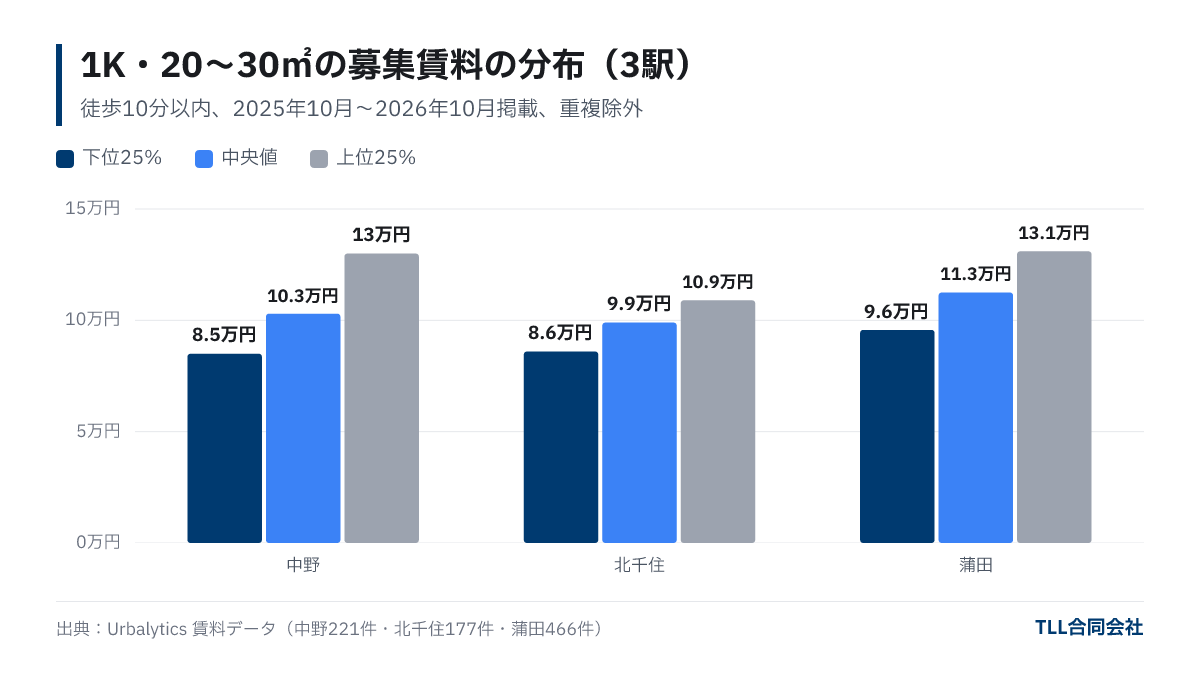
Since top 25% includes newer properties, renovating an older unit does not guarantee reaching that level. As a guideline, if current rent is near the bottom 25%, aiming for the median by renovation is realistic. At Nakano, that gap is 18,000 yen; at Kitasenju, 13,000 yen.
Payback Period Estimates: Comparison for Nakano 1K
Assuming a 1K 25㎡ unit at Nakano with current rent at the 25th percentile (85,000 yen), a 3-month vacancy each time with average 4-year turnover, the following calculations are made. Post-construction rent and vacancy periods are hypothetical and do not guarantee contract outcomes.
| Construction Stage | Assumed Construction Cost | Assumed Post-Renovation Rent | Assumed Vacancy Period | Monthly Effect | Simple Payback Period |
|---|---|---|---|---|---|
| ① Surface Refresh | 280,000 yen | 88,000 yen (+3,000 yen) | 3 months → 1.5 months | about 5,800 yen | about 4.1 years |
| ② Up to Equipment Update | 590,000 yen | 93,000 yen (+8,000 yen) | 3 months → 1 month | about 11,900 yen | about 4.1 years |
| ③ Up to Plumbing Replacement | 1,720,000 yen | 103,000 yen (+18,000 yen) | 3 months → 1 month | about 22,300 yen | about 6.4 years |
| ④ Layout Change | 2,500,000 yen | 110,000 yen (+25,000 yen) | 3 months → 1 month | about 29,600 yen | about 7.0 years |
Source: Construction costs estimated from TLL received standard unit prices; rents referenced from Urbalytics rent data (Nakano 221 listings, Oct 2025 – Oct 2026). Monthly effect = rent increase + (vacancy reduction months × post-renovation rent ÷ 48 months). Taxes, loan interest, and vacancy during construction are not included. Compilation date: October 2, 2026.
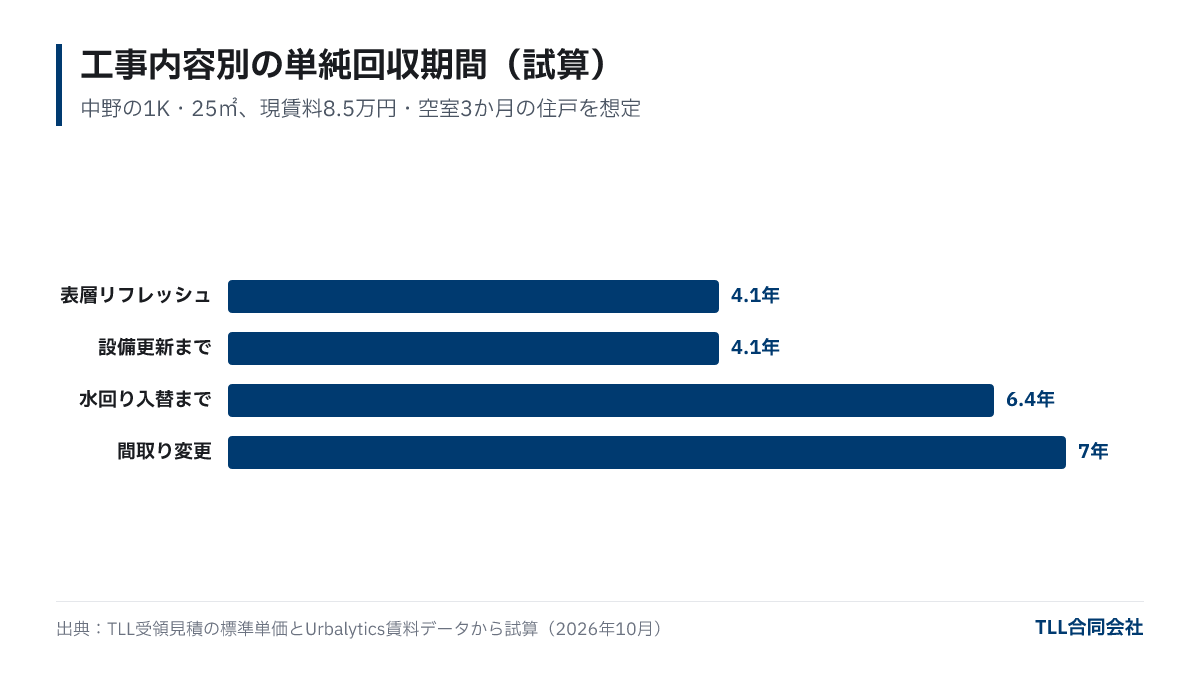
This estimate shows that unless rent increase is proportional to construction scale, payback periods become longer. To recover costs in 5 years (60 months), effects required are about 4,700 yen for ①, 9,800 yen for ②, 28,700 yen for ③, and 41,700 yen for ④. At stations like Kitasenju where rent distribution spread is about 23,000 yen, recovering costs of ③ or ④ solely by rent increase is difficult, making limiting renovations to surfaces or equipment reasonable.

Steps for Investment Decision on Renovation
Before deciding on construction, start by distinguishing whether vacancy is caused by "aging of the unit" or "rent and other terms." If the rent is above market, revising terms rather than renovating may lead to faster leases.
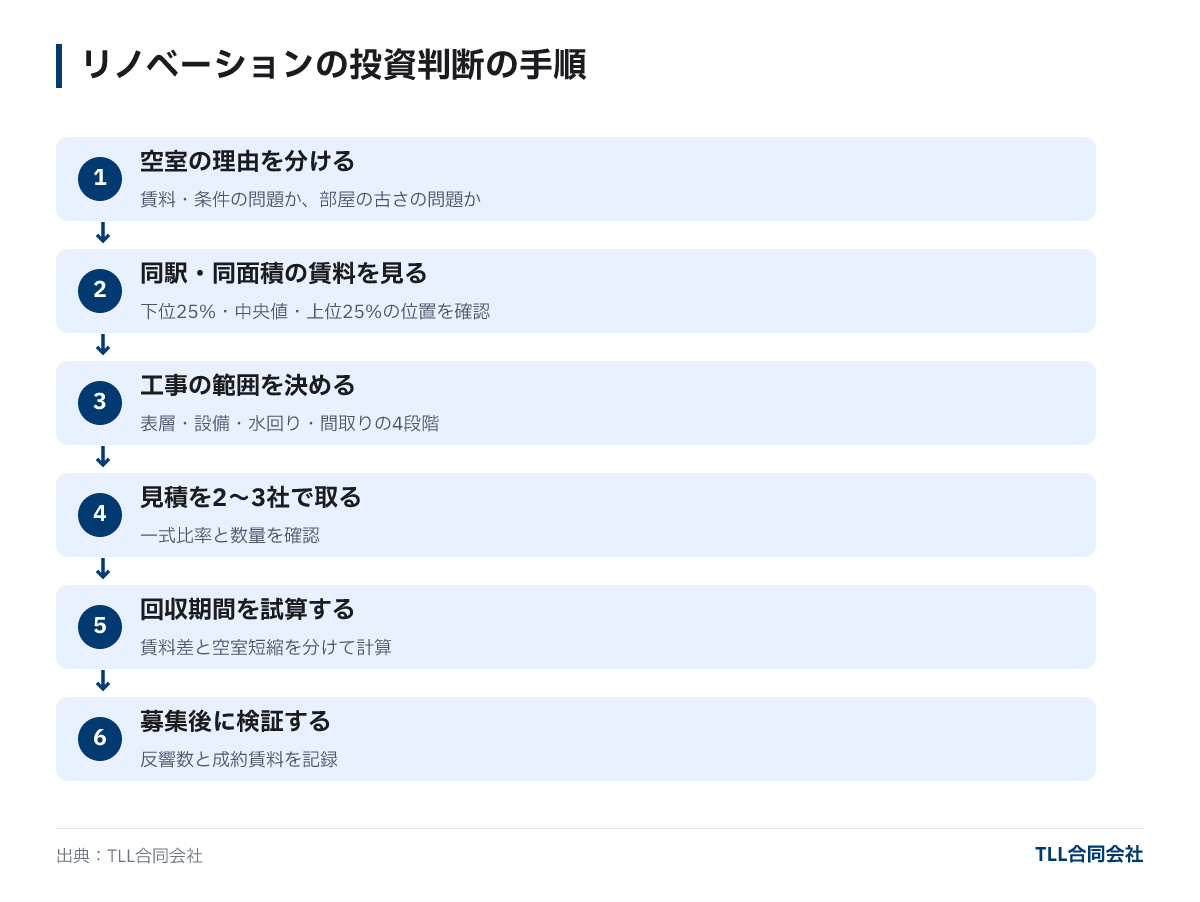
- Separate causes of vacancy: Few viewings? Check listing conditions and photos. Showing interest but no lease? Likely due to unit condition.
- Check rent at same station and size: Identify current rent position in distribution and decide target post-renovation level.
- Define construction scope: Decide how far to renovate from the four cost tiers based on desired payback.
- Obtain 2–3 estimates: Standardize specifications and quantities for comparison. The same work can differ significantly by contractor.
- Calculate payback period: Separate rent increase and vacancy reduction effects and use conservative assumptions.
- Verify after listing: Record inquiry numbers and contract rent to inform decisions for other units.
Also, for tax purposes, whether expenses count as deductible "repairs" in the current year or as capital expenditures subject to depreciation depends on construction details. Confirm with a tax accountant to better project net returns.
Frequently Asked Questions
Q. Will renovation raise rent even in old apartments?
Possibility depends on station-specific rent distribution. Older units rarely reach the top 25% level, so it’s realistic to aim from bottom 25% toward median with cost-effective renovations first.
Q. How many years payback period is acceptable for investing?
There’s no uniform criterion, but one guideline is recovering before the next major repair or planned sale. If selling within a few years is anticipated, limiting renovations to surface or equipment updates may be preferable.
Q. Can I renovate just one unit first to assess effectiveness?
Yes. Testing one unit for inquiry numbers and contract rents before wider implementation helps reduce financial risks.
Q. Can renovation costs be expensed?
It depends on the content and amount; some costs are repairs deductible in the year incurred, others capital expenditures amortized over years. Confirm with your tax accountant as it varies per project.
Summary
- Renovation payback assumes recovery through “rent difference” and “vacancy reduction,” dividing construction cost by the sum of their effects.
- For a 1K 25㎡ unit, rough cost guidelines are 250,000–350,000 yen for surface refresh and 1.5–2 million yen up to plumbing replacement (based on TLL received unit prices).
- Rent distribution ranges differ by station: 45,000 yen at Nakano, 23,000 yen at Kitasenju, and 35,000 yen at Kamata; narrower ranges make large renovations harder to recover.
- At Nakano, surface and equipment updates recover in about 4 years; plumbing changes or more take 6–7 years; larger construction stretches payback.
TLL’s management agency and asset management service provides a comprehensive solution from vacancy cause analysis, defining the scope of work and estimate review, to revising listing conditions.
About this article
- Author
- Kurihara(PM Business)Qualifications: Real Estate Transaction Specialist, FP Level 2, Chief Property Manager, Rental Real Estate Management Specialist
Handles owner relations, repairs and contract administration, drawing on practical experience in both rental and condominium management. He has more than ten years of property management experience, including work at Nippon Kanzai Housing Management. His background covers owner and tenant relations, lease administration, repair coordination, and condominium board and owners' meetings. His qualifications include Japan's Real Estate Transaction Specialist, Chief Property Manager and Rental Real Estate Management Specialist. He focuses on balancing day-to-day responses with preparations for long-term ownership. His articles explain management-company handovers, responsibility for restoration costs, major repairs and equipment replacement. He makes these practical issues easier to understand so owners can weigh cost, necessity and timing.
View profile → - Publisher
- TLL合同会社宅地建物取引業 東京都知事(1)第108202号住宅宿泊管理業 国土交通大臣(01)第F03424号
Data in this article cite their source and as-of date. Market conditions and regulations change, so check the latest information and consult a professional before deciding. Translated from the Japanese original.