When and How Much Does Apartment Exterior Wall Painting Cost? Types of Paint, Durability, Scaffold-Inclusive Cost Estimates, and Choosing Contractors
Kurihara (licensed real estate broker, 宅地建物取引士)PM Business
24 min read
The exterior walls of an apartment start showing fading and fine cracks after about 10 years. Since repainting requires scaffolding and can cost several million yen at once, many owners tend to postpone it without being able to judge “if it’s still okay,” “which paint to choose,” or “whether the estimate is reasonable.”
This article focuses on exterior wall painting for apartments, organizing the repainting timing, checklist of deterioration signs, durability and unit cost by paint type, scaffold-inclusive cost breakdown, and tips for comparing estimates and choosing contractors, based on the Ministry of Land, Infrastructure, Transport and Tourism's materials and TLL’s received construction estimate unit prices. For an overview of repair plans including rooftop waterproofing and plumbing, please see "When and How Much Does Large-Scale Apartment Repair Cost?"
Key Points of This Article
- The Ministry of Land, Infrastructure, Transport and Tourism's “Private Rental Housing Planned Repair Guidebook” sets the repair timing for rental housing exterior wall painting between the 11th and 18th year.
- Among 134 construction estimates received by TLL from 2021 to 2026, two coats of mid/top silicone paint cost 1,200–1,700 yen per ㎡, and wedge-type scaffolding cost 800–1,150 yen per ㎡ (both tax excluded).
- Using standard prices, the repainting, sealing, and metal part painting for a typical 3-story, approximately 10-unit apartment (scaffold 480㎡) cost about 2.18 million yen before tax, 2.4 million yen including tax, with scaffolding accounting for roughly 20%.
Timing Guidelines and Deterioration Signs for Exterior Wall Painting
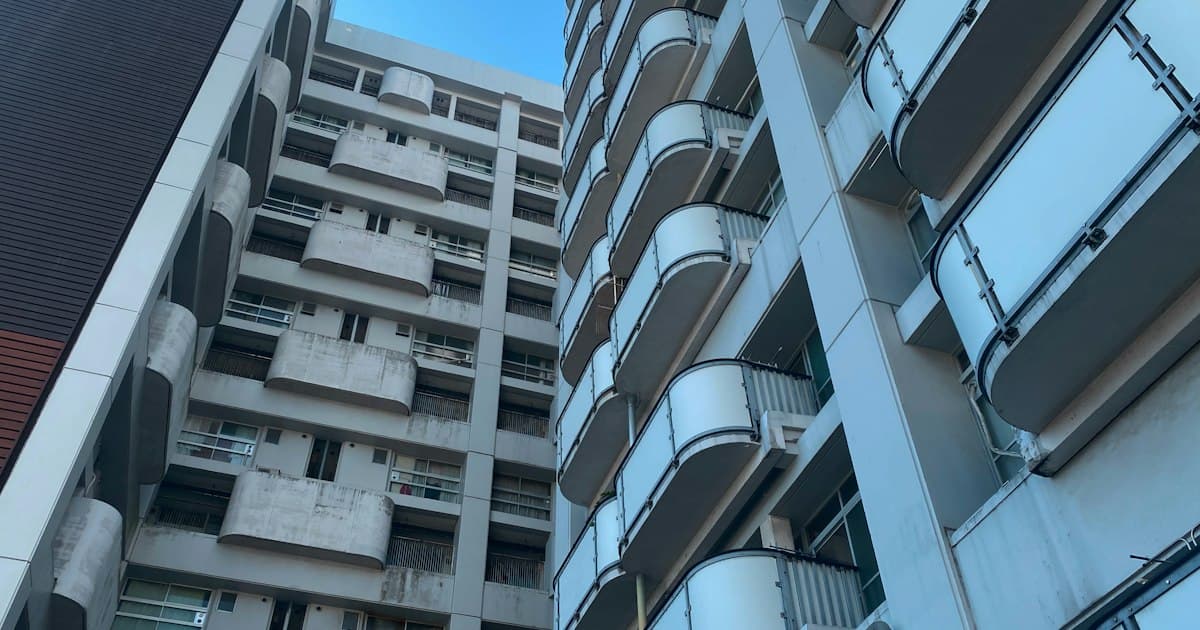
The timing guideline for apartment exterior painting is between the 11th and 18th year after construction. The Ministry of Land, Infrastructure, Transport and Tourism's “Private Rental Housing Planned Repair Guidebook” recommends this range, but actual timing varies based on paint type and location factors (sun exposure, sea breeze, proximity to main roads). Instead of deciding solely by years, it is easier to judge by checking deterioration signs about once a year as follows.
- Chalking: When you rub the exterior wall by hand, white powder appears. This is a sign that the resin in the paint film has decomposed due to ultraviolet rays and waterproof performance has begun to decline.
- Cracks: Fine hairline cracks or wider cracks with possible step differences. If cracks are wide or stepped, have a specialist inspect before rainwater enters.
- Paint film blistering or peeling: Separation from the underlying surface, often requiring more than just partial repair.
- Sealing deterioration: Rubber-like material around window frames or at wall joints showing cracks, shrinking, or gaps.
- Moss, mold, algae: Often found on north-facing surfaces or near plantings, indicating declining waterproof performance of the paint film.
- Rust on metal parts: Rust on external stairs, handrails, and metal doors progresses faster than on exterior walls and should be repainted concurrently for efficiency.
- Indoor water stains: If there are stains on ceilings or around windows, the cause should be investigated without waiting for the scheduled repainting time.

The same guidebook warns that neglecting deterioration without repairs risks a “negative spiral” where occupancy rates decline, rental income decreases, and repair funds fall short. Since the exterior appearance directly affects first impressions in property viewings, repainting is also part of vacancy countermeasures.
Types of Paint, Expected Durability, and Unit Prices
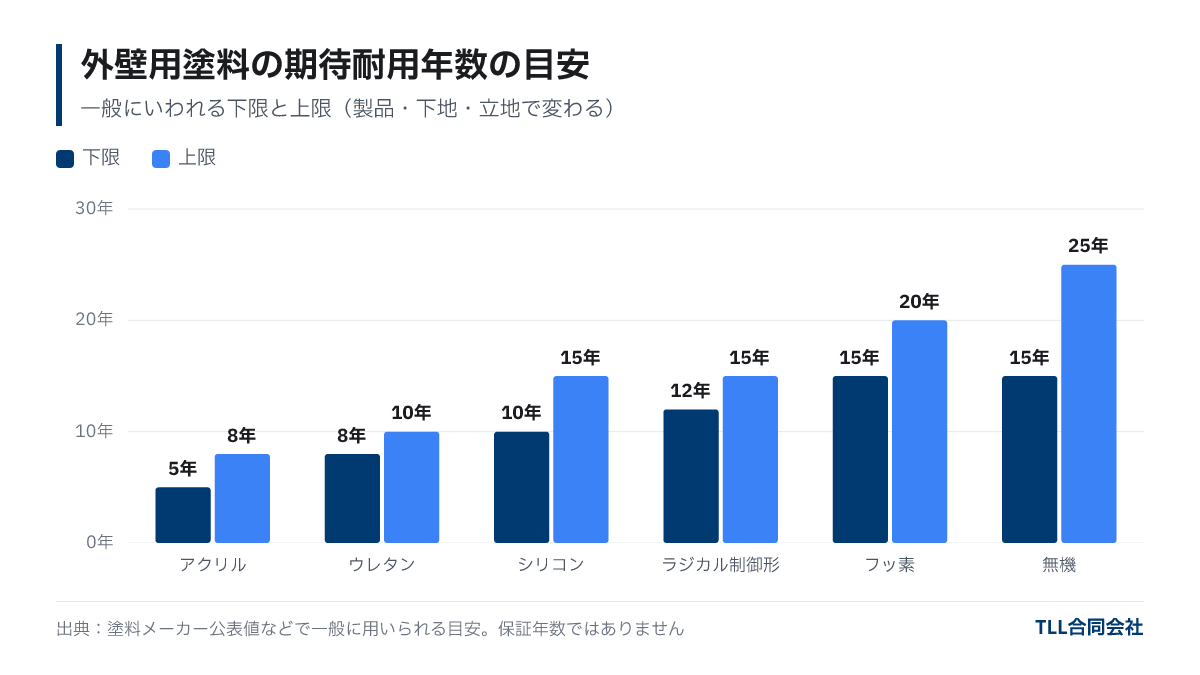
Exterior wall paints differ in durability and price depending on their main resin components. Generally, paints with longer expected lifespans cost more. For rental apartments, silicon-based paints are often chosen for their balance of price and durability. Most exterior paint estimates received by TLL used silicone-based paint.
| Type of Paint | Expected Durability (Years) | Unit Price in TLL Estimates (2 coats mid/top, tax excluded) | Features |
|---|---|---|---|
| Acrylic | 5–8 years | No record | Low cost but requires more frequent repainting |
| Urethane | 8–10 years | No record for exterior walls (Used on metal parts like gutters at 1,000–1,100 yen/m) | High adhesion, often used on attachments |
| Silicone | 10–15 years | 1,200–1,700 yen/㎡ (Nano-tech premium: 1,800–2,400 yen/㎡) | Good balance of price and durability |
| Radical-controlled Type | 12–15 years | 2,500 yen/㎡ (one case, 30㎡ partial repair, reference value) | Designed to suppress UV-induced deterioration |
| Fluorine | 15–20 years | No record | Highly weather resistant, reduces number of repaints |
| Inorganic | 15–25 years | No record | Considered highest durability with highest price |
Source: Expected durability is generally based on manufacturers’ published values and varies with product, substrate, location, and workmanship; it is not a warranty period. Unit prices are aggregated from 134 itemized estimates received by TLL in 2021–2026 (Tokyo 23 wards, Tama, southern Saitama). No unit prices shown for types with no record. Checked on October 2, 2026.
If you want to objectively compare paint weather resistance, check which grade the product conforms to in JIS K 5658 (Building Exterior Weather-Resistant Topcoat Paints). This standard classifies grades by accelerated weather resistance test hours: Grade 1 needs to meet specified gloss retention after 2,500 hours, Grade 2 after 1,200 hours, and Grade 3 after 600 hours. Confirming grades from product names in estimates via catalogues aids comparison.
Higher durability paints cost more upfront but extend repaint intervals, reducing recurring scaffolding costs. For short holding periods or planned sales within a few years, silicone paints are practical; for longer ownership, fluorine or higher grades are candidates to reduce repaint frequency and scaffolding expenses.

Exterior Wall Painting Costs: Breakdown by Scaffold, Substrate, Painting, and Sealing
The total painting cost comprises "scaffolding," "cleaning and substrate repair," "painting (primer, midcoat, topcoat)," "sealing," "attachments (metal parts, etc.)," and "miscellaneous expenses." TLL’s received estimate unit prices are as follows.
| Work Type | Unit | Price Range (tax excluded) | Typical Price |
|---|---|---|---|
| Scaffolding (wedge-type) | ㎡ | 800–1,150 yen | 900 yen |
| Anti-scatter mesh sheet | ㎡ | 100–250 yen | 150 yen |
| High-pressure exterior wall washing | ㎡ | 100–420 yen | 200 yen |
| Crack repair (U-cut + sealing) | m | 2,300 yen | 2,300 yen |
| Primer (microelastic filler/sealer) | ㎡ | 600–1,000 yen | 700 yen |
| Mid & topcoats 2 coats (silicone) | ㎡ | 1,200–1,700 yen | 1,500 yen |
| Sealing replacement (modified silicone) | m | 800–1,500 yen | 1,050 yen |
| Metal parts painting (handrails, gutters, etc.) | m | 1,000–1,100 yen | 1,100 yen |
| Metal door painting | location | 10,500–12,000 yen | 11,000 yen |
| Miscellaneous expenses (disposal, transport, protection, etc.) | Ratio of subtotal | 5–15% | 8–12% |
Source: Price range of estimates received by TLL from 2021 to 2026 (Tokyo 23 wards, Tama area, southern Saitama; 134 construction-related estimates, 3,050 line items). Range is between the 25th and 75th percentiles; typical is median. Crack repair data limited to one value. Data compiled on September 25, 2026.
Based on these unit prices, TLL calculated costs for a typical 3-story, 10-unit apartment. Assumptions: building perimeter 40m, eave height 9m; scaffold area estimated by industry formula "(perimeter + 8m) × (eave height + 1m)" gives 480㎡; painting area is 80% of that, 384㎡; sealing replacement 300m; metal parts 120m and 10 metal doors; miscellaneous expenses at 10% of subtotal.
| Item | Quantity | Amount (tax excluded) |
|---|---|---|
| Scaffolding and mesh sheets | 480㎡ | 504,000 yen |
| High-pressure washing | 384㎡ | 77,000 yen |
| Primer | 384㎡ | 269,000 yen |
| Mid & top coats 2 coats (silicone) | 384㎡ | 576,000 yen |
| Sealing replacement | 300m | 315,000 yen |
| Metal part & metal door painting | 120m & 10 locations | 242,000 yen |
| Miscellaneous expenses (10%) | — | 198,000 yen |
| Total | — | Approx. 2,180,000 yen (Approx. 2,400,000 yen including tax) |
Source: TLL’s calculation using the typical unit prices from the above table. Actual costs vary depending on building shape, extent of cracks, paint grade, and site conditions (ease of scaffolding assembly). Data compiled on October 2, 2026.
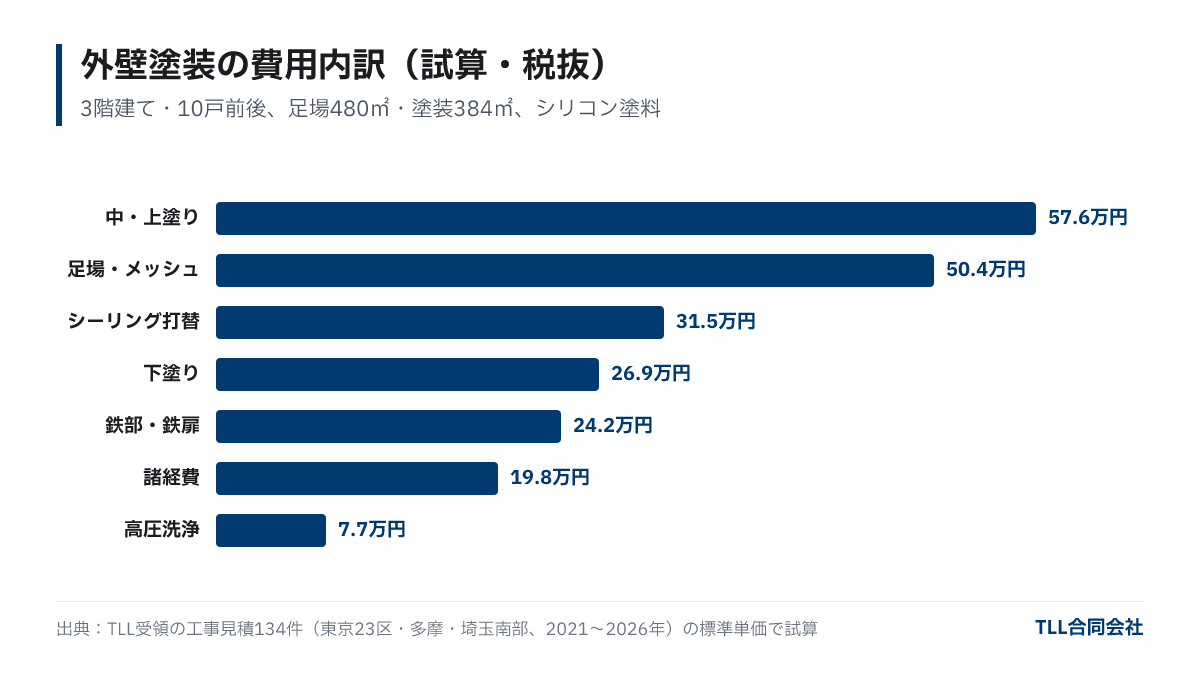
Scaffolding accounts for about 20% of the total cost and is required for each painting job. Performing rooftop waterproofing or metal repainting in different years doubles scaffolding costs, so it is standard to complete them together using the same scaffold. Adding urethane waterproofing to the rooftop, TLL’s estimate records for large-scale repairs of 3 to 5-story, 10-unit apartments range between 2.5 million and 5 million yen including tax. Upgrading paint grade increases cost by paint area multiplied by unit price difference — for example, a 1,000 yen/㎡ increase adds about 380,000 yen to this estimate.
How to Compare Estimates and Choose Contractors
When comparing exterior wall painting estimates, the basic approach is to separate "quantity" and "unit price" instead of comparing only total amounts. TLL encountered cases where scaffold area differed by about 1.8 times between contractors for the same building. Confirm the following when comparing:
- Basis for quantities: Ask for the basis of scaffold area if it exceeds the industry formula by 20% or more, or if painting area or sealing length are missing.
- Ratio of "lump sum" items: If lump sum items exceed half of the detailed costs, request a breakdown with quantities and unit prices for fair comparison.
- Paint product name and number of coatings: Check whether the estimate clearly states manufacturer and product names, and number of primer, midcoat, and topcoat applications, not just “silicone paint.”
- Scope omissions: Extremely low estimates may omit some surfaces, attachments, or sealing work. Verify the scope.
- Guarantee: Confirm if warranty certificates are issued, length and coverage (e.g., peeling or blistering), and availability of periodic inspections.
- Permits and insurance: Painting contracts over 5 million yen including tax require construction business permits (painting work). Confirm contractor’s enrollment in insurance covering damages during construction.
Requesting estimates from about three contractors with the same specifications and quantities allows direct unit price comparisons. The workflow from contractor selection to completion is as follows.
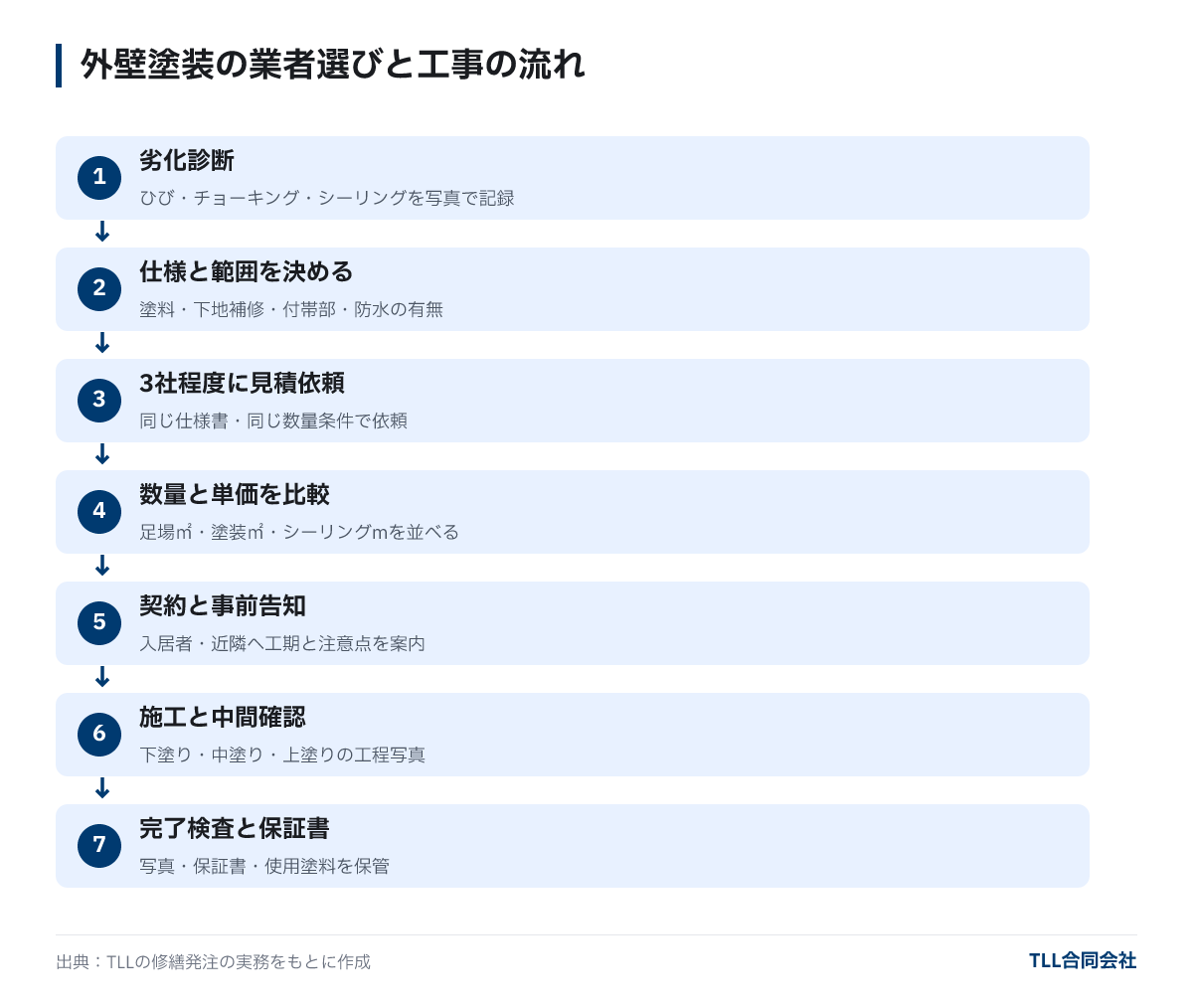
During construction, scaffolding and mesh sheets block sunlight and residents may be unable to hang laundry on balconies on painting days. Inform tenants early in writing about construction schedules, working hours, laundry and air conditioner outdoor unit precautions, and greet neighbors to help prevent complaints. After completion, keep photos of each process, warranties, and paint records for future repair plans and property sales explanations.
Tax-wise, repainting to maintain the building’s current condition is generally treated as a repair expense deductible in that year. However, work that increases property value or durability may qualify as capital expenditure subject to depreciation. The National Tax Agency’s Tax Answer "Judgment on What Is Not Considered Repair Expenses" (No.1379) summarizes criteria; ask a tax accountant in advance when costs are large for peace of mind.
FAQ
Q. When should apartment exterior wall painting generally be done?
The Ministry of Land, Infrastructure, Transport and Tourism's “Private Rental Housing Planned Repair Guidebook” advises 11 to 18 years. If you see chalking, cracks, or sealing deterioration regardless of years, please request inspection.
Q. How much does exterior wall painting cost for about a 10-unit apartment?
Using TLL’s estimate unit prices for a typical 3-story, 10-unit apartment (scaffold 480㎡), painting, sealing, and metal parts repaint cost about 2.4 million yen including tax. Large-scale repairs including rooftop waterproofing range from about 2.5 to 5 million yen including tax, per TLL records.
Q. How much is scaffolding cost?
Based on estimates received by TLL, wedge-type scaffolding cost 800 to 1,150 yen per ㎡, and anti-scatter mesh sheets cost 100 to 250 yen per ㎡ (tax excluded). For a 480㎡ scaffold, this amounts to about 500,000 yen, roughly 20% of the total cost.
Q. Which should I choose, silicone or fluorine paint?
Generally, silicone paint’s durability is 10 to 15 years, fluorine 15 to 20 years. For short ownership periods, silicone is suitable; for longer periods, fluorine or higher can reduce repaint frequency and scaffolding costs.
Summary
- Exterior painting timing guideline is 11 to 18 years after construction (per Ministry of Land, Infrastructure, Transport and Tourism). Check for chalking, cracks, sealing deterioration, and metal rust annually.
- Expected durability is generally 10–15 years for silicone, 15–20 years for fluorine, and 15–25 years for inorganic paint. TLL’s estimates show two coats of silicone at 1,200–1,700 yen per ㎡ (tax excluded).
- Estimated cost for a typical 3-story, 10-unit apartment is about 2.4 million yen including tax, with scaffolding about 20%. Combining rooftop waterproofing and metal repainting with the same scaffold is efficient.
- When comparing estimates, separate quantities and unit prices, check product names, coating counts, scopes, and warranty across about three companies.
At TLL, our management services can support building inspections, estimate comparisons, and tenant notifications during construction on behalf of owners. Please consult us even if it’s just to verify estimate reasonableness. See Asset Management & Operation Services for details.
Featured image (image): Photo: Paul Becker / Unsplash
About this article
- Author
- Kurihara(PM Business)Qualifications: Real Estate Transaction Specialist, FP Level 2, Chief Property Manager, Rental Real Estate Management Specialist
Handles owner relations, repairs and contract administration, drawing on practical experience in both rental and condominium management. He has more than ten years of property management experience, including work at Nippon Kanzai Housing Management. His background covers owner and tenant relations, lease administration, repair coordination, and condominium board and owners' meetings. His qualifications include Japan's Real Estate Transaction Specialist, Chief Property Manager and Rental Real Estate Management Specialist. He focuses on balancing day-to-day responses with preparations for long-term ownership. His articles explain management-company handovers, responsibility for restoration costs, major repairs and equipment replacement. He makes these practical issues easier to understand so owners can weigh cost, necessity and timing.
View profile → - Publisher
- TLL合同会社宅地建物取引業 東京都知事(1)第108202号住宅宿泊管理業 国土交通大臣(01)第F03424号
Data in this article cite their source and as-of date. Market conditions and regulations change, so check the latest information and consult a professional before deciding. Translated from the Japanese original.