Is It Possible to Get Full Loan or Over Loan for Real Estate Investment? Conditions and Risks Calculated
Emi Tokudomi (licensed real estate broker, 宅地建物取引士)Acquisition Staff
22 min read
Many prospective buyers ask, "Is it possible to purchase an entire building with almost no own funds?" A full loan, which covers the entire property price, or an over loan, which also includes ancillary expenses, can still be arranged if the right conditions are met. However, the higher the loan amount, the heavier the monthly repayments become, reducing the margin to withstand vacancies or rising interest rates.
This article illustrates when full loans and over loans can be arranged, shows how repayment ratios and net income change based on the proportion of own funds through calculations, summarizes trends by lender type, and discusses the impact of interest rate hikes.
Key points of this article
- For a building priced at 100 million yen with a 6% gross yield, purchasing with a 2.5% interest rate over 30 years results in a repayment ratio of 79.0% for a full loan and 55.3% with a 30% down payment (TLL calculation).
- Using the median gross yields of one-building properties listed for sale from October 2025 to October 2026 near six Tokyo-area stations (e.g., Akabane 4.80%, Kitasenju 5.18%), full loans exceed a 90% repayment ratio and yield negative net income after expenses (based on Urbalytics data analyzed by TLL).
- The Bank of Japan raised the policy interest rate to about 1.25% on September 18, 2026. For a 100 million yen loan over 30 years, a 1% rate increase raises annual repayments by about 650,000 yen.
What Are Full Loans and Over Loans? Are They Still Available?
In conclusion, full loans and over loans are considered only when "the borrower's asset background is strong and the property's collateral valuation exceeds its price." They are not methods accessible to everyone.
- Full Loan: Borrowing the entire property price while paying ancillary fees like brokerage commissions, registration fees, and taxes with own funds.
- Over Loan: Borrowing not only the property price but also the ancillary fees, resulting in almost zero own funds.
Ancillary fees are estimated at about 7% of the property price (breakdown calculated in "Ancillary Costs When Purchasing Income Properties"). For a 100 million yen property, this is roughly 7 million yen, which differentiates full loans from over loans by whether it is borrowed.
When lenders determine the loan amount, they consider the property’s appraisal value, income value, borrower's annual income, financial assets, and existing loans together. If the property’s valuation does not reach the price or the borrower’s available assets are insufficient, getting full financing is challenging. For basics on screening, see "The Basics of Real Estate Investment Loans."

How Do Repayment Ratio and Net Income Change by Own Fund Ratio?
Even for the same property, as the loan-to-price ratio increases, repayment ratio (annual repayment ÷ expected full occupancy rent) rises and net income decreases. The following assumptions were used to calculate:
- Property price 100 million yen, gross yield 6% (expected full occupancy rent 6 million yen/year). This approximates the median yields around Funabashi and Omiya, described later.
- Vacancy loss and operating expenses (management fees, repairs, fixed asset tax, insurance, etc.) are set at 20% of expected full occupancy rent, producing net operating income (NOI) before repayment of 4.8 million yen/year.
- Ancillary fees 7 million yen, loan period 30 years, equal principal and interest repayments. Taxes are not considered.
| Loan Type | Loan Amount | Own Funds | Annual Repayment (2.5%) | Repayment Ratio (2.5%) | Net Income (2.5%) | Repayment Ratio (3.5%) | Net Income (3.5%) |
|---|---|---|---|---|---|---|---|
| Over Loan | 107 million yen | 0 yen | Approx. 5.07 million yen | 84.6% | Approx. −270,000 yen | 96.1% | Approx. −970,000 yen |
| Full Loan | 100 million yen | 7 million yen | Approx. 4.74 million yen | 79.0% | Approx. 60,000 yen | 89.8% | Approx. −590,000 yen |
| Down Payment 10% | 90 million yen | 17 million yen | Approx. 4.27 million yen | 71.1% | Approx. 530,000 yen | 80.8% | Approx. −50,000 yen |
| Down Payment 20% | 80 million yen | 27 million yen | Approx. 3.79 million yen | 63.2% | Approx. 1.01 million yen | 71.8% | Approx. 490,000 yen |
| Down Payment 30% | 70 million yen | 37 million yen | Approx. 3.32 million yen | 55.3% | Approx. 1.48 million yen | 62.9% | Approx. 1.03 million yen |
Source: TLL calculation (assumptions as of October 2, 2026. Net income = NOI − annual repayment, before tax).
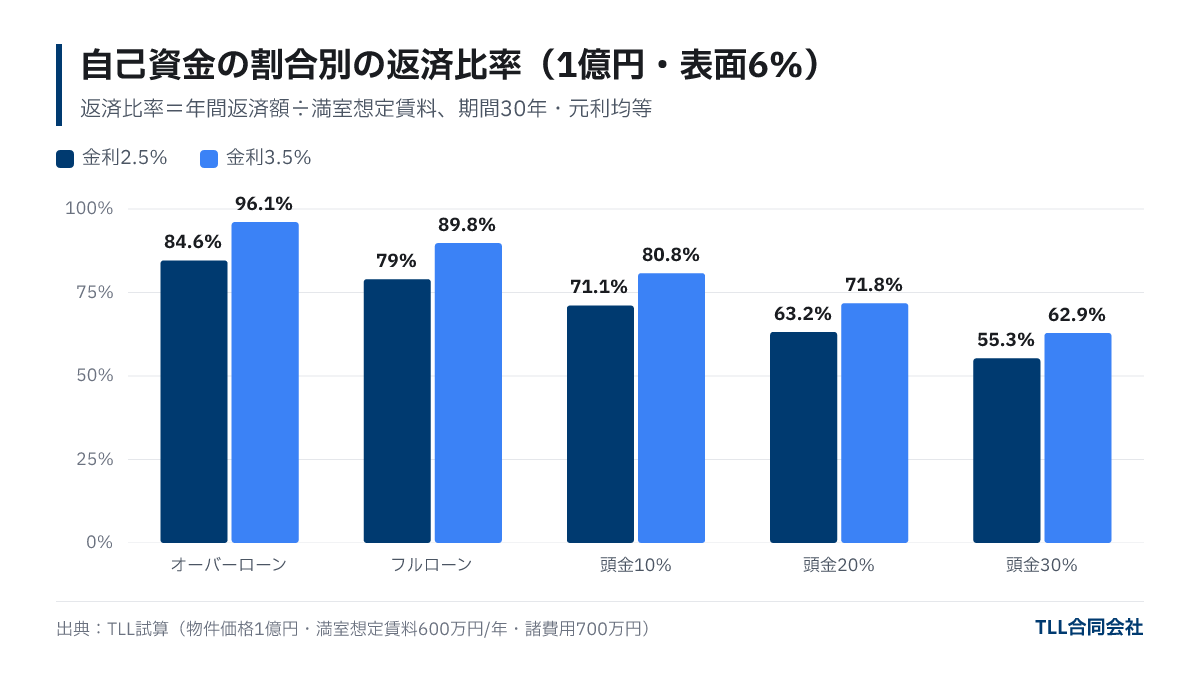
At a 2.5% interest rate with a full loan, net income is only around 60,000 yen per year. The break-even occupancy rate (occupancy rate to cover operating expenses and repayments) is about 94% for full loans and approximately 100% for over loans. Losing just one unit means a deficit. With a 30% down payment, the break-even occupancy rate falls to about 70%.
The loan term also matters. Even for the same full loan, if the term is 20 years, annual repayments rise to about 6.36 million yen, exceeding rent even at full occupancy. Older properties often have shorter loan terms, making full loans even less feasible.
Full Loan Using Median Yields in Tokyo Metropolitan Area
Looking at actual listed prices, it is currently difficult to achieve positive net income with full loans in central wards or stations close to Tokyo’s center. Using median gross yields for one-building properties for sale from October 2025 to October 2026 published by Urbalytics, we calculated repayment ratios assuming a loan equal to the property price.
| Station | Number of Listings | Median Gross Yield | Repayment Ratio (2.5%) | Repayment Ratio (3.5%) | Net Income / Property Price (2.5%) |
|---|---|---|---|---|---|
| Akabane (Kita-ku) | 34 cases | 4.80% | 98.8% | 112.3% | −0.90% |
| Kamata (Ota-ku) | 52 cases | 5.01% | 94.6% | 107.6% | −0.73% |
| Kitasenju (Adachi-ku) | 53 cases | 5.18% | 91.5% | 104.0% | −0.60% |
| Funabashi (Chiba Prefecture) | 44 cases | 6.00% | 79.0% | 89.8% | +0.06% |
| Omiya (Saitama Prefecture) | 44 cases | 6.20% | 76.5% | 86.9% | +0.22% |
| Hachioji (Tokyo) | 76 cases | 7.95% | 59.6% | 67.8% | +1.62% |
Source: Urbalytics one-building (BUILDING) listings data. Listings with price changes posted between October 2, 2025, and October 2, 2026 (excluding duplicates). Repayment ratios and net income calculated by TLL (30-year term, equal principal and interest, operating expenses and vacancy loss at 20% of expected full occupancy rent). Data compiled on October 2, 2026.
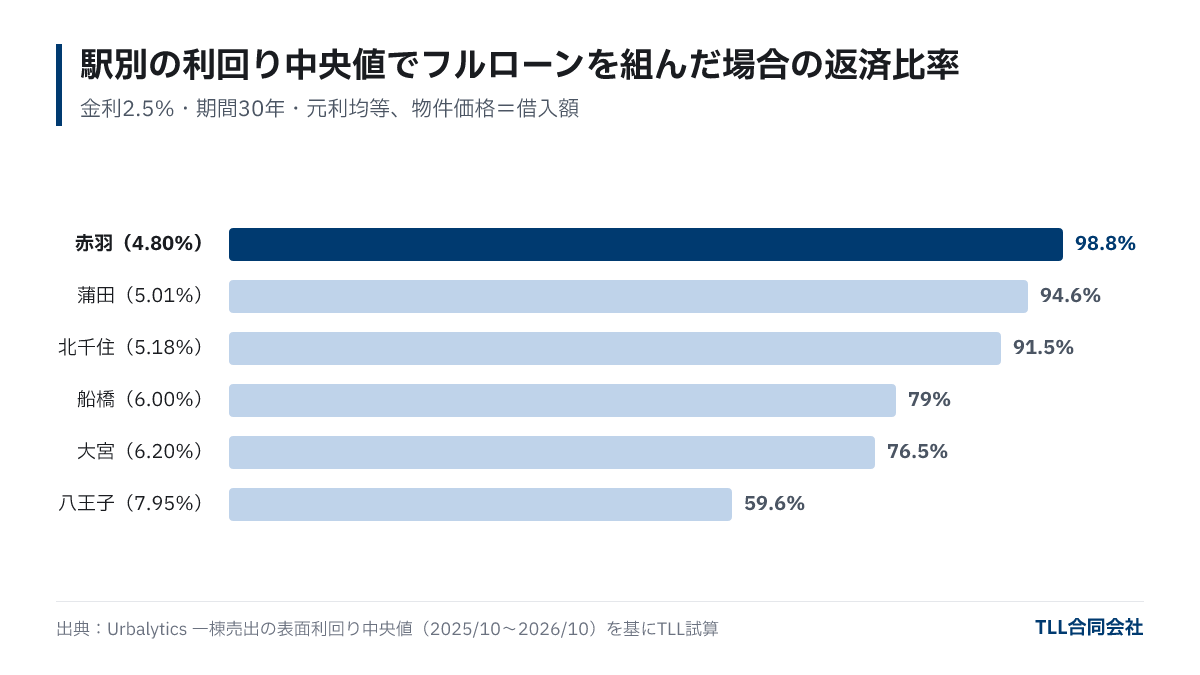
At stations with gross yields around 5%, even a 2.5% interest rate results in repayments exceeding 90% of rents. At stations with yields near 8%, full loans generally work numerically, but higher yields often reflect vacancy risks or aging properties baked into the price. It is important to also note that median gross yields include expected full occupancy rents as published by the sources.
Loan Trends by Type of Financial Institution
Loan ratios and interest rates vary by lender and timing. Here, we summarize general trends by lender type rather than individual institutions.
| Type | Loan Ratio Trend | Interest Rate Trend | Suitable for |
|---|---|---|---|
| Major Banks (City Banks/Megabanks) | Often require substantial own funds and financial assets | Relatively low | Borrowers with strong asset backgrounds, cases for inheritance or asset management purposes |
| Regional Banks / Trust Banks | May provide high loan ratios if borrower profile and collateral evaluation are good | Moderate | Borrowers living or working in lending areas, properties within those areas |
| Credit Unions / Credit Associations | Often require a certain amount of own funds; may be flexible on properties exceeding useful life | Moderate | Borrowers living near branches, regional properties |
| Non-bank Lenders | May offer higher loan ratios and accommodate older properties | Higher than banks, with additional fees often charged | Properties or profiles difficult to qualify at banks |
Even lenders offering full loans generally impose conditions such as minimum annual income, financial assets, property location, and limits on existing loans. High loan ratios paired with higher interest rates reduce net income. Always consider loan ratio and interest rate together.

Impact of Rising Interest Rates and Risks of Increasing Borrowing
The higher the loan amount, the greater the repayment increase when interest rates rise. After ending its negative interest rate policy in March 2024, the Bank of Japan raised its policy interest rate (unsecured call rate overnight target) to about 0.75% on December 19, 2025, about 1.0% on June 16, 2026, and about 1.25% on September 18, 2026 (Bank of Japan “Regarding Changes in Financial Market Operations” announcements). Variable interest rate investment loans generally reflect movements in short-term rates like these.
In the above calculation, annual repayments for a 30-year 100 million yen full loan are approximately 4.74 million yen at 2.5% and about 5.39 million yen at 3.5%. A 1% interest rate increase adds roughly 650,000 yen per year, changing net income from positive 60,000 yen to negative 590,000 yen. For a 30% down payment (loan 70 million yen), the increase is about 450,000 yen annually, with net income remaining around 1.03 million yen.
Beyond interest rates, high loan-to-price ratios involve the following risks:
- Difficulty selling when desired: Before repayments reduce principal, the remaining loan balance may exceed the sale price, requiring additional funds to sell and prolonging holding periods.
- Out-of-pocket expenses for vacancy and repairs: Thin net income means covering guest departures or equipment failures from salary or other personal funds.
- Harder to obtain subsequent loans: Large total borrowing relative to income or assets may disadvantage second or later property loan applications. Approaches to scaling your portfolio are explained in "How to Expand Scale in One-Building Investment."
What to Confirm Before Considering a Full Loan
- Can net income remain positive even with interest rates 1–2% higher (or at least within a coverable range from income)?
- The profitability if occupancy drops to 85–90%.
- Whether the loan term is reasonable considering the building’s structure and age.
- Whether you can maintain 6–12 months’ worth of rent as reserves after purchase.
- Difference between remaining debt and estimated sale price after 5 or 10 years.
Even slightly reducing the loan ratio significantly improves the break-even occupancy rate. Finding properties with balanced yields and prices connects to sustainable borrowing. The income properties handled by TLL are available at the members page (free registration).
Frequently Asked Questions
Q. What is the difference between full loans and over loans?
Full loans borrow all of the property price but pay ancillary costs with own funds. Over loans include borrowing ancillary costs as well. For a 100 million yen property, the difference is whether to borrow about 7 million yen in ancillary costs (around 7%).
Q. What annual income is needed to get a full loan?
There is no fixed threshold based only on income. Lenders assess annual income along with financial assets, existing loans, collateral evaluations, and profitability. Since criteria differ by lender, it is common to consult multiple institutions and compare.
Q. What repayment ratio is advisable?
There is no fixed answer, but lower ratios better withstand vacancies and interest rate hikes. Our calculations show that around an 80% repayment ratio, the break-even occupancy exceeds 90%, meaning 1–2 vacancies eliminate net income.
Q. Should I avoid full loans now with rising interest rates?
It cannot be said universally, but the larger the loan, the bigger the impact of rate increases. Before purchasing, we recommend calculating your cash flow with a 1–2% rate increase to check if you can cover the difference before deciding.
Summary
- Full loans and over loans are only considered when the borrower has strong assets and the property’s collateral valuation is high.
- In a scenario with 100 million yen property price, 6% gross yield, 2.5% interest, 30 years, repayment ratios are 79.0% for full loan and 55.3% for 30% down payment. Break-even occupancy rates approximately 94% and 70%, respectively.
- Using median gross yields around 5% at some stations, full loans exceed 90% repayment ratio and show negative net income (based on sales data from October 2025 to October 2026).
- Policy interest rate was raised to about 1.25% on September 18, 2026. For a 100 million yen loan, a 1% increase raises annual repayments by about 650,000 yen—checking cash flow under potential rate hikes is important.
Featured image (illustration): Photo: alina ozerova / Unsplash
About this article
- Author
- Emi Tokudomi(Acquisition Staff)Qualifications: Real Estate Transaction Agent
After working in real estate sales support, rental property management, and brokerage, now engages in acquisition operations. Holds a Real Estate Transaction Agent license and bookkeeping qualifications, and supports property value with extensive hands-on experience and specialized expertise.
View profile → - Publisher
- TLL合同会社宅地建物取引業 東京都知事(1)第108202号住宅宿泊管理業 国土交通大臣(01)第F03424号
Data in this article cite their source and as-of date. Market conditions and regulations change, so check the latest information and consult a professional before deciding. Translated from the Japanese original.