When a Tenant Passes Away in a Rental Property: Disclosure Obligations, Initial Steps for Owners, and Impact on Rent and Sale
Kurihara (licensed real estate broker, 宅地建物取引士)PM Business
20 min read
Tenants passing away inside rental properties is something all owners may face, especially with the rise in single-member and elderly households. Even amid the shock from sudden news, owners must handle interactions with the police and bereaved families, sort out contracts and remaining belongings, and prepare explanations for the next tenant—requiring several judgment calls.
This article focuses on the content of the Ministry of Land, Infrastructure, Transport and Tourism’s (MLIT) “Guidelines on Disclosure of Person’s Death by Real Estate Agents” established in October 2021. It organizes the scope and duration considered necessary for disclosure, the owner’s initial response flow, points to confirm regarding special cleaning, remaining belongings, and insurance, and the impact on rent and sale. All explanations are based on consideration for the deceased and their family, detailing practical procedures.
Key Points of This Article
- MLIT Guidelines (October 2021) state that natural deaths such as senility or illness, and accidental deaths in daily life such as falls or choking, generally do not require disclosure. However, cases where the body was undiscovered for a long time and special cleaning was performed are treated differently.
- In rental cases, deaths other than natural deaths and those involving special cleaning generally do not require disclosure after about three years from occurrence (or discovery). There is no such time guideline for sales.
- For a 1K unit (20–30㎡) near Nakano station with a median rent of 103,000 yen, lowering rent by 20% for 3 years results in an estimated revenue loss of about 740,000 yen (Urbalytics rent data, October 2026).
Concept of Disclosure Obligation: Scope of MLIT Guidelines
The guidelines indicate currently reasonable, general standards for real estate agents on how much to disclose to parties involved regarding any previous death in the property. The target scope is residential-use real estate. Although owners themselves are not directly subject, management and brokerage companies base their disclosure documents on these standards, so owners should understand them.
| Case | Rental | Sale |
|---|---|---|
| Natural death (senility, illness, etc.), accidental death in daily life (falls, bath accidents, choking, etc.) | Generally no disclosure required | Generally no disclosure required |
| Above deaths where body undiscovered for a long time and special cleaning or large-scale renovations were done | Generally no disclosure required after about 3 years from discovery | No time guideline (disclose if it significantly affects buyer’s decision) |
| Other deaths (suicide, homicide, accident, etc.) | Generally no disclosure required after about 3 years from occurrence | No time guideline (disclose if it significantly affects buyer’s decision) |
| Deaths occurring in adjacent units or common areas not regularly used in daily life | Generally no disclosure required | Generally no disclosure required |
Source: Created by TLL based on Ministry of Land, Infrastructure, Transport and Tourism “Guidelines on Disclosure of Person’s Death by Real Estate Agents” (October 2021). Excludes cases with particularly high criminality, public awareness, or societal impact.
Two additional points to hold in mind: First, for any case, if tenants or buyers ask about the incident or if there are special circumstances warranting social attention, it is required to disclose regardless of time elapsed or cause of death. Second, if the death occurs in parts commonly used daily such as balconies, shared entrances, elevators, corridors, or stairs, the treatment equals that for the unit itself.
When disclosing, information shared includes timing (or discovery), location, cause of death, and special cleaning performed, but personal details like name, age, or exact discovery situation need not be shared. Consideration for the honor and peaceful life of the deceased and family is required.
Owner’s Initial Steps When Tenant Passes Away
The first step is for the owner or the management company not to enter the room alone but to contact the police and emergency contacts. Then contract matters and indoor belongings should be arranged sequentially with the heirs.
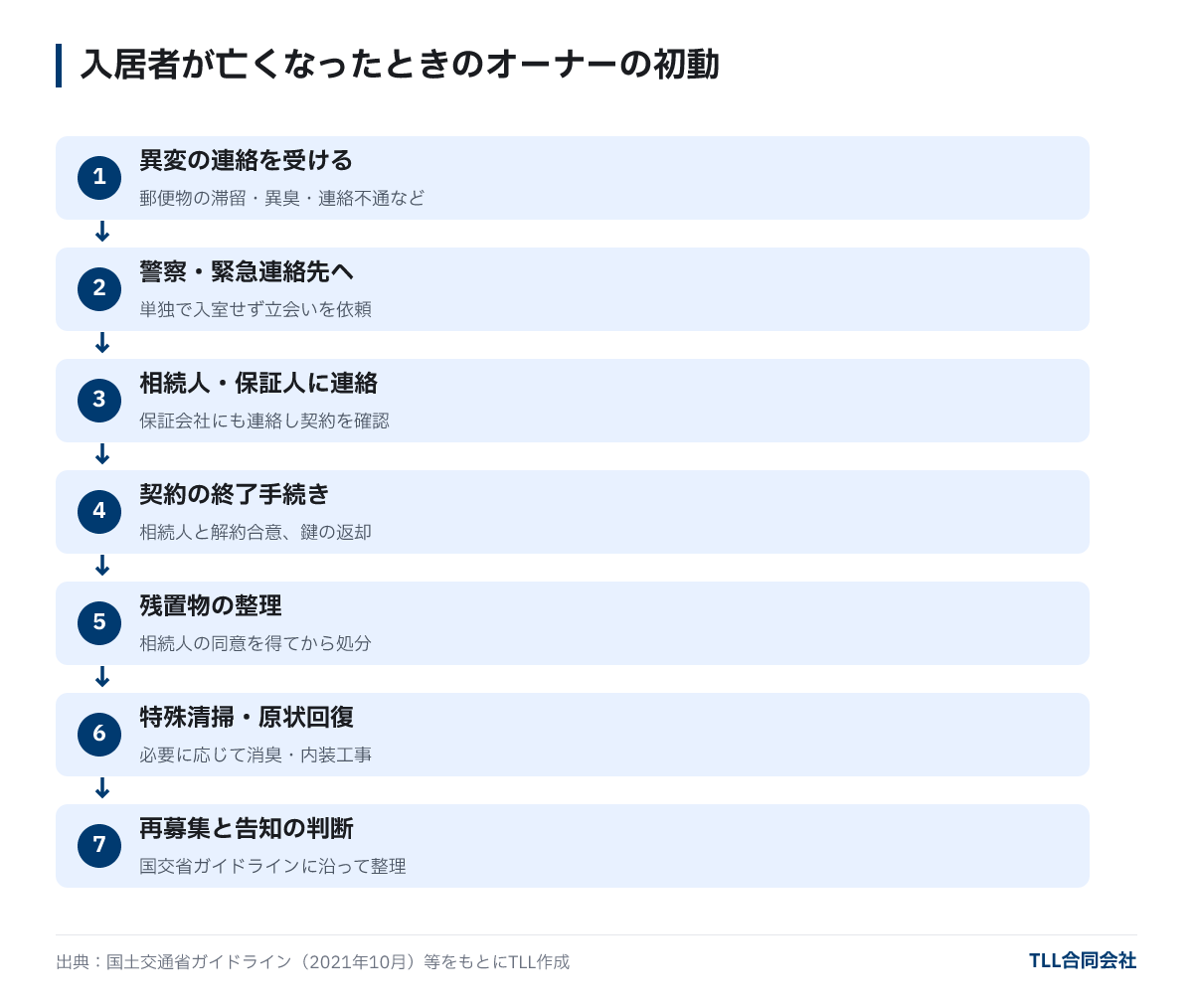
- Receiving notice of abnormality: Reports of accumulated mail, inability to reach the tenant, or odors from neighbors or guarantor companies can be triggers.
- Contacting police/emergency contacts: Entry to confirm safety must be done under police or emergency personnel supervision.
- Contacting heirs/guarantors: Contact the joint guarantor and rent guarantee company and confirm contract details and guarantee scope.
- Contract termination procedures: Since leasehold rights are inheritable, contract termination proceeds by agreement with heirs.
- Sorting remaining belongings: Indoor belongings are the heirs’ property; disposing of them solely by owner’s decision may cause disputes later.
- Special cleaning/restoration: Perform deodorizing, disinfection, and interior work as needed.
- Re-leasing and disclosure judgment: Following the guidelines, decide on necessity and content of disclosure in consultation with management and brokerage companies.

Points to Confirm Regarding Special Cleaning, Remaining Belongings, and Restoration
If there is a long delay before discovery, ordinary housekeeping cleaning may be insufficient, requiring specialized cleaning and deodorizing by professionals. Since costs vary greatly based on the degree and scope of contamination, it is advisable to obtain detailed estimates from multiple companies and compare.
Interior work performed after special cleaning typically follows the usual restoration unit prices. According to TLL’s received construction quotes, standard prices (before tax) include replacing mass-produced wallpaper at about 950 yen per ㎡, cushion flooring about 2,800 yen, floor tile overlay about 4,800 yen, and full replacement of unit baths around 635,000 yen. The total restoration cost for 1R/1K units generally falls between 150,000 to 300,000 yen including tax (based on 2021–2026 quotes). If work extends to floor base or piping replacement, costs can rise significantly.
Regarding remaining belongings, MLIT and Ministry of Justice published “Model Contract Clauses on Processing of Remaining Belongings” in June 2021. This preemptively allows entrusting contract cancellation and furniture disposal to a representative after death, primarily for elderly single tenants (generally over 60 years old). It is worth considering including such clauses in future tenant agreements.
Insurance Considerations
Insurance and riders are available for owners to cover restoration costs following a tenant’s death inside, as well as losses from vacancy or rent reductions. Coverage details (including natural deaths) and limits differ by product, so confirm specifics in your current fire insurance riders and insurers’ policy documentation. Also verify if rent guarantee companies’ coverage includes such restoration costs for peace of mind.

Impact on Rent: Estimating Revenue Loss During Disclosure Period
Properties requiring disclosure may be leased at a reduced rent. How much to lower rent varies greatly depending on case details, location, unit condition, and timing, so there is no fixed market standard. Here, we estimate revenue loss assuming the rental disclosure period guideline of roughly 3 years with various rent reduction scenarios.
| Assumed Reduction | Monthly Rent | Monthly Revenue Loss | 3-Year (36 months) Revenue Loss |
|---|---|---|---|
| 10% | 92,700 yen | 10,300 yen | Approx. 371,000 yen |
| 20% | 82,400 yen | 20,600 yen | Approx. 742,000 yen |
| 30% | 72,100 yen | 30,900 yen | Approx. 1,112,000 yen |
Source: TLL calculations based on Urbalytics rent data (within 10 minutes walk of Nakano station, 20–30㎡, posted Oct 2, 2025 to Oct 2, 2026, 221 unique listings, median 103,000 yen). Reduction assumptions are hypothetical and do not represent actual levels. Vacancy extension periods not included. Data aggregated October 2, 2026.
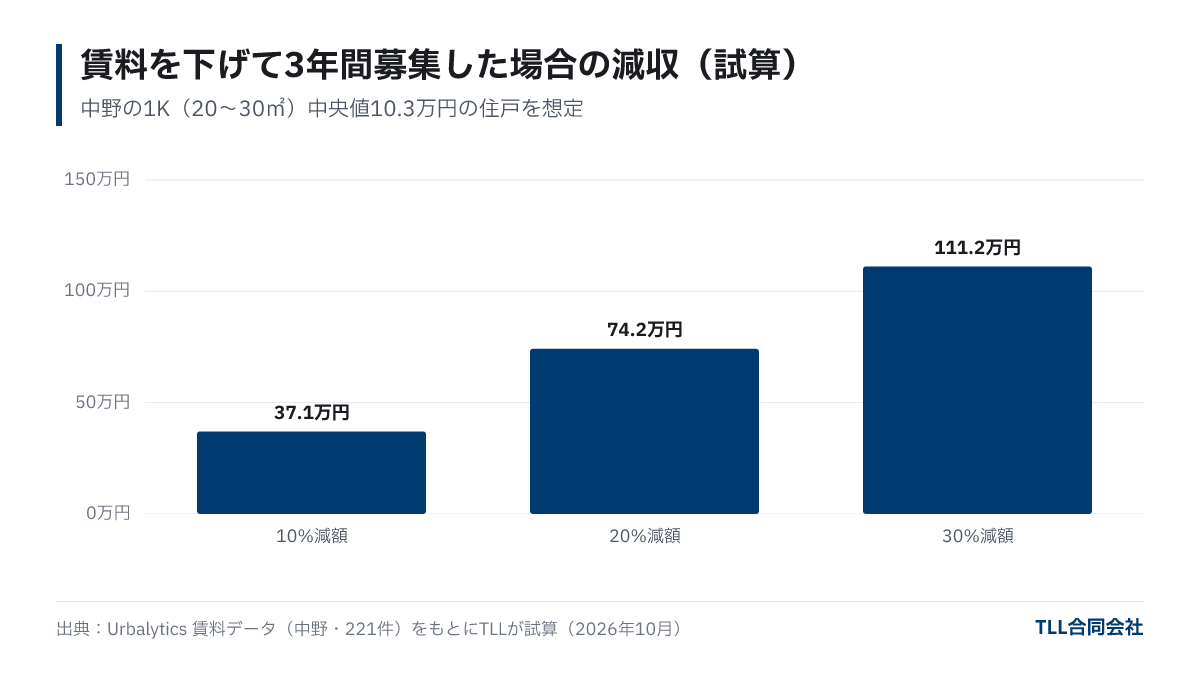
In reality, vacancy periods may also lengthen alongside rent reduction. On the other hand, completely renovating interiors and carefully explaining disclosures factually can sometimes secure tenants close to normal terms. Before lowering rent, ensure the property condition is good and consult with management companies on how to write disclosures.
Impact on Sale and Considerations
Unlike rental, sales have no approximate time guideline like “about 3 years.” For deaths other than natural or daily-life accidental ones, or when special cleaning was performed, disclosure to buyers is required regardless of elapsed time if it significantly affects buyer decisions. Failing to disclose truthfully can lead to disputes over contract nonconformity later, so sellers should accurately list known facts in disclosure documents.
Price impacts vary by property and case, but options include not only ordinary buyers but also specialized buyers experienced with properties having circumstances. Considerations for selling disclosed or older properties are also explained in our Article on Selling Properties with Rebuild Restrictions, Leasehold Rights, and Older Apartments.
Frequently Asked Questions
Q. If a tenant dies of illness and is discovered immediately, is disclosure required?
The guidelines generally state that natural deaths such as from senility or illness do not require disclosure in rental or sales. However, if asked by the tenant or buyer, the fact must be disclosed.
Q. How long is disclosure required for rentals?
Deaths other than natural deaths, or those involving special cleaning, generally require no disclosure once about 3 years have passed from occurrence (or discovery). Exceptions are cases with high criminality or social impact.
Q. Can the owner dispose of remaining furniture and belongings?
Belongings inside the unit belong to the heirs and should be disposed of only with their consent. Future contracts could adopt MLIT and Ministry of Justice model clauses allowing delegates to handle contract cancellation and belongings disposal after death.
Q. How much is rent typically lowered for the next tenant?
There is no fixed market standard; it depends on case details, location, and unit condition. For a Nakano 1K unit with a median rent of 103,000 yen, a 20% reduction for 3 years results in an estimated revenue loss of about 740,000 yen.
Summary
- MLIT Guidelines (October 2021) consider natural deaths and accidental deaths in daily life generally do not require disclosure, with special cleaning cases treated separately.
- For rentals, disclosure for deaths other than natural and those involving special cleaning is generally unnecessary after about 3 years, but disclosure is required if asked or if social impact is large.
- Initial steps include contacting police/emergency services without entering alone, and arranging contracts and belongings with heirs.
- In Nakano, lowering rent 20% for 3 years on a 1K median rent 103,000 yen unit results in an estimated revenue loss of about 740,000 yen.
TLL’s Management and Asset Management Services offer consultation from contacting related parties upon tenant death, arranging restoration, to setting terms for re-leasing.
Featured image (Image): Photo: Hans Eiskonen / Unsplash
About this article
- Author
- Kurihara(PM Business)Qualifications: Real Estate Transaction Specialist, FP Level 2, Chief Property Manager, Rental Real Estate Management Specialist
Handles owner relations, repairs and contract administration, drawing on practical experience in both rental and condominium management. He has more than ten years of property management experience, including work at Nippon Kanzai Housing Management. His background covers owner and tenant relations, lease administration, repair coordination, and condominium board and owners' meetings. His qualifications include Japan's Real Estate Transaction Specialist, Chief Property Manager and Rental Real Estate Management Specialist. He focuses on balancing day-to-day responses with preparations for long-term ownership. His articles explain management-company handovers, responsibility for restoration costs, major repairs and equipment replacement. He makes these practical issues easier to understand so owners can weigh cost, necessity and timing.
View profile → - Publisher
- TLL合同会社宅地建物取引業 東京都知事(1)第108202号住宅宿泊管理業 国土交通大臣(01)第F03424号
Data in this article cite their source and as-of date. Market conditions and regulations change, so check the latest information and consult a professional before deciding. Translated from the Japanese original.