
How to Choose a Property Management Company - Fee Benchmarks, Scope of Services, and Key Contract Clauses
Xiao Li (licensed real estate broker, 宅地建物取引士)Asset Management
24 min read
When you start looking for a company to manage your apartment, estimates come in many forms such as "3% of rent," "5%," or "flat fee," making it difficult to know what to compare. Even if the rate is low, additional charges for cleaning or repair arrangements can cause your monthly payments to actually increase.
This article is organized for owners choosing a management company, covering what to check under the Act on Advancement of Proper Management of Rental Housing (賃貸住宅管理業法, Chintai Jūtaku Kanri Gyōhō), typical management fee rates, how to compare scopes of work, contract clauses to watch, and key questions to ask in interviews. If you are considering self-management versus outsourcing, see "Self-management or Management Company: Which Is Better?" and if you want to switch from your current company, refer to "How and When to Change Property Management Companies."
Key Points of This Article
- Property management businesses managing 200 units or more must be registered with the Minister of Land, Infrastructure, Transport and Tourism, and must provide a written explanation of fees and service details before contract signing (Act on Advancement of Proper Management of Rental Housing, fully enforced June 15, 2021).
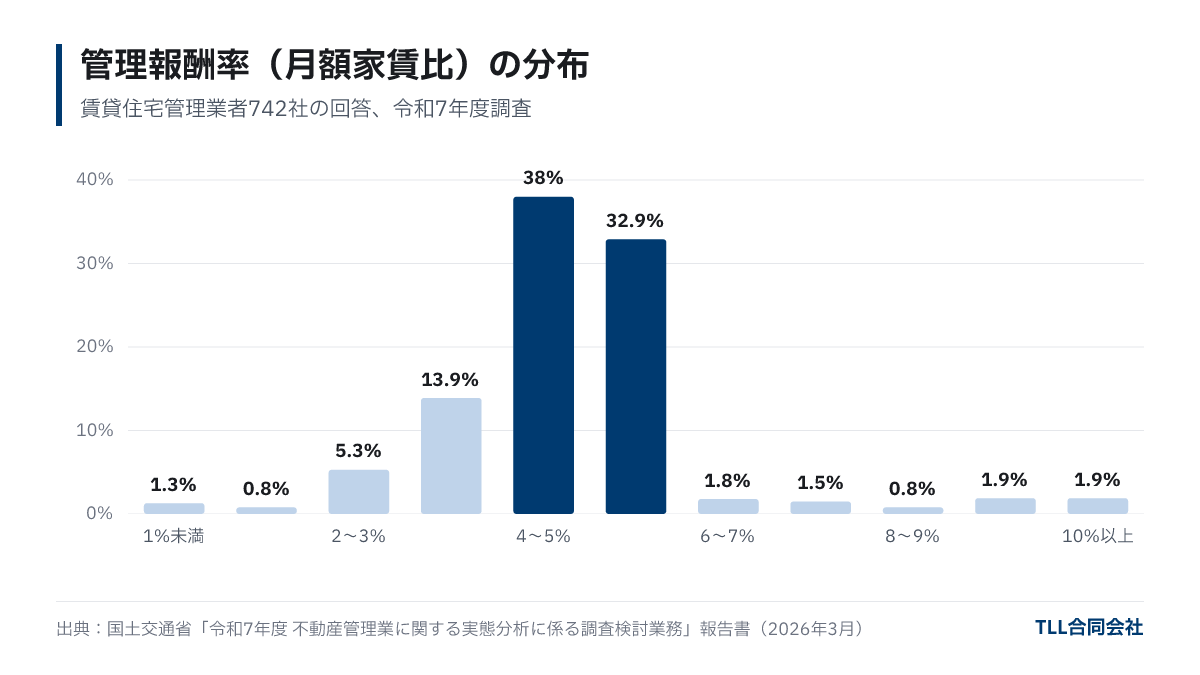
- The Ministry of Land, Infrastructure, Transport and Tourism’s FY2025 survey (published March 2026, 742 respondents) shows management fee rates are concentrated around 4–6% of rent, with 38.0% charging "4% to less than 5%" and 32.9% "5% to less than 6%." About 70% fall within this range overall.
- For a 10-unit 1K apartment, the annual management fee difference between a 3% and 5% rate is about 220,000 to 280,000 yen, based on median 1K rent at five Tokyo stations (Urbalytics data, Oct 2025–Oct 2026).
First Things to Check: Registration and Important Matters Explanation
When choosing a management company, first confirm whether they are registered under the Act on Advancement of Proper Management of Rental Housing. Under this law, businesses managing 200 or more units must register with the Minister of Land, Infrastructure, Transport and Tourism to operate. Businesses managing fewer than 200 units may register voluntarily, and the same obligations apply to registered entities.
Main obligations imposed on registered businesses include:
- Appointment of Operational Managers: Each sales or office location must have at least one operational manager with knowledge and experience.
- Important Matters Explanation: Before concluding a management contract, they must provide a written explanation of management fees, service contents, and implementation methods.
- Issuance of Written Documents at Contract Signing: After contract conclusion, promptly deliver a document containing required information.
- Segregated Management: Rent and deposits received from tenants must be kept separate from the company’s own funds.
- Regular Reporting to Owners: Provide periodic reports on management operations (the Ministry recommends at least once a year).
- Prohibition of Subcontracting Entire Operations: The management company must not outsource all management duties entirely to another business.

You can verify registration presence and registration number through the Ministry's "Construction Business/Real Estate Business Information Search System." The Important Matters Explanation document is separate from the contract itself and should be received before contract signing. If only the contract is sent without the explanation, you should ask for confirmation immediately. Note that "sublease (specified lease)" where the management company rents and re-leases the building under the same law is subject to different regulations (e.g., restrictions on misleading advertisement and pre-contract explanations) and has a different contract form than management outsourcing.
Common Management Fee Rates: Mostly 4–6% of Rent
The main approach to management fees is applying a percentage to monthly rent, typically between 4% and 6%. According to a March 2026 survey by the Ministry, 78.2% of respondents used the "proportional to monthly rent" method, and 13.3% used flat fee per unit or building (886 valid responses). The distribution of fee rates is as follows.
| Management Fee Rate (Percentage of Monthly Rent) | Response Percentage |
|---|---|
| Less than 3% | 7.4% |
| 3% to less than 4% | 13.9% |
| 4% to less than 5% | 38.0% |
| 5% to less than 6% | 32.9% |
| 6% to less than 10% | 6.0% |
| 10% or more | 1.9% |
Source: Ministry of Land, Infrastructure, Transport and Tourism, "FY2025 Survey on the Actual Condition Analysis of Real Estate Management Industry," March 2026 report. Online survey targeted members of the Japan Property Management Association, the National Association of Rental Property Managers, and the All Japan Real Estate Association, with 742 responses to the fee rate question. Categories "less than 3%" and "6–10%" are combined for reporting purposes. Confirmed on October 2, 2026.
Converting fee rate differences into amounts clarifies their significance. Using median 1K (20–30㎡) rent at five Tokyo stations, the annual management fee was estimated for a fully occupied 10-unit apartment.
| Station | Sample Count | Median 1K Rent | Annual Fee (3% rate) | Annual Fee (5% rate) | Difference |
|---|---|---|---|---|---|
| Ikebukuro | 481 listings | 100,000 yen | 360,000 yen | 600,000 yen | 240,000 yen |
| Kamata | 520 listings | 110,000 yen | 396,000 yen | 660,000 yen | 264,000 yen |
| Kita-Senju | 271 listings | 99,000 yen | 356,000 yen | 594,000 yen | 238,000 yen |
| Akabane | 186 listings | 91,500 yen | 329,000 yen | 549,000 yen | 220,000 yen |
| Kinshicho | 450 listings | 115,000 yen | 414,000 yen | 690,000 yen | 276,000 yen |
Source: Urbalytics rental listing data. For units 20–30㎡ near each Tokyo station, listings posted between October 2, 2025, and October 2, 2026 (excluding duplicates in same building and size). Rent figures are listing rents, not contracted rents. Fees calculated as "median rent × 10 units × 12 months × fee rate," assuming full occupancy, based on TLL estimates (tax excluded). Data compiled on October 2, 2026.
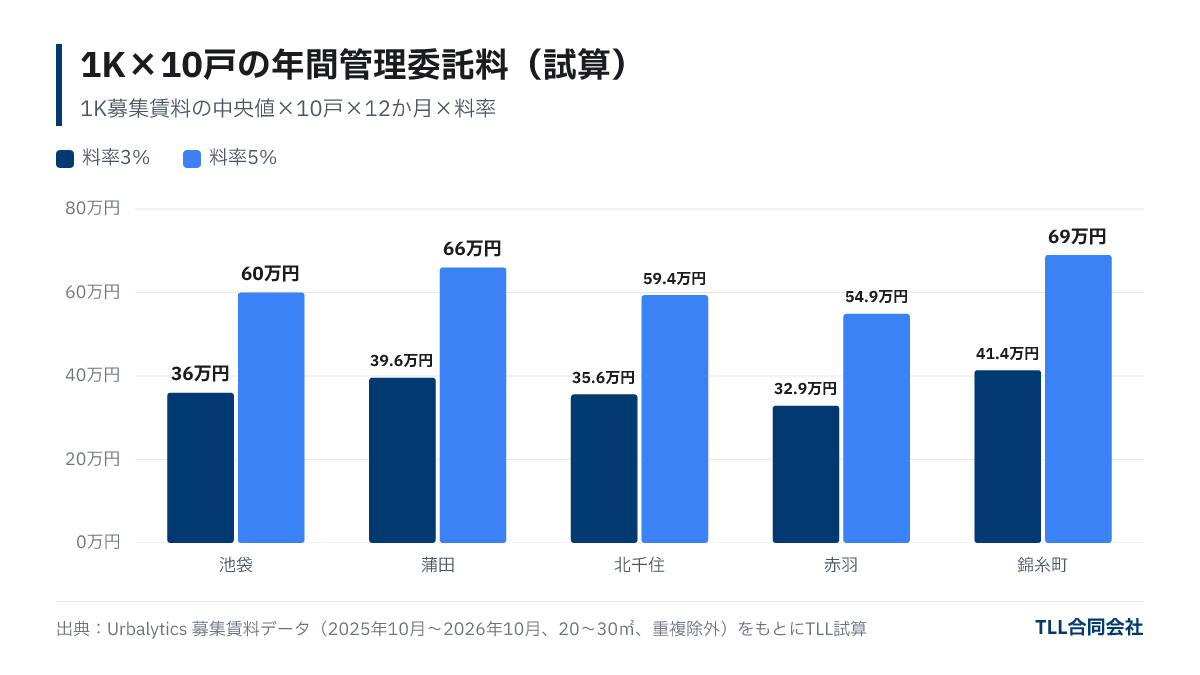
A 2-percentage point difference in fee rate means an annual difference in the 200,000 yen range for 10 units. However, this difference can easily reverse if even one vacancy is filled sooner. For example, filling a 100,000 yen unit 3 months early creates a 300,000 yen difference, so it’s important to compare not only fee rates but also scope of services under equivalent criteria.
Don’t Compare by Fee Rate Alone: Service Scope and Optional Charges
Even if two companies both charge "5% of rent," service scopes differ. In the same Ministry survey, about 90% include rent collection, delinquency follow-up, move-in/out assistance, and complaint handling as standard services within the fee. However, cleaning, statutory inspections, and long-term repair planning are often optional or not offered by many companies.
| Service | Performed as Basic Service | Performed as Option | Not Provided |
|---|---|---|---|
| Tenant Complaint Handling | 95.0% | 1.9% | 3.0% |
| Move-in/Move-out Assistance | 92.4% | 3.5% | 4.1% |
| Delinquency Follow-up and Reporting | 92.3% | 2.4% | 5.3% |
| Tenant Recruitment | 89.5% | 7.8% | 2.7% |
| Security Deposit Settlement | 89.4% | 2.9% | 7.7% |
| Vacancy Countermeasure Proposals | 77.7% | 15.1% | 7.2% |
| Repair Work Estimates and Arrangements | 71.0% | 21.2% | 7.8% |
| Long-term Repair Planning | 42.4% | 22.6% | 35.0% |
| Statutory Inspections of Common Facilities | 22.7% | 43.9% | 33.4% |
| Daily Cleaning of Common Areas | 21.9% | 32.6% | 45.5% |
Source: Ministry of Land, Infrastructure, Transport and Tourism, "FY2025 Survey on the Actual Condition Analysis of Real Estate Management Industry," March 2026 report, excerpt from questions on management service content (886 valid responses). Confirmed October 2, 2026.
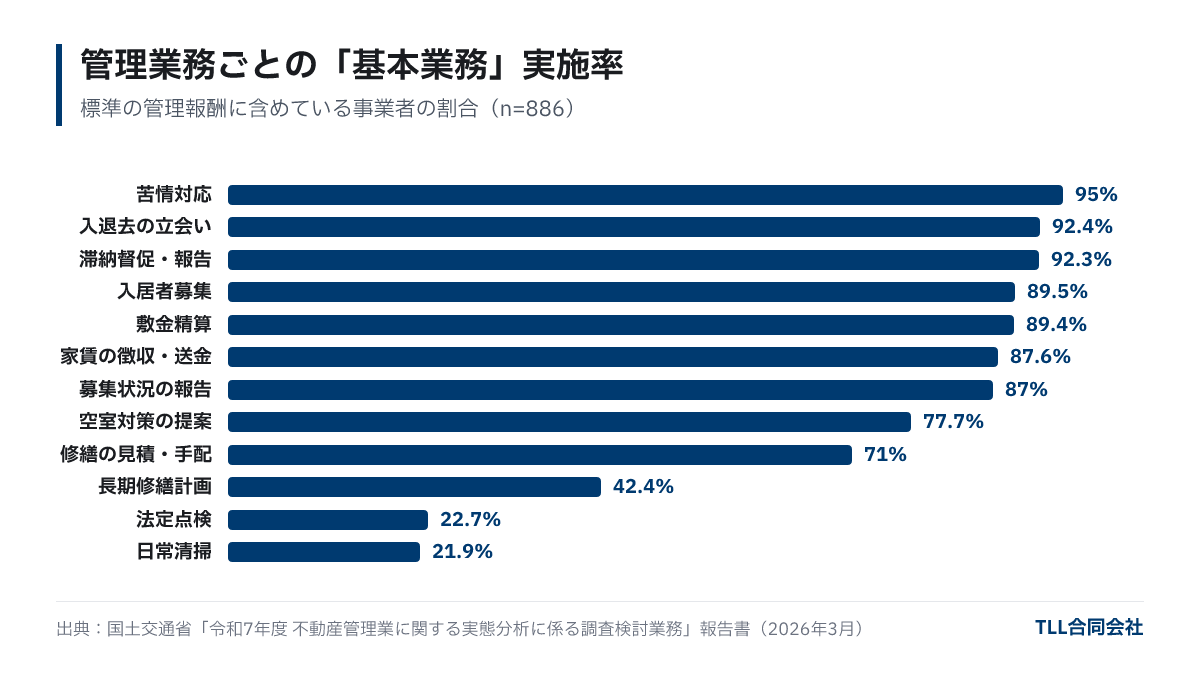
When comparing estimates, create a list of services from the above table and ask each company to specify whether each is "included in fee," "option (price listed)," or "not provided." This will clarify the actual cost burdens. Especially the following three points often show large differences between companies:
- Tenant Recruitment Costs: Who pays brokerage fees and advertising fees, and who pays renewal processing fees, tenant or owner?
- Building Maintenance: Whether common area cleaning, statutory inspections, and fire equipment inspections are included in fees or charged separately with management company markup on outsourcing costs.
- Repair Arrangements: How estimates are obtained (e.g., multiple quotes), and the upper limit amount that can be ordered without owner approval.
Contract Clauses to Check
Compare the contract you receive with the Ministry’s published "Standard Rental Housing Management Contract" to spot missing or unique clauses. Especially, confirm the following items before signing:
- Scope and Implementation of Management Services: Are inspection and cleaning frequencies specified? Are subcontracted duties and subcontractors clearly listed?
- Management Fees and Cost Burdens: Is the fee rate applied only to rent or also to common service charges or parking fees? How are vacant periods handled? What costs are billed separately?
- Advance Payments and Approval Limits: What is the upper limit for costs the manager can pay without owner consent?
- Rent and Deposit Transfer: Timing from receipt to remittance and methods of segregated funds management.
- Emergency Operations: Scope of post-reporting permitted during disasters or accidents and handling of related costs.
- Content and Frequency of Reports: When and how are reports on income/expenditure, occupancy, and repair history delivered?
- Contract Termination Notice: How many months’ notice is required? Are there penalties? How are documents, keys, and deposits handled at contract end?
The standard contract leaves the cancellation notice period blank as "at least ○ months" for the parties to agree on. Long notice periods or high penalties for early termination can restrict switching to another company later. The specific procedure for switching is explained in "How and When to Change Property Management Companies."
Questions to Ask Before Choosing
At meetings or proposal reviews, ask all candidates the following questions in the same order to discern differences based on the detail of their answers.
- What is your rental property management registration number, number of units under management, and service area?
- Who will be the contact person for this property, and how many units are they responsible for?
- When vacancy occurs, how many days until listing starts, and through which media and brokers is information released?
- What data (local vacancy and contract cases) do you use for rent adjustment proposals?
- What is your process for delinquency follow-up, and how do you coordinate with guarantor companies?
- How many companies do you get repair estimates from, and what is the maximum amount you can approve without owner consent?
- Who handles tenant calls during nights and holidays?
- Can you show samples of monthly and annual reports?
- How do you handle contract termination notice periods, fees, and handover procedures?

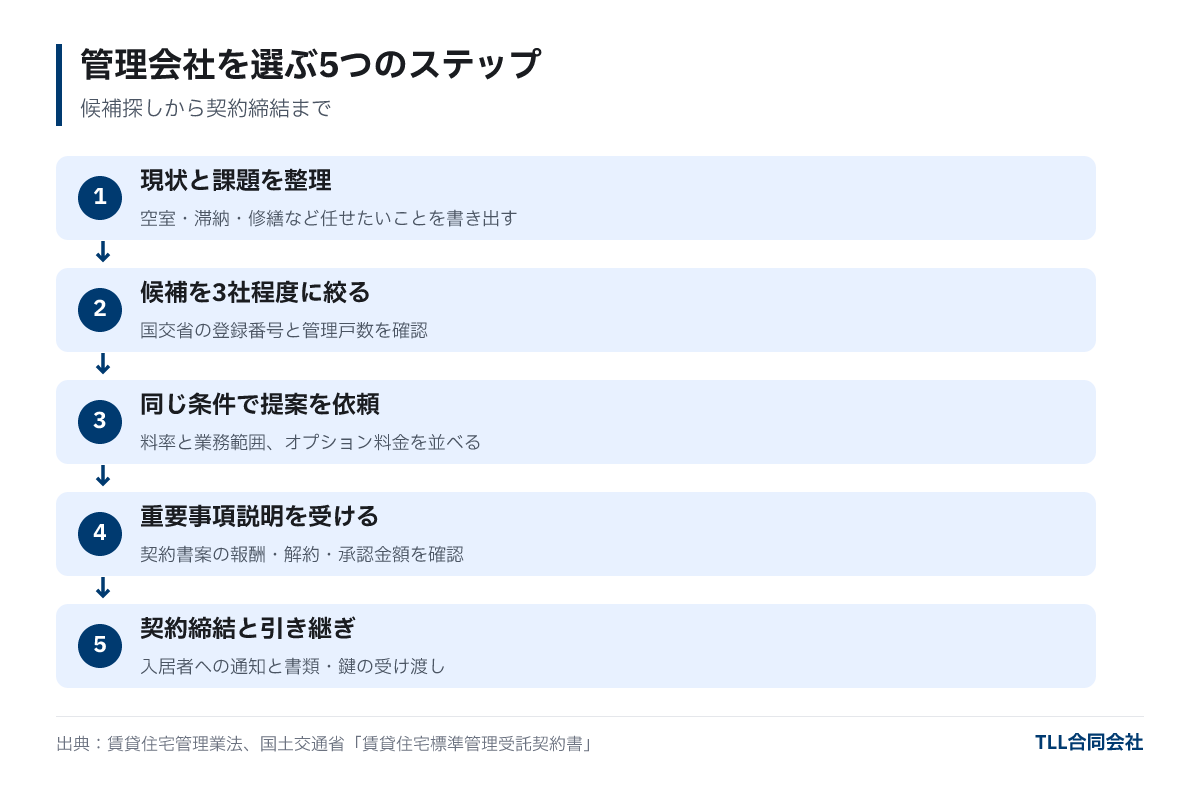
Sample reports best reflect management quality. Check if they include not only occupancy and delinquency trends but also response counts to listings and proposals for rent revision. The selection process consists of five steps.
Frequently Asked Questions
Q. What is the common range for management fees?
About 80% use a fee rate applied to rent, and the rate mostly ranges between 4% and 6%. The Ministry’s FY2025 survey showed 38.0% charge between 4% and less than 5%, and 32.9% between 5% and less than 6%.
Q. How can I check if a management company is registered?
You can search registration numbers and business names through the Ministry’s "Construction Business/Real Estate Business Information Search System." Registration is mandatory for companies managing 200 or more units.
Q. Should I pick the company with the lowest fee rate?
If cleaning, statutory inspections, or repair arrangements are charged separately, total costs may be higher despite a lower fee rate. Compare the inclusion or exclusion of services and ancillary fees, and also consider vacancy periods and rental price levels.
Q. When do I receive the Important Matters Explanation?
Before signing the management agreement. Registered companies must provide a written explanation of fees, service contents, and implementation methods.
Summary
- Management companies operating 200 or more units are required to register with the government, provide important matters explanations before contracting, segregate funds, and regularly report. Always check the registration number first.
- Management fees predominantly range between 4% and 6% of rent (Ministry report March 2026). For 10 units of 1K, the difference between 3% and 5% fee rates is about 220,000 to 280,000 yen annually (Tokyo 5 stations, Urbalytics).
- Many companies charge separately or do not cover cleaning, statutory inspection, and long-term repair planning, so compare service inclusion, option fees, and exclusions for each item.
- Review contracts side-by-side with the Ministry’s standard template and carefully confirm approval limits, reporting frequency, cancellation notice periods, and penalties before signing.
TLL’s management services cover leasing and tenant communication as well as income monitoring, rent optimization and cost reduction proposals, and monthly reporting. We provide detailed breakdowns of included services and separate fees during consultation. For details, please see Asset Management and Operation Services.
Featured image (illustrative): Photo: Dorothy Kuromi / Unsplash
About this article
- Author
- Xiao Li(Asset Management)Qualifications: Real Estate Transaction Specialist, Building Management Specialist
The operational lead for real estate sales and property management. At NTT Communications, he spent more than eight years managing DX projects for major enterprises, overseeing the full process from requirements definition through delivery and operations. At TLL, he handles the entire deal management cycle for income-producing properties, including sales strategy planning, investor sourcing, contract execution, settlement, and handover, providing well-matched opportunities and smooth transaction execution for domestic and international investors and operators.
View profile → - Publisher
- TLL合同会社宅地建物取引業 東京都知事(1)第108202号住宅宿泊管理業 国土交通大臣(01)第F03424号
Data in this article cite their source and as-of date. Market conditions and regulations change, so check the latest information and consult a professional before deciding. Translated from the Japanese original.