The 2027 Fluorescent Lamp Issue: Costs, Electricity Savings, and Payback Period for Switching Apartment Common Area Lighting to LED
Kurihara (licensed real estate broker, 宅地建物取引士)PM Business
22 min read
Many apartment buildings still use fluorescent lamps for lighting in corridors, staircases, and entrances. Some owners panic when they hear "fluorescent lamps will no longer be usable in 2027" and rush to consider replacements. However, the actual ban applies only to manufacturing and import/export; continuing to use existing fluorescent lamps is not prohibited.
That said, replacement lamps will become harder to obtain, and older fixtures will see deterioration of ballasts. This article outlines the regulations and timelines on fluorescent lamp restrictions based on the Minamata Convention on Mercury, the costs of replacing common area lighting with LED, and estimates of electricity cost savings and payback periods with clarified assumptions.
Key points of this article
- Due to the amendment of the Enforcement Order of the Mercury Pollution Prevention Act (December 2024), the manufacturing and import/export of general lighting fluorescent lamps will be banned by lamp type, with straight tube and circular types prohibited from January 1, 2028 (Ministry of the Environment). Use, sale, and purchase are not prohibited.
- Three construction estimates received by TLL for 2025–2026 indicate that LED retrofitting by fixture costs approximately 11,000 to 20,000 yen per location, while work focused on lamp replacement costs about 3,900 yen (excluding tax).
- Assuming 20W savings per lamp, electricity cost of 31 yen/kWh, and construction cost of 15,000 yen per fixture, payback periods for full fixture LED replacement are about 5.5 years with 12-hour daily operation and about 2.8 years with 24-hour daily operation.
What is the 2027 fluorescent lamp issue? Phased ban on manufacturing and import/export
The "2027 fluorescent lamp issue" refers to the phased ban on manufacturing and import/export of general lighting fluorescent lamps by the end of 2027. At the 5th Conference of the Parties (COP5) to the Minamata Convention on Mercury held in October–November 2023, it was decided to eliminate manufacturing and import/export of all general lighting fluorescent lamps by the end of 2027. In Japan, the Enforcement Order of the Mercury Pollution Prevention Act was amended in December 2024, designating all general lighting fluorescent lamps as regulated products (specified mercury-containing products).
| Type of lamp | Date manufacturing/import/export is banned | Main apartment usage location |
|---|---|---|
| Bulb-shaped fluorescent lamps | January 1, 2026 (over 30W banned January 1, 2027) | Entrance lights, outdoor lights, downlights |
| Compact fluorescent lamps | January 1, 2027 | Downlights, wall sconces |
| Straight tube fluorescent lamps | January 1, 2028 (halo phosphor types banned January 1, 2027) | Corridors, staircases, bicycle parking areas, indoor kitchen lights |
| Circular fluorescent lamps | January 1, 2028 (halo phosphor types banned January 1, 2027) | Circular corridor lights, indoor ceiling lights |
Source: Ministry of the Environment "Regulations on General Lighting Fluorescent Lamps", Ministry of Economy, Trade and Industry and Ministry of the Environment documents. Some exceptions apply. Verified October 2, 2026.
The ban only applies to manufacturing and import/export; using installed fluorescent lamps or selling and buying existing stock is not prohibited. However, after the ban date, there will be no new production, so replacement lamps will be limited to existing stock and may become difficult to obtain. To avoid situations where common area lights cannot be replaced when burned out, it is practical to plan replacements while stock is still available.

Replace only lamps or entire fixtures?
There are two methods to convert common area lighting to LED: replacing fluorescent lamps with LED lamps while keeping existing fixtures, or replacing entire fixtures with LED lighting. Fixtures that have been in place for many years are generally recommended to be replaced entirely.
Fluorescent lamp fixtures contain ballasts, which deteriorate over time. The Japan Lighting Manufacturers Association suggests an appropriate replacement period of 8–10 years and a maximum service life of 15 years for lighting fixtures. Lighting manufacturers recommend replacing the entire fixture when converting fluorescent fixtures to LED. Installing only LED lamps in old fixtures may cause hazards such as smoke or fire. Similarly, installing straight LED tubes incompatible with the fixture is also dangerous.
In common areas, there may be emergency lighting or exit signs that must comply with the Building Standards Act or Fire Service Act. These must be replaced separately from general lighting with consultation from fire equipment or electrical contractors.
Used fluorescent tubes contain mercury and cannot be disposed of as household garbage when coming from business activity like apartment common areas. They must be treated according to Waste Disposal Law and other regulations. Confirming that disposal of removed fluorescent tubes is included in the estimate when ordering work can save effort.
Estimated costs to switch common area lighting to LED
The cost of LED retrofitting is about 10,000 to 20,000 yen per location for fixture replacement, and a few thousand yen if mainly lamp replacement work. Details from construction estimates received by TLL have been converted into unit prices per location.
| Work description (estimate details) | Number of locations | Amount (excluding tax) | Per location | Estimate date |
|---|---|---|---|---|
| LED replacement of lighting fixtures (fixture + lamp included) | 5 locations | 100,000 yen | 20,000 yen | March 2026 |
| Installation of 40-type LED lighting | 6 locations | 65,000 yen | Approx. 10,800 yen | November 2025 |
| Fluorescent to LED replacement (mainly lamp replacement price) | 6 locations | 23,500 yen | Approx. 3,900 yen | 2025 |
Source: Itemized construction estimates received by TLL (3 rental properties in Tokyo and Saitama). The small sample size means values should be considered approximate; costs vary depending on fixture type, height, and wiring conditions. For reference, a 2024 estimate received by TLL put the price for a 40-type straight fluorescent lamp at 1,700 yen (excluding tax). Data collected October 2, 2026.
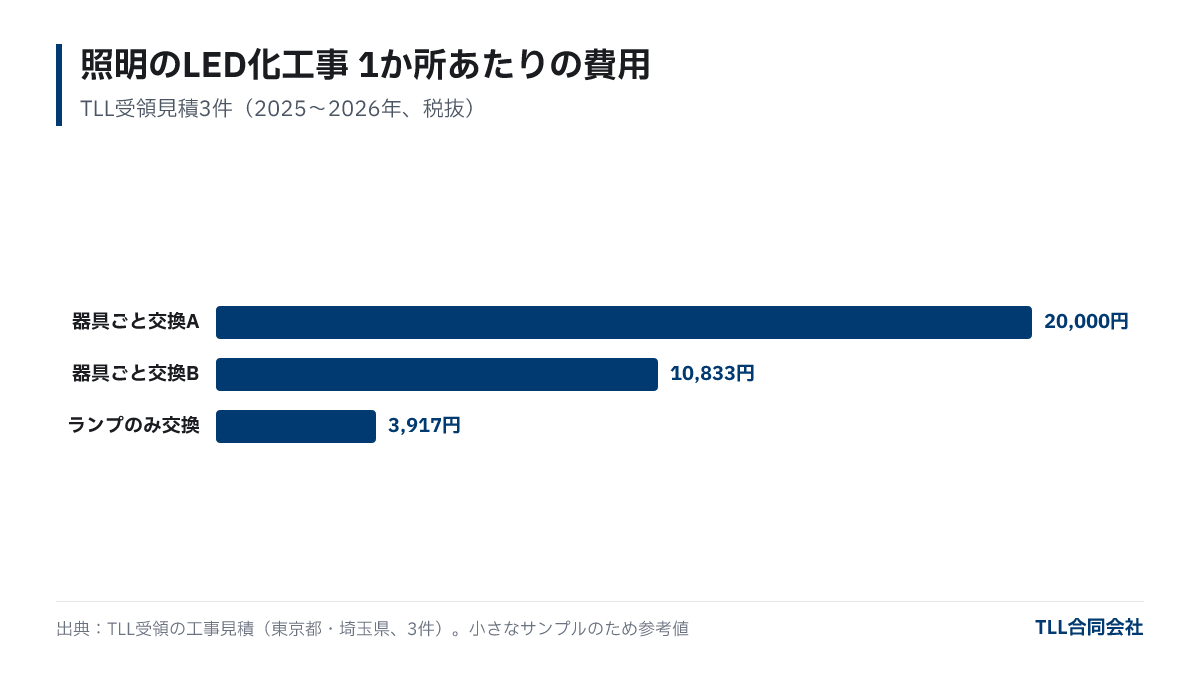
Replacing entire fixtures costs 3 to 5 times more initially than lamp-only replacement, but eliminates risk of accidents due to ballast deterioration and renews the fixture itself. For a building with 20 lamps in common areas, replacing fixtures at 15,000 yen per lamp results in a benchmark cost of about 300,000 yen.
Electricity savings and payback period estimates
Replacing common area lighting with LED fixtures reduces annual electricity costs by approximately 2,700 yen per lamp with 12-hour daily operation and about 5,400 yen with 24-hour operation. The assumptions for the calculation are as follows.
- Power consumption: Fluorescent fixtures (one 40-type lamp) assumed at 40W, LED fixtures at 20W, resulting in 20W savings per lamp (actual figures depend on fixture model number).
- Operating hours: For outdoor corridors and stairs, timers restrict operation to 12 hours at night; indoor corridors and stairwells assumed 24-hour operation.
- Electricity rate: 31 yen/kWh (tax included) based on national household appliance fair trade council guideline (revised July 2022). Actual rates vary by contract.
- Construction cost: 15,000 yen per lamp for fixture replacement (midpoint of TLL estimate range 11,000–20,000 yen).
| Number of lamps | Construction cost (fixture replacement) | Annual savings (12-hour operation) | Annual savings (24-hour operation) |
|---|---|---|---|
| 10 lamps | 150,000 yen | Approx. 27,000 yen | Approx. 54,000 yen |
| 20 lamps | 300,000 yen | Approx. 54,000 yen | Approx. 109,000 yen |
| 30 lamps | 450,000 yen | Approx. 81,000 yen | Approx. 163,000 yen |
Source: TLL calculations based on the above assumptions. Savings = 20W × operating hours × 365 days × 31 yen/kWh × number of lamps. Does not include savings from reduced lamp replacement or labor costs. Data gathered October 2, 2026.
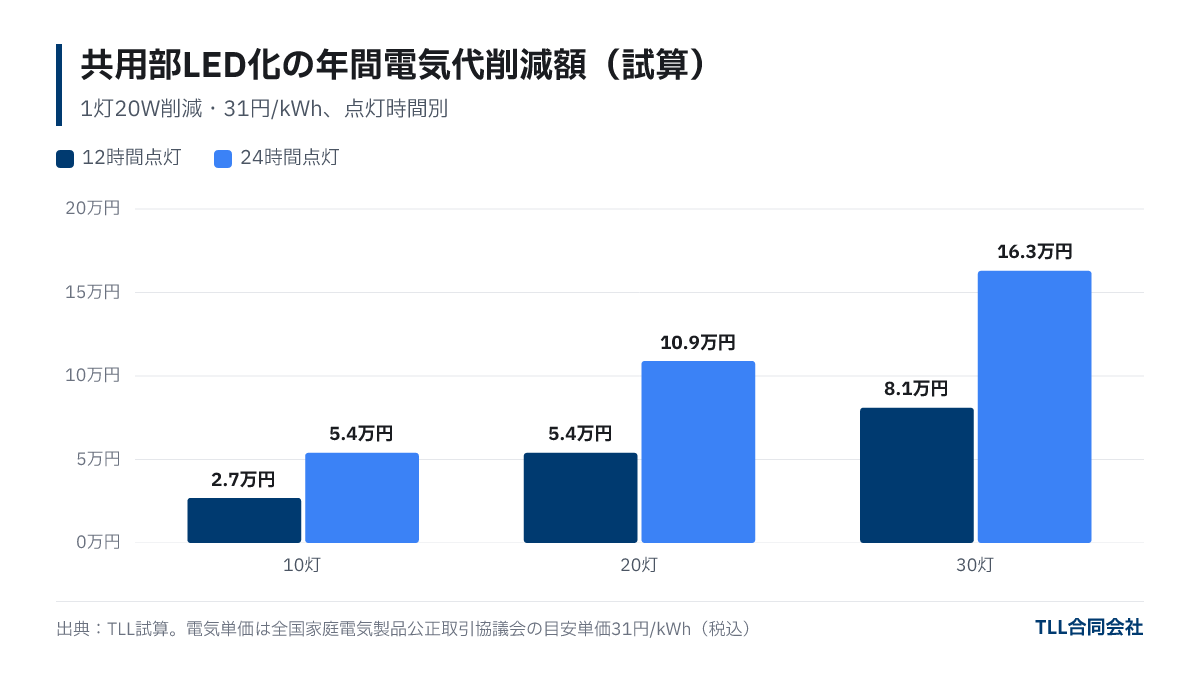
The payback period depends only on operating hours and electricity cost, not the number of lamps. Comparing electricity rates of 25, 31, and 35 yen/kWh results in the following payback periods.
| Electricity rate | Payback period (12-hour operation) | Payback period (24-hour operation) |
|---|---|---|
| 25 yen/kWh | Approx. 6.8 years | Approx. 3.4 years |
| 31 yen/kWh | Approx. 5.5 years | Approx. 2.8 years |
| 35 yen/kWh | Approx. 4.9 years | Approx. 2.4 years |
Source: TLL calculations based on construction cost of 15,000 yen per lamp divided by annual savings per lamp. Data gathered October 2, 2026.
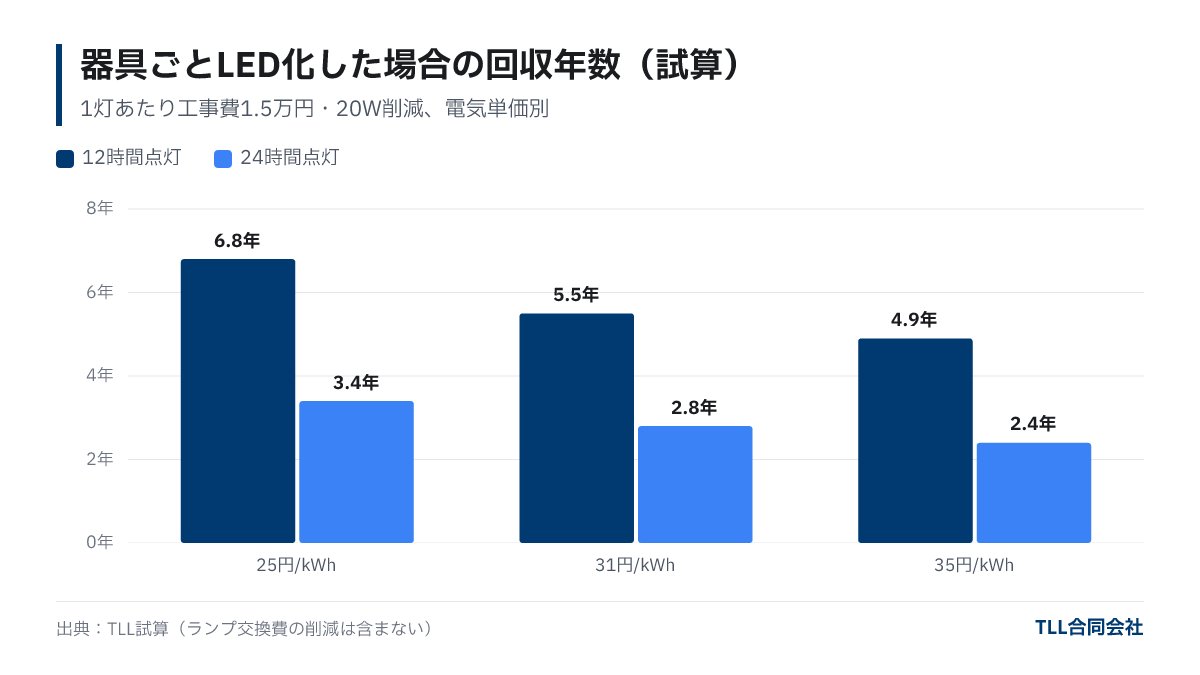
These calculations do not include savings from reduced lamp purchases or replacement labor. Since LEDs require less frequent replacement than fluorescent lamps, actual payback periods may be shorter. Electricity costs for common areas are fixed expenses borne by owners even when units are vacant, so savings directly improve net operating income. Other income improvement methods beyond rent are introduced in "How to Increase Ancillary Income for Apartments".

How to proceed with common area LED retrofitting
Start by counting the types and number of lighting fixtures in the common areas and checking operating hours and electricity bills. Knowing the fixture installation year helps decide whether to replace the fixture entirely.
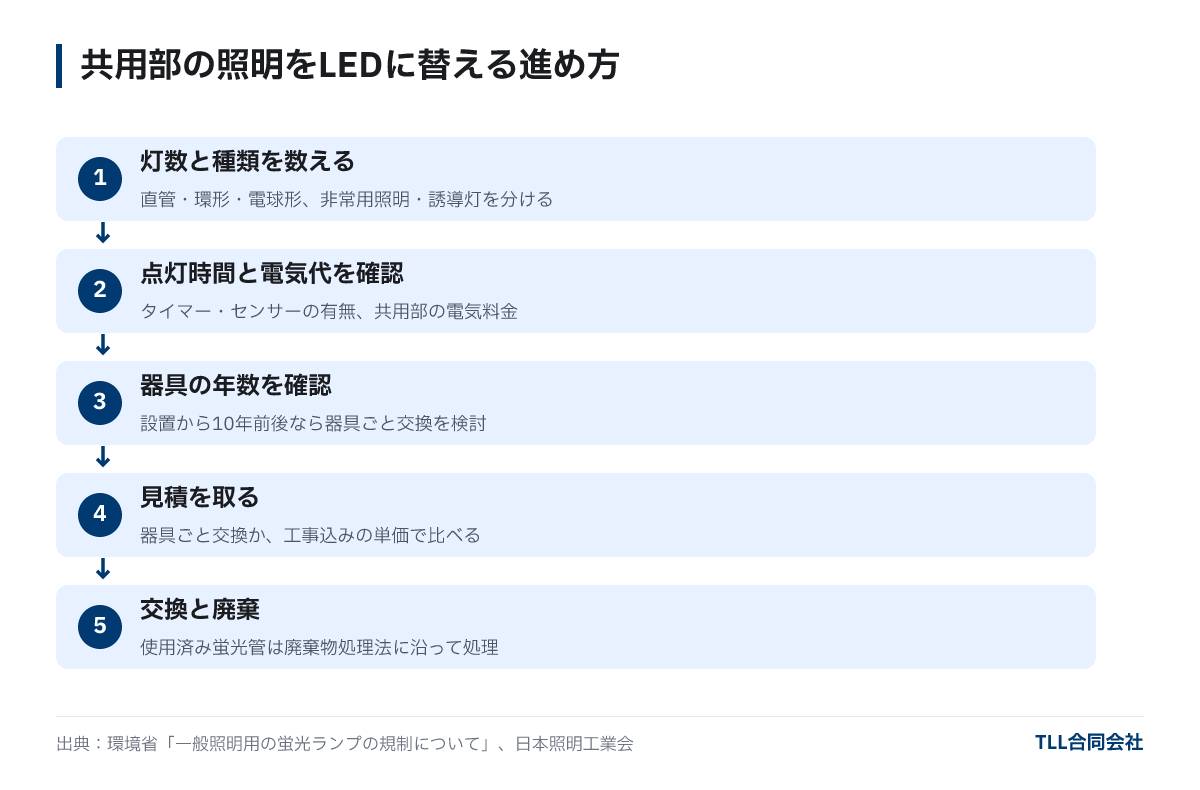
If major renovations such as repainting exterior walls or metals are planned, replacement of lighting at the same time makes it more efficient to replace outdoor and high fixtures using scaffolding. For ideas on renovation timing and costs, see "When and How Much for Large-Scale Apartment Repairs?". Also, selecting fixtures with motion or brightness sensors can reduce actual operating hours. Some municipalities offer subsidies for energy-saving equipment, so check with the district or city where the property is located.
Frequently Asked Questions
Q. Will fluorescent lamps become unusable after 2027?
No. Only manufacturing and import/export will be banned; use of installed fluorescent lamps and sale/purchase of existing stock is still allowed. However, replacement lamps will be limited to existing stock, so planned replacement is necessary.
Q. When will manufacturing bans for straight tube fluorescent lamps begin?
Manufacturing and import/export bans for straight tube and circular fluorescent lamps begin January 1, 2028 (those using halo phosphor begin January 1, 2027). Bulb-shaped lamps are banned from January 1, 2026 (over 30W from January 1, 2027), and compact fluorescent lamps from January 1, 2027.
Q. Is it safe to install LED lamps only in existing fluorescent fixtures?
If the ballast in the fixture has deteriorated, there is a risk of smoke or fire. The Japan Lighting Manufacturers Association recommends replacing lighting fixtures after 8–10 years. Consider fixture replacement for older equipment.
Q. How much can electricity costs be reduced by switching common areas to LED?
Assuming 20W savings per lamp and electricity cost of 31 yen/kWh, savings are about 2,700 yen annually per lamp for 12 hours daily use and 5,400 yen for 24 hours. For 20 lamps, this totals approximately 54,000 to 109,000 yen annually.
Summary
- Manufacturing and import/export bans for general lighting fluorescent lamps begin January 1, 2028 for straight tube and circular types, and January 1, 2027 for compact types (Ministry of the Environment). Use and purchasing of existing stock is not prohibited.
- Older fixtures likely have deteriorated ballasts, so fixture replacement is the basic approach. Appropriate replacement period for lighting fixtures is 8–10 years (Japan Lighting Manufacturers Association).
- TLL estimates show fixture LED replacement costs about 11,000 to 20,000 yen per location (excluding tax, from 3 samples).
- Assuming 20W savings, 31 yen/kWh electricity cost, and 15,000 yen construction cost, payback periods are about 5.5 years for 12-hour daily operation and about 2.8 years for 24-hour operation.
TLL’s management services include leasing and tenant support as well as income monitoring, rent optimization, cost reduction proposals, and monthly reporting. We also offer consultation on electricity and repair estimate reviews for common areas as part of cost reduction. For details, visit Asset Management & Operation Services.
Featured image (image): Photo: David Jorre / Unsplash
About this article
- Author
- Kurihara(PM Business)Qualifications: Real Estate Transaction Specialist, FP Level 2, Chief Property Manager, Rental Real Estate Management Specialist
Has more than 10 years of experience in the property management field. Across both rental management and condominium management, has handled a wide range of responsibilities including owner relations, tenant relations, contract administration, repair coordination, and the operation of board and general meetings.
View profile → - Publisher
- TLL合同会社宅地建物取引業 東京都知事(1)第108202号住宅宿泊管理業 国土交通大臣(01)第F03424号
Data in this article cite their source and as-of date. Market conditions and regulations change, so check the latest information and consult a professional before deciding. Translated from the Japanese original.