How Much Should Owners Pay for Restoration When Tenants Move Out? MHLW Guidelines, Elapsed Years, and Cost Estimates
Xiao Li (licensed real estate broker, 宅地建物取引士)Asset Management
25 min read
When a tenant moves out, the issue of how much of the wall paper stains or floor scratches can be charged to the tenant is one of the most common sources of disputes between owners and tenants. Charging too much can lead to problems in returning the security deposit, while being too lenient may force the owner to cover costs that could have been charged to the tenant.
This article organizes the division of costs between owners and tenants, the concept of elapsed years (durable years) affecting the burden ratio, the Tokyo Metropolitan Ordinance for the Prevention of Rental Housing Disputes, and estimated costs based on restoration work estimates received by TLL, all based on the Ministry of Land, Infrastructure, Transport and Tourism’s "Troubles Concerning Restoration and Guidelines (Revised Edition)". For reviewing post-move-out rental conditions, see also "Apartment Vacancy Measures".
Key Points of This Article
- The Ministry of Land, Infrastructure, Transport and Tourism’s guideline defines restoration not as "returning to the state at the time of renting," but as repairing damages caused by intentional or negligent tenant acts or usage beyond normal wear and tear; normal wear such as fading from sunlight or furniture marks is generally the owner's responsibility.
- Wallpaper (cross) and cushion flooring have a durable life of 6 years with a residual value of 1 yen; even if stained by a tenant, after 3 years of occupancy the tenant’s share is about 50% of the replacement cost, and after 6 years it is nearly 0%.
- The restoration work estimates received by TLL show a price range of 150,000 to 300,000 yen for 1R/1K and 300,000 to 600,000 yen (tax included) for 2K/2DK, often exceeding the median rent of 89,000 to 115,000 yen (equivalent to 1 month’s security deposit) for 1K properties near three Tokyo stations.
What Restoration Means: It Is Not Returning to the State When Rented
Restoration refers to repairing the decrease in building value caused by tenant occupancy/use, specifically damages resulting from the tenant’s intentional or negligent acts, breach of the duty of care, or use beyond ordinary wear and tear. The Ministry of Land, Infrastructure, Transport and Tourism’s guideline (revised August 2011) clearly defines this and states that restoration does not mean returning to the original rental condition.
This concept was codified in the revised Civil Code enforced in April 2020. Article 621 of the Civil Code states that the tenant is obligated to repair damage upon move-out but excludes normal wear and tear and aging. In other words, repair costs for stains and deterioration that normally occur during ordinary living are included in the rent and are borne by the owner.
It is easier to organize the concept of wear and tear by dividing it into the following three:
- Aging: changes occurring naturally over time, such as wall paper or tatami discoloration due to sunlight (owner’s responsibility)
- Normal wear and tear: marks left by furniture or blackening on walls behind refrigerators (electric discoloration), caused by ordinary use (owner’s responsibility)
- Wear and tear due to tenant's intentional or negligent acts: cigarette tar, mold spread from neglected condensation, scratches made during moving (tenant’s responsibility, but considering elapsed years)
Itemized Burden Division and Cost Estimates
In actual move-out settlements, each part is checked to determine examples where the owner bears the cost, examples where the tenant bears it, and whether elapsed years are considered. The table below combines the guideline division with unit cost estimates for restoration work received by TLL.
| Part | Owner-Borne Examples | Tenant-Borne Examples | Consideration of Elapsed Years | Estimated Unit Cost (Excl. Tax) |
|---|---|---|---|---|
| Walls and Ceilings (Wallpaper) | Discoloration from sunlight, electric discoloration, holes from thumbtacks or pins, poster marks | Cigarette tar/odor, mold from unattended condensation, holes for heavy objects nails/screws, graffiti | Durable life 6 years with residual value 1 yen | Mass-produced wallpaper replacement 950–1,050 yen/m² |
| Floor (Cushion Floor/Carpet) | Furniture marks, fading due to sunlight | Stains/mold after spilled drinks, rust stains under refrigerator left untreated | Durable life 6 years with residual value 1 yen | Cushion floor replacement 2,800–3,000 yen/m² |
| Floor (Hardwood Flooring) | Waxing, furniture marks | Scratches caused by moving | Partial repairs not considered (full replacement uses building’s durable life) | Floor stripping 800–880 yen/m² |
| Tatami Mats | Re-covering for the next tenant, discoloration due to sunlight | Stains from drinks, intentional damage | Woven tatami surface considered consumable; no consideration | Re-covering 4,500 yen/piece |
| Sliding Doors and Paper Screens (Fusuma & Shoji) | Replacement for next tenant | Damage, graffiti, pet scratches | Paper considered consumable; no consideration | Fusuma 3,000–4,400 yen/piece; Shoji 3,000–4,900 yen/piece |
| Equipment and Cleaning | House cleaning if tenant performed normal cleaning, failure due to lifespan | Neglected grease/water stains, lost keys | Equipment uses durable life with residual value 1 yen (lost keys and cleaning do not consider elapsed years) | House cleaning: 1K 16,000–20,000 yen, 2K/2DK 26,000–32,000 yen |
Source: Burden division and elapsed years summary are from the Ministry of Land, Infrastructure, Transport and Tourism’s "Troubles Concerning Restoration and Guidelines (Revised Edition)" (August 2011) appendix. Construction unit prices are ranges based on TLL’s collected restoration work quotations (134 cases in Tokyo 23 wards, Tama, Southern Saitama) from 2021 to 2026, as of September 2026. Confirmation date: October 2, 2026.

The tenant’s financial responsibility basically covers the "minimum unit necessary for repairing the damaged part." For wallpaper, the square meter unit is preferred; if replacing an entire face to match color and pattern, it is considered acceptable for the tenant to bear the cost for that whole face. If the entire room is discolored by tobacco tar, it is reasonable to charge the tenant for replacing wallpaper throughout the entire room.
Concept of Elapsed Years: Wallpaper Has 6-Year Durable Life with Residual Value 1 Yen
Even if the damage is the tenant’s responsibility, it is not possible to charge them the full amount of repair costs. The guideline assumes that wallpaper and equipment have certain durable years and their value decreases with time, so tenants’ burden ratios decrease as elapsed years increase. In the revised edition reflecting tax law changes, the residual value after durable years is set at 1 yen.
| Elapsed Years (if brand new at move-in) | Move-in | 1 Year | 2 Years | 3 Years | 4 Years | 5 Years | 6 Years or More |
|---|---|---|---|---|---|---|---|
| Tenant Burden Ratio (Durable Life 6 Years) | 100% | Approx. 83% | Approx. 67% | 50% | Approx. 33% | Approx. 17% | Residual Value 1 Yen |
Source: Calculated by TLL based on the Ministry of Land, Infrastructure, Transport and Tourism’s "Troubles Concerning Restoration and Guidelines (Revised Edition)" concept (straight-line method where residual value is 1 yen after 6 years). If there were already elapsed years at move-in, calculations start from that value. Confirmation date: October 2, 2026.
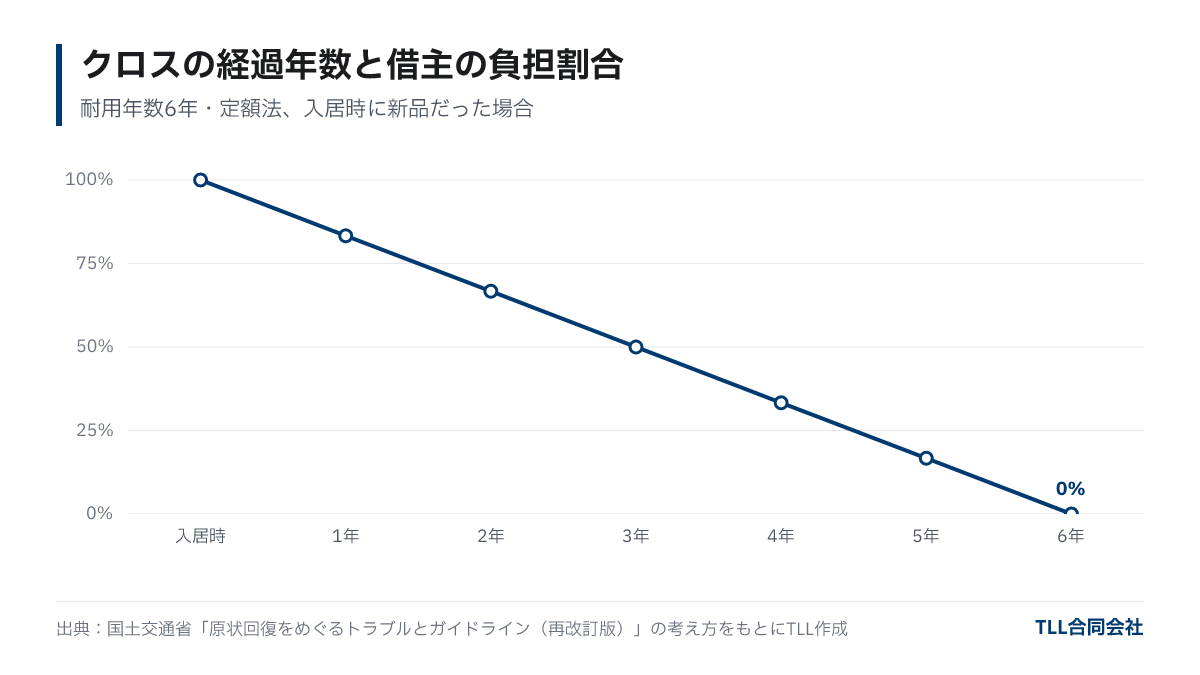
For example, if a tenant moved into a 1K apartment with new wallpaper and after 3 years moves out with graffiti on one wall (approx. 10 m²), the replacement cost at 950 yen/m² totals 9,500 yen; applying the 50% tenant burden yields around 4,750 yen charged to the tenant, with the remainder borne by the owner. For the same damages after 6 years or longer occupancy, almost nothing can be charged to the tenant.
The durable years in the guideline for each part are: kitchen sink 5 years; air conditioner, refrigerator, gas stove, intercom 6 years; toilets, washbasins, plumbing and sanitary equipment 15 years; unit baths, bathtubs, and integrated building parts equal the building’s durable life. Meanwhile, cylinder replacement due to lost keys is charged fully to the tenant without considering elapsed years.
Tokyo Metropolitan Ordinance for the Prevention of Rental Housing Disputes and Special Provisions
For residential rental housing in Tokyo, the "Ordinance on the Prevention of Disputes Related to Residential Leasing in Tokyo" (commonly called Tokyo Rule) requires licensed real estate agents to explain the following contents in writing when acting as the contracting agent or intermediary. This applies to new contracts dated October 1, 2004 and later, excluding contract renewals and commercial properties such as shops or offices.
- Basic concept of restoration at move-out
- Basic concept of repairs during tenancy
- Contents the tenant is responsible for in the actual contract (whether special provisions exist and their details)
- Contact information about repair and maintenance during tenancy

If the tenant is asked to bear costs at move-out that differ from the principle, like house cleaning fees, it must be stipulated as a special provision in the contract. The guideline lists three requirements for such a special provision to be valid: ① there is an objective and reasonable reason such as necessity and no profiteering, ② the tenant recognizes that they bear more than ordinary restoration obligations, ③ the tenant shows consent to assume that burden. Writing the specific amount and scope and explaining it at contract signing are effective ways to reduce disputes at move-out.
Restoration Cost Estimates and Security Deposits
TLL’s received restoration work estimates show total costs by floor plan of 150,000 to 300,000 yen for 1R/1K; 300,000 to 600,000 yen for 2K/2DK; and 600,000 to 1,200,000 yen (tax included) for 3LDK or larger. These totals include both parts borne by the owner (normal wear) and parts charged to tenants. To compare with security deposits, we list the median rental prices for 3 Tokyo stations.
| Station | Median 1K Rent (20–30 m²) | Number of Cases | Median Rent (40–55 m²) | Number of Cases |
|---|---|---|---|---|
| Nakano | 100,000 yen | 295 cases | 217,500 yen | 192 cases |
| Oi-machi | 115,000 yen | 266 cases | 232,000 yen | 78 cases |
| Nishi-Kasai | 89,000 yen | 78 cases | 128,000 yen | 67 cases |
Source: Urbalytics rental listing data. Data collected from listings for residential units nearest each Tokyo station, published between October 2, 2025 and October 2, 2026 (excluding duplicate listings of the same building, size, and rent). Rent is listing rent, not contracted rent. Restoration cost estimates are ranges from TLL’s received work quotations. Date compiled: October 2, 2026.
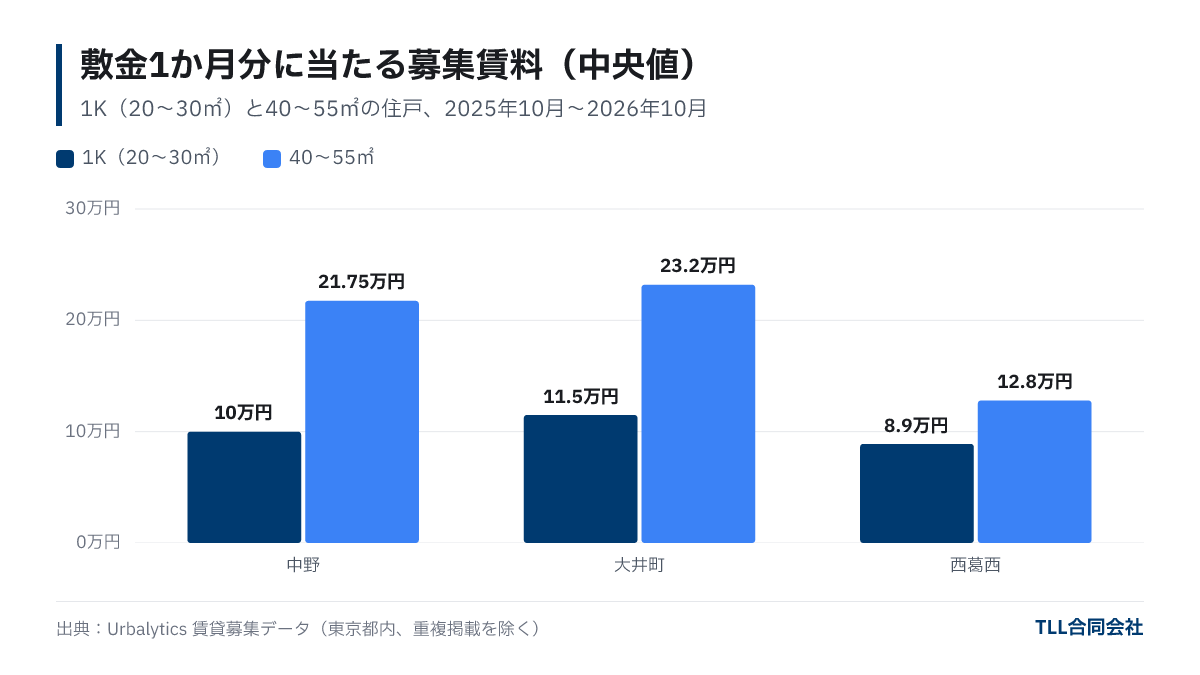
Assuming a 1-month security deposit for 1K ranges from 89,000 to 115,000 yen, this often falls short of the total restoration costs (150,000 to 300,000 yen). Since only damages caused by intentional or negligent acts can be charged to tenants, it is prudent to incorporate the owner’s share of restoration costs per move-out into annual financial plans.
In reducing costs, checking estimate details is also effective. Among restoration estimates received by TLL, some cases achieved a 21–44% reduction from the initial estimate to the final order by carefully reviewing quantities and scope. It is basic to verify each item, such as whether a full wallpaper replacement is necessary or partial replacement suffices, or if flooring can be covered with new flooring over the existing one. The general flow from move-out to settlement is as follows:
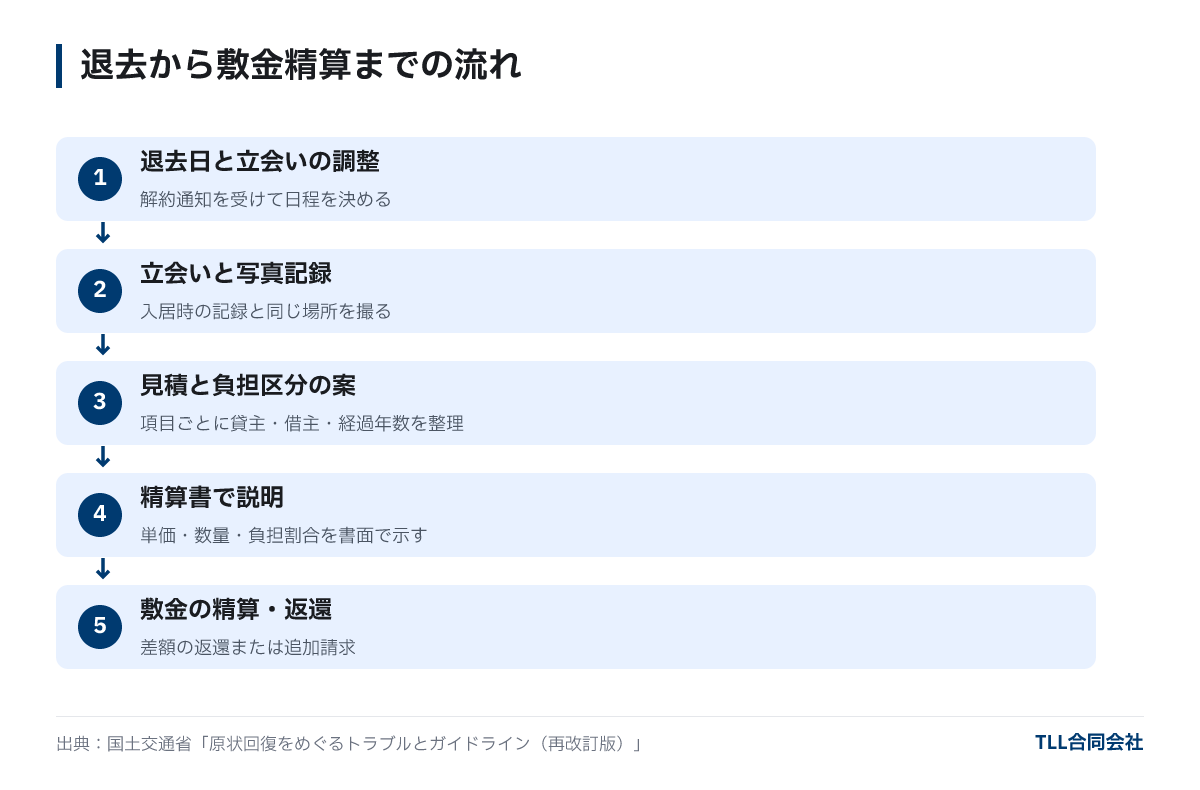
A very effective way to prevent disputes is to take photos of the same locations at move-in and move-out. The guideline includes a checklist format for move-in and move-out inspections.
Frequently Asked Questions
Q. How much can be charged to a tenant for wallpaper replacement costs?
Only stains or damages caused by the tenant’s intentional or negligent acts are charged, applying the burden ratio based on elapsed years. Wallpaper’s durable life is 6 years with residual value 1 yen, so after 3 years the tenant’s share is about 50%, and after 6 years it is nearly zero.
Q. Can house cleaning fees be charged to tenants?
If the tenant performed normal cleaning during occupancy, professional house cleaning fees are generally borne by the owner. To charge tenants for cleaning, the contract must clearly state the amount and scope in special provisions, explained at contract signing.
Q. What is the Tokyo Rule?
It is the Tokyo Metropolitan Ordinance on the Prevention of Disputes Related to Residential Leasing, which requires real estate agents in Tokyo to explain in writing the concepts of restoration and repairs, special provision contents, etc., when mediating or acting as contracting agents for residential leases. It applies to new contracts since October 2004.
Q. How much does restoration cost for a 1K apartment?
According to restoration work estimates received by TLL, the typical cost range for 1R/1K is 150,000 to 300,000 yen (tax included). Of this, only the part caused by tenant intentionality or negligence can be charged to tenants.
Summary
- Restoration does not mean returning to the original rental state; normal wear and aging are owners’ responsibilities in principle (MHLW guidelines, Civil Code Article 621).
- Wallpaper and cushion floors have a 6-year durable life with residual value 1 yen; tenant share is about 50% after 3 years and nearly zero after 6 years.
- In Tokyo, licensed real estate agents are required to explain restoration concepts and special provisions in writing. Any deviation from principles requires specific special provisions and explanation.
- Restoration total costs are roughly 150,000 to 300,000 yen for 1R/1K (TLL estimate records), often exceeding one month’s security deposit (89,000 to 115,000 yen) at three Tokyo stations; owners should factor their share into cash flow plans.
TLL’s management agency service covers leasing and tenant correspondence, cash flow monitoring, rent adjustment and cost reduction proposals, to monthly reporting. Feel free to consult us on estimate appropriateness or burden division. See Asset Management and Operation Services for details.
Eyecatch image (illustration): Photo: Christian Lue / Unsplash
About this article
- Author
- Xiao Li(Asset Management)Qualifications: Real Estate Transaction Specialist, Building Management Specialist
The operational lead for real estate sales and property management. At NTT Communications, he spent more than eight years managing DX projects for major enterprises, overseeing the full process from requirements definition through delivery and operations. At TLL, he handles the entire deal management cycle for income-producing properties, including sales strategy planning, investor sourcing, contract execution, settlement, and handover, providing well-matched opportunities and smooth transaction execution for domestic and international investors and operators.
View profile → - Publisher
- TLL合同会社宅地建物取引業 東京都知事(1)第108202号住宅宿泊管理業 国土交通大臣(01)第F03424号
Data in this article cite their source and as-of date. Market conditions and regulations change, so check the latest information and consult a professional before deciding. Translated from the Japanese original.