

How and When to Change Your Property Management Company: From Contract Termination Notice to Tenant Notification
Kurihara (licensed real estate broker, 宅地建物取引士)PM Business
26 min read
"Vacancies don’t fill quickly," "Reports are delayed, so I don’t know what’s happening." Many property owners feel dissatisfied with their management company but postpone changing due to the hassle of the process. In practice, once you check the contract and arrange the handover, you can switch without causing significant burden to tenants.
This article organizes the signs that indicate you should consider changing your management company, the termination notice period and penalty fees to check in your property management contract, procedures for handing over deposits, tenant information, keys, and delinquency status, tenant notifications, and the schedule leading up to the change.
Key points of this article
- The Ministry of Land, Infrastructure, Transport and Tourism’s (MLIT) "Standard Rental Housing Management Entrustment Contract" leaves the termination notice period blank as "○ months prior," so it is decided by the parties involved. First, check the termination clause and stipulations on payments substituting notice in your contract.
- The average asking monthly rent for 15–30㎡ units near five Tokyo stations ranges approximately from 88,000 to 113,000 yen. For a 10-unit apartment, a 1% difference in management fee rate equates to 106,000 to 135,000 yen annually (October 2026, Urbalytics rental listings data).
- An existing vacancy lasting about 1.2 months for one unit cancels out a 1% difference in management fee. When selecting a management company, consider not only the fee rate but also their ability to fill vacancies quickly and the thoroughness of the handover process.
Signs You Should Consider Changing Your Management Company
You should consider changing your management company if repeated issues occur with vacancies, reporting, or financial flow and efforts to improve do not change the situation. Decide based on recurring problems, not single errors.
- Vacancies persist for a long time: There is a long gap between tenant move-out and new contract, with no concrete proposals for rent or marketing condition adjustments.
- Reporting is insufficient or delayed: Only statements of income and expenses arrive, without details on inquiries, viewings, or leasing status.
- Tenant support is slow: Responses to equipment breakdowns or complaints are delayed, and tenants contact the owner directly.
- Repair estimates lack justification: Repairs are quoted only as "lump sum," with no proposals for competitive bids.
- Payments and settlements are unclear: Rent transfer dates are delayed, and explanations about deposits and entrusted funds are inadequate.
- No proposals to improve profitability: No discussion on additional income such as parking lots or vending machines (ancillary income beyond rent) or cost reduction measures.
If you are unsure whether to continue with entrustment or revert to self-management, reviewing costs and workload in "Self-Management vs. Outsourced Management: Which Is Better?" will help clarify your decision.
What to Check in the Property Management Contract Before Changing
The first step is to read your current property management entrustment contract and confirm the termination notice period, penalty fees, and contract duration. Failing to check this can cause overlapping management fees from the old and new contracts during the transition.

Termination Notice Period
Article 21 of MLIT’s "Standard Rental Housing Management Entrustment Contract" allows either the owner or management company to terminate the contract by submitting a written notice "at least ○ months prior." The period is left blank to be defined individually. Calculate your switch date backward from the number of months stated in your contract. Use a method that can prove the date later (e.g., recorded postal mail) to avoid disputes.
Penalty Fees and Payments in Lieu of Notice
Paragraph 2 of the same Article 21 states that if "the equivalent amount of management fees for ○ months" is paid, the contract can be terminated any time without waiting for the notice period. If you want to switch quickly, check if this clause exists and how many months it covers. Also, review any penalty fees stipulated for terminating during the contract period in the special provisions.
Contract Period and Renewals
For contracts with automatic renewal, confirm whether notice before the renewal date is required or if the contract can be terminated any time with notice after renewal. Also, "sublease (specified lease agreement)" contracts, where the management company leases the property itself, are separate from management entrustment and may require justifiable reasons under the Law on Land and Building Leases for termination by the owner. Confirm procedures separately if switching from sublease to management entrustment.
Explanations from the New Management Company
The Rental Housing Management Business Act mandates management companies to explain important matters in writing before contract execution (Article 13) and provide written documents upon contract signing (Article 14). It also requires segregated management of rent and deposits as separate from the company’s assets (Article 16) and periodic reports to owners (Article 20). Management companies managing 200 or more units must register with the MLIT Minister, so confirm the registration number of your new management company.
Evaluating the Profitability of Changing Management Companies Using Vacancy and Fee Rates
When comparing management companies, focusing only on fee rates can be misleading because differences in vacancy length often have larger financial impacts. We aggregated asking rents for single-occupancy units (15–30㎡) at five Tokyo 23-ward stations using Urbalytics data.
| Station | Data Count | Average Asking Rent (Monthly) | Average Exclusive Area | Annual Difference for 1% Fee Rate Gap (10 Units) |
|---|---|---|---|---|
| Akabane | 254 listings | Approx. 88,000 yen | 23.1㎡ | Approx. 106,000 yen |
| Kita Senju | 380 listings | Approx. 96,000 yen | 22.7㎡ | Approx. 115,000 yen |
| Ikebukuro | 500 listings | Approx. 102,000 yen | 22.8㎡ | Approx. 122,000 yen |
| Kamata | 500 listings | Approx. 103,000 yen | 23.1㎡ | Approx. 124,000 yen |
| Kinshicho | 500 listings | Approx. 113,000 yen | 24.6㎡ | Approx. 135,000 yen |
Source: Urbalytics rental listings data (Tokyo area, units 15–30㎡ near each station, mainly from January to September 2026). Listings for Ikebukuro, Kamata, and Kinshicho capped at 500. Figures represent asking rents, not contracted rents. "Annual difference for 1% fee rate" is estimated by average asking rent × 10 units × 12 months × 1%. Data collected on October 2, 2026.
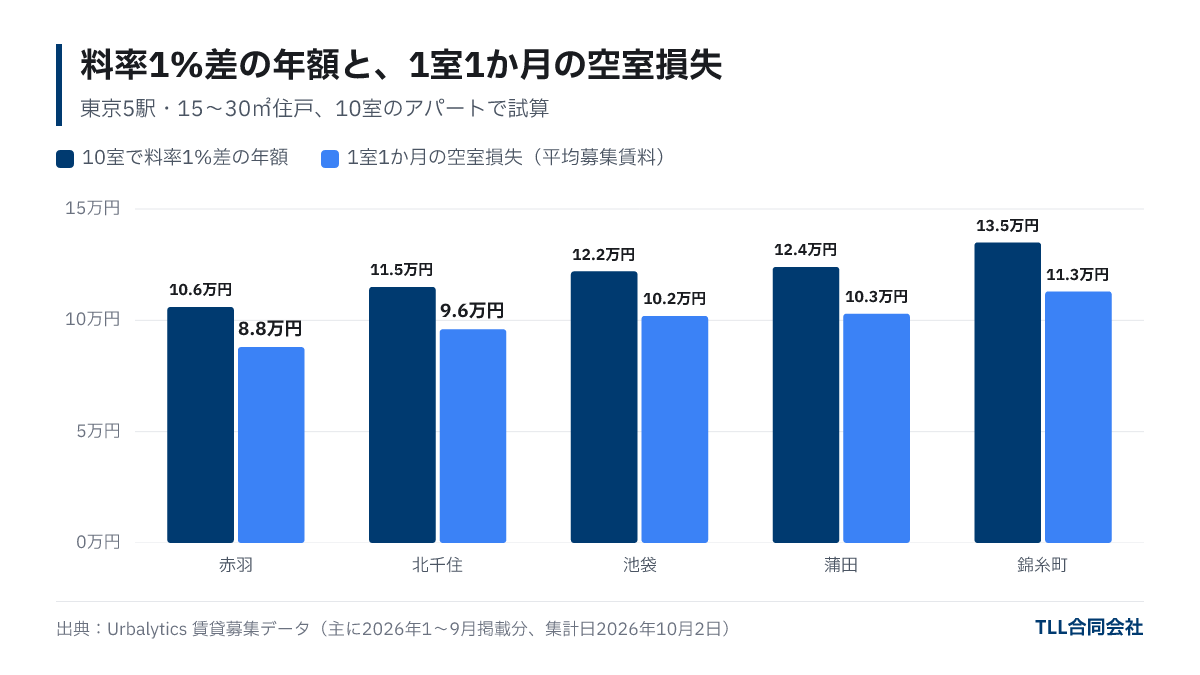
For a 10-unit apartment, a 1% difference in fee rate leads to an annual difference of 100,000 to 130,000 yen. In contrast, a vacancy of one unit for one month causes a rent loss of 88,000 to 113,000 yen. Calculations show that a 1% difference in fee rate is offset if a vacancy lasts about 1.2 months for one unit. When comparing fee rates, inquire about typical vacancy-to-next-tenant move-in periods. You can learn more about adjusting rent and marketing conditions in "Apartment Vacancy Measures."
Also, suspensions in leasing activities during the handover lead directly to vacancy loss. Choose a change date when there are few planned move-outs or listings, and if vacancies exist, arrange for the new management company to start leasing from day one by handing over photos and marketing materials.
Handover Procedures: Deposits, Tenant Information, Keys, and Delinquency
The key to handover is to set a date for receiving without omission these four items from the old management company: "documents," "funds," "keys," and "delinquency status." Article 22 of the Standard Rental Housing Management Entrustment Contract requires the old management company to deliver documents and entrusted funds at contract end, and report rent delinquency details.

- Tenant information and contract documents: Copies of lease agreements and important explanation documents, tenant application forms, renewal history, contact information, and parking/bicycle contracts. Because these include personal information, determine handover methods and scope with both old and new management companies in advance.
- Deposits and entrusted funds: Article 7 of the Standard Contract assumes the management company hands over tenant deposits received to the owner. Check by room whether deposits have already been transferred to the owner’s account or are still held by the management company, and have any held deposits handed over with a settlement statement.
- Keys: Receive copies of keys for each unit and for common areas, meter boxes, mailboxes, and storage with a receipt noting quantities. Article 12 stipulates that key management is the owner’s responsibility; management companies hold keys temporarily during move-ins and outs.
- Delinquency status: Obtain written reports detailing which units are delinquent at the change date, amounts owed, history of notices sent, and reports to guarantee companies. Decide who will handle delinquency collection for amounts before the change date.
- Building and equipment records: Repair history, statutory inspection reports, contact details and contracts for equipment and cleaning contractors, and fire insurance policies.
If units use rent guarantee companies, the guarantee contracts’ contacts may remain with the old management company. Confirm with the guarantee company whether guarantees will continue and if notification of contact changes is necessary. An overview of rent guarantee companies is explained in "What Are Rent Guarantee Companies?"
Tenant Notification and Switching Rent Payment Accounts
Even if you change the management company, the lease agreement remains between the owner and tenant, so tenant consent is generally not required. However, notification is essential. Article 23 of the Standard Contract requires the owner and management company to promptly notify tenants when management services end.

The notification letter should include:
- The date the management company changes and the new management company’s name and contact information (including emergency contact)
- The new rent payment account and the month the change takes effect (clearly stating "from rent for month ○")
- That lease terms (rent, contract duration, etc.) remain unchanged
- That inquiries from the change date onward should be directed to the new management company
Sending the notice jointly from old and new companies prevents tenants from suspecting suspicious information. If using automatic withdrawal or payment collection services, the switch may take time, so confirm procedures early. For one or two months after the change, reconcile rent payments against the old account for any mistaken payments and prearrange refund methods with the old management company if needed.
Schedule Until the Change
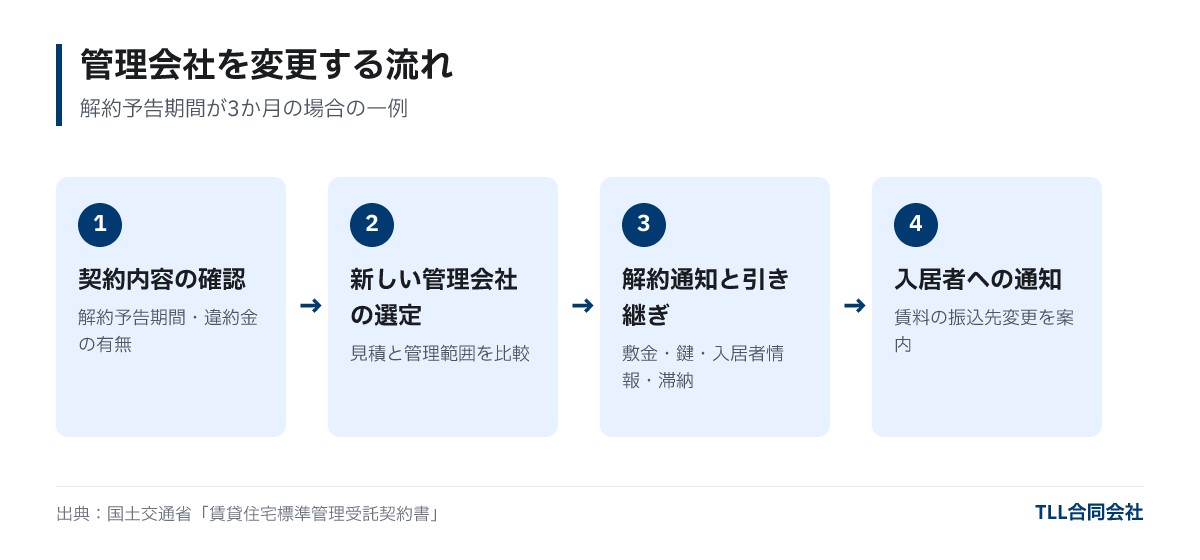
Using a contract with a 3-month termination notice period as an example, here is the flow until the change date. If your notice period differs, adjust the timing of "notice of termination" (row 2) earlier or later accordingly.
| Timing | Actions by Owner | Actions by Management Company |
|---|---|---|
| 4 months prior | Check termination clause, penalties, and renewal date in contract. Receive proposals from candidate new management companies. | New management company inspects the property and presents management approach and fee rate. |
| 3 months prior | Submit written termination notice to old management company. Receive important matter explanation and sign contract with new management company. | Old management company appoints a person in charge for the handover. |
| 2 months prior | Create lists of documents, keys, and entrusted funds to be transferred; set handover date. Confirm contacts and names on guarantee contracts, insurance, and contractor agreements. | Coordinate handover items between old and new management companies. |
| 1 month prior | Finalize and distribute tenant notification letter. Decide month to switch rent payment destination. | New management company prepares photos and layouts for units currently available. |
| Change date | Receive documents, keys, entrusted funds, and delinquency reports with receipts. | New management company begins tenant support and leasing activities. |
| 1–2 months after change | Reconcile rent payments against old account for erroneous deposits. Confirm final settlement statement. | New management company submits first monthly report. |
Frequently Asked Questions
Q. Is tenant consent required to change the management company?
In entrustment contracts, the lease contract parties are the owner and tenant, so tenant consent is generally not required to change management companies. However, the change of management company and new contact and payment destinations must be notified promptly.
Q. What is the typical termination notice period?
The MLIT standard contract leaves this blank and it is set per contract. Use the number of months in your contract’s termination clause as the standard and confirm that first.
Q. Does the deposit need to be returned by the old management company?
It depends on whether deposits have already been transferred to the owner’s account or are still held by the management company. Confirm this in a room-by-room list, and have any deposits held by the company handed over with a settlement sheet.
Q. What happens if rent delinquency occurs during the changeover?
Obtain a written report on delinquency status from the old management company as of the change date and pre-decide who will handle delinquency collection for amounts prior to the change date. For rooms with guarantors, confirm reporting changes to guarantee companies.
Q. How long does changing the management company take?
For contracts with a 3-month termination notice, allow about 4 months including contract review and selecting a new management company. If a payment-in-lieu-of-notice clause exists, the period can sometimes be shortened.
Summary
- If recurring issues with vacancies, reporting, or financial flow persist, consider changing your management company.
- The MLIT Standard Contract leaves the termination notice period blank to be determined per contract. Confirm notice period, penalty fees, and renewal date first.
- For single-occupancy units near five Tokyo stations, a 1% fee rate difference for 10 units equals an annual difference of 106,000 to 135,000 yen, approximately matching rent for 1 unit being vacant 1.2 months (October 2026, Urbalytics). Choose based on vacancy management ability rather than just fee rates.
- During handover, receive documents, deposits and entrusted funds, keys, and delinquency status duly and with receipts, and jointly notify tenants of rent payment changes.
TLL offers property management services ranging from 3–5% of monthly rent income (excluding tax, depending on property size), covering leasing, tenant support, renewal and termination procedures, and monthly reporting. We welcome consultations on switching from other management companies. For details, see Asset Management and Operation Services.
About this article
- Author
- Kurihara(PM Business)Qualifications: Real Estate Transaction Specialist, FP Level 2, Chief Property Manager, Rental Real Estate Management Specialist
Has more than 10 years of experience in the property management field. Across both rental management and condominium management, has handled a wide range of responsibilities including owner relations, tenant relations, contract administration, repair coordination, and the operation of board and general meetings.
View profile → - Publisher
- TLL合同会社宅地建物取引業 東京都知事(1)第108202号住宅宿泊管理業 国土交通大臣(01)第F03424号
Data in this article cite their source and as-of date. Market conditions and regulations change, so check the latest information and consult a professional before deciding. Translated from the Japanese original.