

Which to Prioritize: New NISA or Real Estate Investment? Comparison by System, Returns, Liquidity, and Taxation
Xiao Li (licensed real estate broker, 宅地建物取引士)Asset Management
19 min read
Since the new NISA (Nippon Individual Savings Account) started in 2024, we have increasingly received inquiries from people who have begun investing in mutual funds through NISA asking, "I’m interested in real estate investment as well, but which should I prioritize?" Both are ways to grow assets, but they differ greatly in required capital, available borrowing, effort involved, and tax mechanisms.
This article does not decide which is better but compares the systems and characteristics, then organizes considerations by purpose and ways to combine the two. The figures are as of October 2026.
Key Points of This Article
- The annual non-taxable investment limit for the new NISA is ¥3.6 million (accumulated investment quota ¥1.2 million, growth investment quota ¥2.4 million), with a lifetime non-taxable holding limit of ¥18 million (of which ¥12 million is for the growth investment quota), and an unlimited holding period (Financial Services Agency NISA Special Website, confirmed October 2026).
- The median gross yield for whole-building properties for sale ranges widely depending on the station—from 4.80% at Akabane to 7.95% at Hachioji (October 2025–October 2026, Urbalytics, 6 stations). Gross yield is calculated before deducting expenses and vacancy.
- The new NISA can be started with small amounts, offers ease of sale, and investment gains are tax-free. Real estate investment enables leveraging loan financing to increase investment amount and earn rental income but involves more effort and borrowing risks. Prioritization depends on purpose, funds, and time.
Key Points of the New NISA System
The new NISA is a system that makes dividends and capital gains from stocks and mutual funds non-taxable. Since January 2024, it has become a permanent system with the following features (confirmed October 2026 on the Financial Services Agency NISA Special Website).
- Annual Investment Limit: Accumulated investment quota ¥1.2 million, growth investment quota ¥2.4 million, total ¥3.6 million if combined.
- Lifetime Non-Taxable Holding Limit: ¥18 million (based on purchase price). Of this, ¥12 million is allocated to the growth investment quota.
- Non-Taxable Holding Period: Unlimited.
- Quota Reuse: If you sell, the quota equal to the purchase price of the sold security is restored in following years.
- Eligible Persons: Domestic residents aged 18 or older as of January 1 of the year.
- Eligible Products: Accumulated investment quota applies to certain mutual funds suitable for long-term, systematic, diversified investment, growth investment quota applies to listed stocks and mutual funds, excluding some products.
Without a NISA account, capital gains from sales of listed stocks are generally taxed at 20.315% (15% income tax, 0.315% special reconstruction income tax, 5% resident tax) (National Tax Agency Tax Answer No.1463, laws as of April 1, 2026). Gains through NISA are tax-exempt, but losses within a NISA account cannot be offset against profits in other accounts nor carried forward.

Features of Real Estate Investment and Market Gross Yield
Real estate investment involves buying properties to rent out and earning rental income and future capital gains from sales. In many cases, borrowers use financial institution loans to buy properties worth several times their own funds. As a reference, we collected gross yield data for whole-building properties on sale near Tokyo and six adjacent stations.
| Station | Number of Listings | 25th Percentile | Median | 75th Percentile | Median Price |
|---|---|---|---|---|---|
| Akabane (Kita Ward) | 34 listings | 4.22% | 4.80% | 6.58% | ¥171 million |
| Kamata (Ota Ward) | 52 listings | 4.22% | 5.01% | 5.88% | ¥201.3 million |
| Kita-Senju (Adachi Ward) | 53 listings | 4.34% | 5.18% | 6.00% | ¥151.7 million |
| Funabashi (Chiba Prefecture) | 44 listings | 5.18% | 6.00% | 6.53% | ¥158 million |
| Omiya (Saitama Prefecture) | 44 listings | 5.50% | 6.20% | 6.61% | ¥166.5 million |
| Hachioji (Tokyo) | 76 listings | 6.49% | 7.95% | 8.64% | ¥92.4 million |
Source: Urbalytics whole-building (BUILDING) sales data. Listings and price changes from October 2, 2025 to October 2, 2026, excluding duplicates. Gross yield = annual listed rent ÷ price. Data as of October 2, 2026.
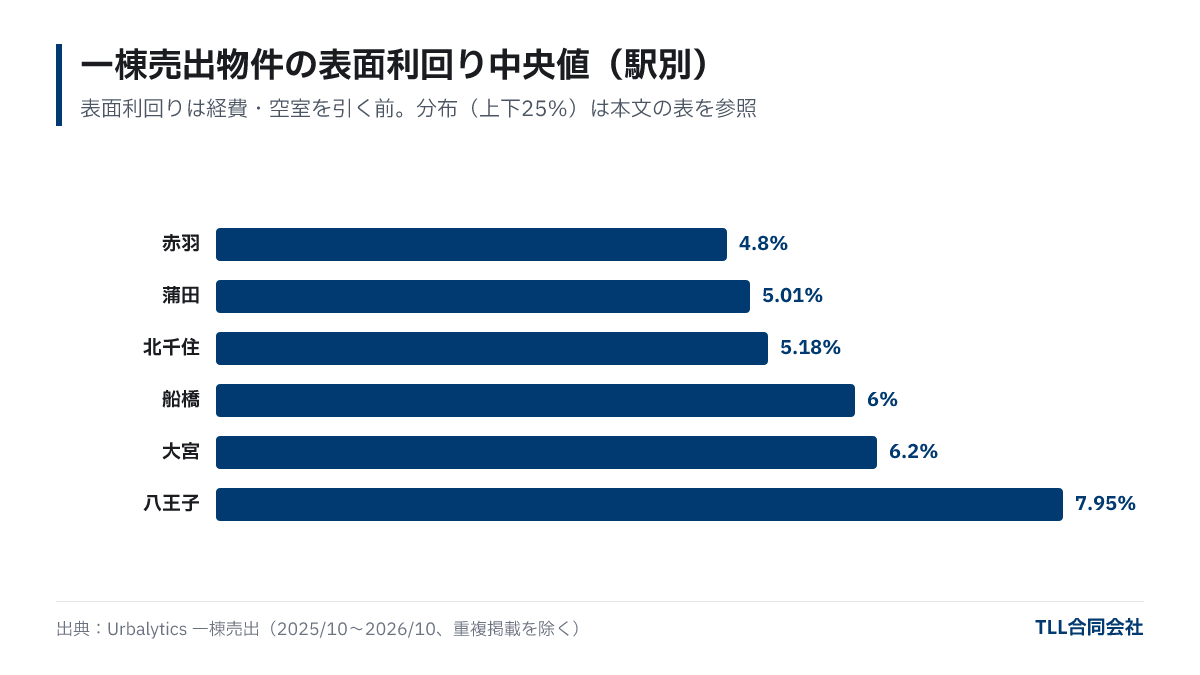
Gross yield is before deducting management fees, repair costs, fixed asset tax, and vacancy. Actual net income often is around 20% lower than the gross yield, plus loan repayments. Also, property prices mainly start at around ¥100 million, making the investment scale very different from annual NISA quotas. How to choose properties is explained in "How to Choose Income Properties".
Comparison Between New NISA and Real Estate Investment
The main differences are listed item by item. This is not to judge which is better, but to understand their distinct characteristics.
| Item | New NISA (Mutual Funds, Stocks) | Real Estate Investment (Whole-building, Unit) |
|---|---|---|
| Required Capital to Start | From small amounts. Monthly accumulations can start from a few thousand yen. | Approximately 10-30% own funds plus miscellaneous fees (~7% of property price). |
| Source of Income | Dividends, distributions, capital gains. | Rental income, capital gains from sales. |
| Leverage (Borrowing) | Not available within NISA accounts. | Loans enable owning properties several times own capital. Losses can also be amplified. |
| Liquidity (Ease of Conversion to Cash) | Can be liquidated in several days if market is open. | Often takes several months to sell, including price negotiations. |
| Effort Required | Choosing products and periodic review. | Tenant recruitment, repairs, tax filing, etc. Can outsource management. |
| Taxation | Investment gains are tax-exempt. Losses cannot be offset. | Rental income taxed as real estate income with comprehensive taxation. Deficits can offset income such as salary (excluding interest on loans for land acquisition). Capital gains tax: 20.315% if owned >5 years, 39.63% if ≤5 years. |
| Main Risks | Price fluctuations, currency risk (for overseas assets). | Vacancy, interest rate hikes, repairs, disasters, price decline, difficulty selling. |
| Ease of Diversification | One mutual fund can diversify across many securities. | Capital tends to concentrate on one property. |
Source: Financial Services Agency NISA Special Website, National Tax Agency Tax Answer No.1463, No.2250, No.3208, No.3211 (laws as of April 1, 2026), compiled by TLL.
Consideration By Purpose
Which to prioritize depends on the investment purpose. Below are characteristics to emphasize for typical purposes.
Building Assets Long-Term for Retirement
The nature of the new NISA fits well with this: the ability to accumulate monthly from small amounts, tax-free gains, and the possibility to partially liquidate when needed. If combining real estate, there is the idea of using rental income after loan payoff as retirement income.
Wanting Monthly Rental Income (Net Cash Flow)
If regular cash income is important, rental income from real estate investment is a candidate. However, if borrowing ratio is high, net cash flow can be slim and affected negatively by interest rate rises or vacancies. It’s important to simulate income if interest rates rise before purchase.
Planning for Inheritance and Asset Transfer
Real estate is evaluated differently from cash for inheritance tax, with rental properties having lower evaluation. Because properties can be difficult to divide and require maintenance, this is a field to proceed with advice from a tax accountant.
Busy with Main Job and Cannot Spend Much Effort
The new NISA is advantageous for lower effort. Real estate effort can be reduced by entrusting management companies, but property selection, loan arrangements, and repair decisions remain the owner’s responsibility.

How to Combine and Prioritize
There’s no need to choose only one between the new NISA and real estate investment. It is easier to organize by thinking through the following steps about your priorities and allocation.
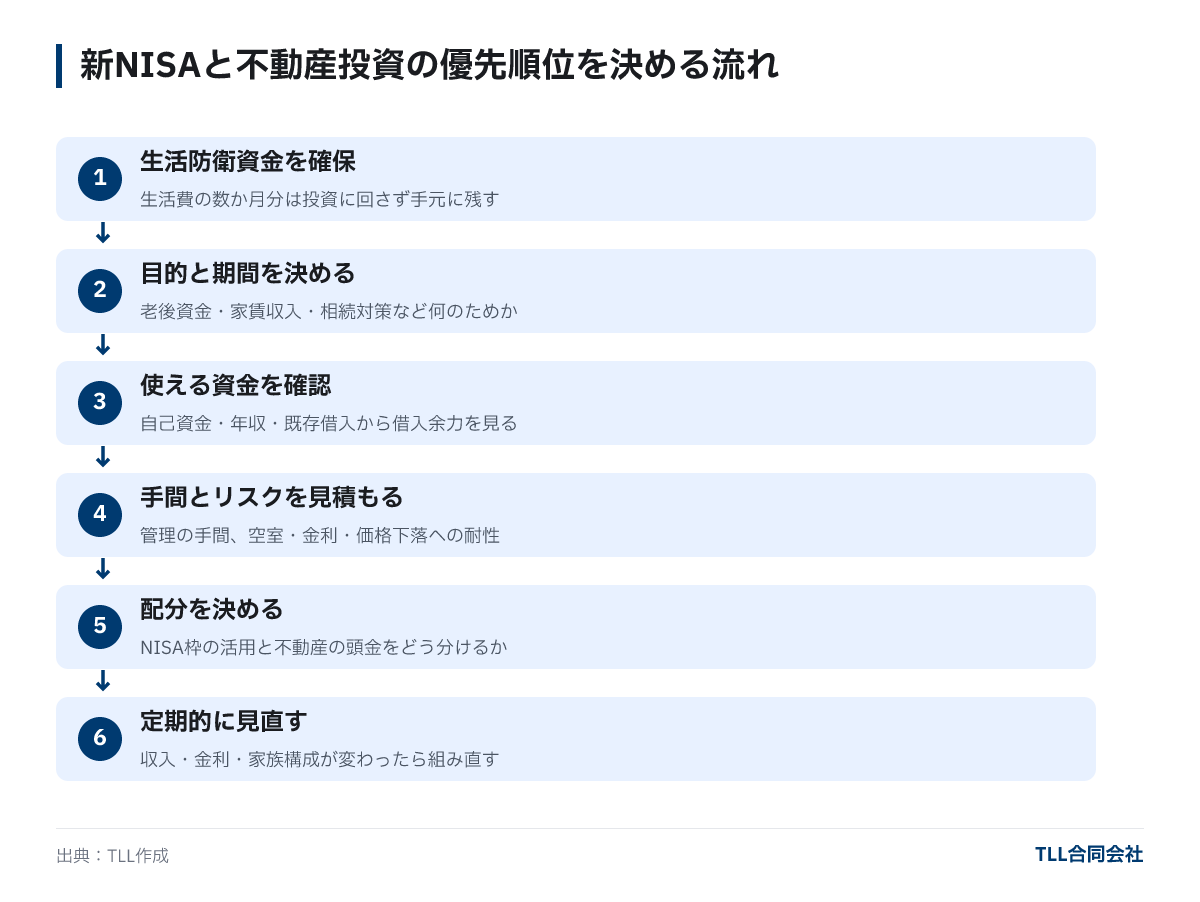
Examples of ways to combine are as follows.
- Continue accumulation in NISA while separately saving for property down payment: Use NISA quota for long-term asset building and reserve down payment and contingency funds in deposits.
- Own real estate while holding easily liquidated assets in NISA: Because real estate sales take time, maintain readily accessible assets separately.
- Build financial asset reserves to prepare for loans: Lenders check deposits and securities in loan screening for real estate investment.
In any combination, it is essential to keep several months’ living expenses outside investment. When seriously considering real estate investment, you can start by seeing currently handled properties and grasping yield and price levels through TLL’s member page (free registration).
Frequently Asked Questions
Q. Which should I start first: new NISA or real estate investment?
There is no single correct answer. If prioritizing starting small and liquidity, new NISA is suitable. If you have substantial savings and income from your main job and want rental income, real estate investment is a candidate. It’s recommended to organize your purpose, funds, and time before deciding.
Q. What are the annual investment limit and lifetime cap for the new NISA?
The annual limit is ¥3.6 million total (accumulated investment quota ¥1.2 million, growth investment quota ¥2.4 million), with a lifetime non-taxable holding limit of ¥18 million, including ¥12 million for the growth investment quota (Financial Services Agency NISA Special Website, confirmed October 2026).
Q. Can funds managed in NISA be used as a down payment for real estate?
You can use proceeds from selling products in the NISA account as a down payment. The quota used to purchase the sold product will restore in subsequent years. Since prices fluctuate, if the purchase timing is fixed, consider transferring from volatile products early to avoid risk.
Q. Can losses from real estate investment offset NISA gains?
No. NISA gains are already tax-exempt, and losses within the NISA account cannot be offset against other income. Real estate income deficits can offset income such as salary (excluding interest on loans for land acquisition).
Summary
- The new NISA offers a tax-free investment limit of ¥3.6 million annually and ¥18 million lifetime (including ¥12 million growth investment quota), with unlimited holding period as of October 2026.
- The median gross yield for whole-building properties varies from 4.80% to 7.95% by station (October 2025–October 2026, 6 stations). Net yields are lower after expenses, vacancies, and loan repayments.
- The new NISA features small capital requirements, liquidity, and tax exemption; real estate investment features loan leverage and rental income, with differences in effort and loan risk.
- Rather than choosing one, secure emergency living funds, decide allocation based on purpose, funds, and time, and review regularly.
Featured image (image): Photo: Nicholas Cappello / Unsplash
About this article
- Author
- Xiao Li(Asset Management)Qualifications: Real Estate Transaction Specialist, Building Management Specialist
The operational lead for real estate sales and property management. At NTT Communications, he spent more than eight years managing DX projects for major enterprises, overseeing the full process from requirements definition through delivery and operations. At TLL, he handles the entire deal management cycle for income-producing properties, including sales strategy planning, investor sourcing, contract execution, settlement, and handover, providing well-matched opportunities and smooth transaction execution for domestic and international investors and operators.
View profile → - Publisher
- TLL合同会社宅地建物取引業 東京都知事(1)第108202号住宅宿泊管理業 国土交通大臣(01)第F03424号
Data in this article cite their source and as-of date. Market conditions and regulations change, so check the latest information and consult a professional before deciding. Translated from the Japanese original.