Investing in Tokyo Hostels and Simple Lodging|Licensing, Yields and Akabane, Takadanobaba and Nerima
Takanobu EzakiAccommodation Business Manager
13 min read
A Tokyo hostel investment cannot be assessed from the asking price and projected accommodation revenue alone. Start by checking whether the intended use can be licensed at that address and in that building, then calculate what remains after operating expenses.
A sales brochure describing a property as suitable for simple lodging does not guarantee approval. This article uses Akabane, Takadanobaba and Nerima to explain due diligence and yield comparisons. Legal information was checked on 9 October 2026.
Key points
- A hostel's licensing category depends on its layout and operating model; it is separate from a notification under the Private Lodging Business Act.
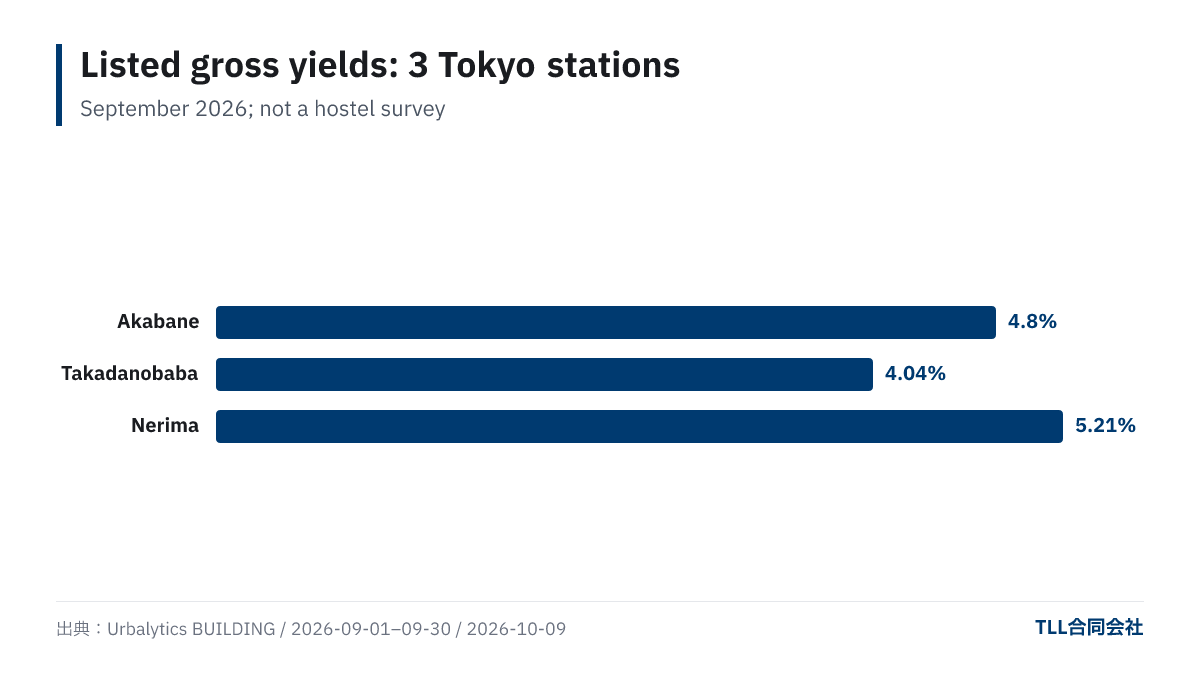
- September 2026 median listed gross yields for ordinary whole buildings were 4.80% in Akabane, 4.04% in Takadanobaba and 5.21% in Nerima. These are not hostel operating returns.
- Discuss the same plans with health, building and fire authorities before buying, and translate their requirements into works and operating budgets.
Which licence does a hostel need?
The word “hostel” does not determine the licence. A facility based on shared sleeping accommodation may fall within simple lodging, or kani-shukusho. A private-room plan should be discussed with the health centre to distinguish it from hotel and ryokan operations. Plans and actual operations matter more than the commercial name.
Minpaku notified under the Private Lodging Business Act is subject to a 180-day annual limit. It is a separate system from a Hotel Business Act licence; special-zone minpaku is also distinct. See the Japan Tourism Agency's explanations of the Hotel Business Act and Private Lodging Business Act.
Buying a licensed building does not necessarily transfer its operating licence. Confirm procedures for changing the operator or transferring the business, and the treatment of equipment changes, before signing.

Building, fire and operational checks before buying
Assess zoning, building compliance, fire equipment and local facility and management standards together. A home in an exclusively residential zone cannot simply be assumed suitable for lodging. Once a station area is selected, check zoning against the property's precise address and land records.
Collect building confirmation records, the inspection certificate and current plans. Ask an architect to check alterations, stairs, escape routes and room layout. Exemption from a change-of-use confirmation procedure does not remove applicable safety requirements. Fire and building works can affect each other, so adding two separate estimates may miss necessary work.
Staffing and check-in methods should be planned alongside equipment. Night response, key handover, guest records, waste storage and cleaning routes affect the space and budget required. The Tokyo 23-ward regulation overview is a starting point; verify the specific project against current official guidance.
How should the three areas be compared?
Compare address-specific permissions and usable operating space.
Akabane: For properties in Kita Ward, review reception arrangements and key management on the plans. Kita Ward's licensing page requests consultation at the planning stage. Read it alongside the Kita Ward article and check that any existing licence matches actual operations.
Takadanobaba: A property near the station may be in Shinjuku or Toshima Ward, changing the authority and rules. Shinjuku announced a policy to strengthen regulation of both minpaku and licensed lodging in September 2026. Separate existing rules from proposals and confirm the standards expected to apply when acquiring the property (official mayoral briefing).
Nerima: Check the cost and area needed for staffing and management space. Use Nerima's licensing guidance and the Nerima article to understand the process. Noise, luggage movement and waste arrangements in residential streets can also affect operating costs.
Separate hostel returns from rental yields
Listed whole-building rental yields can help assess a fallback if conversion is not viable. They are not evidence of hostel profitability.
| Station | Buildings | Median gross yield |
|---|---|---|
| Akabane | 9 | 4.80% |
| Takadanobaba | 6 | 4.04% |
| Nerima | 4 | 5.21% |
Source: Urbalytics BUILDING listings in Tokyo with a listing or price update during 1–30 September 2026; retrieved 9 October 2026. Duplicates, completed sales, unpublished appraisals and defined outliers are excluded. Listed annual income may be actual or full-occupancy income. Age, structure and walking distance are not matched; samples are small and are not limited to lodging facilities.
For dormitories, model annual sales using available beds × saleable days × bed occupancy × average bed rate. For private rooms, use room-based figures. Do not mix beds and rooms. Account for licensed capacity, closures and cleaning-related downtime, then subtract booking fees, cleaning and linen, staffing, utilities, insurance, taxes and maintenance.
Dividing operating profit only by the purchase price overstates returns when conversion costs are substantial. Compare total investment including acquisition costs, works, equipment and opening preparation. Calculate cash remaining after debt service separately. See gross and net yields.
Request the basis for the seller's occupancy and rate assumptions. For an operating facility, examine monthly revenue, booking channels, cancellations and expenses. A strong peak season should not be extrapolated across the year.

How to organise pre-contract due diligence
Make the purchase terms concrete once licensing requirements and estimates are available. Include interest and maintenance during the period before opening.
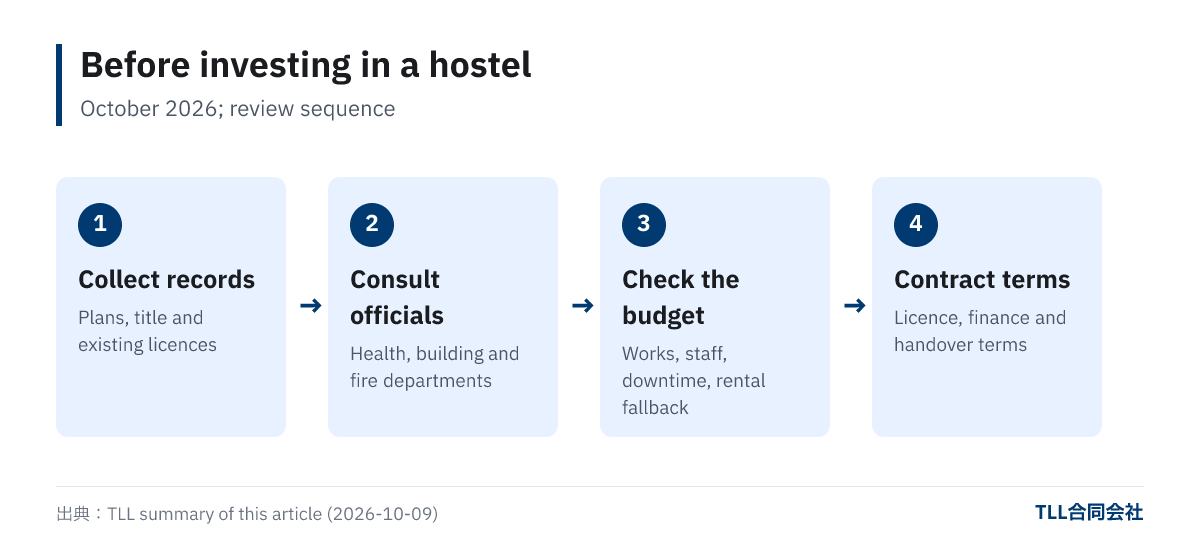
- Collect title, building records, plans, existing licences and operating history; check discrepancies against the actual property.
- Show the same plan to health, building and fire departments and list unresolved requirements.
- Reflect those requirements in works and staffing budgets. Compare low-occupancy and long-term-rental fallback cases.
- Specify the treatment of failed licensing or financing, equipment handover and conversion costs in the contract.
A claim that the building can later revert to housing also needs scrutiny of works and lease arrangements. Keep plans and estimates for both uses and check exit costs. Compare management proposals using the same scope for night response and cleaning.
Frequently asked questions
Q. Can a hostel operate for more than 180 days a year?
A Hotel Business Act licence is not subject to the minpaku law's 180-day cap. Approval and local compliance remain necessary; the name “hostel” alone does not establish eligibility.
Q. Can these building yields be used to forecast hostel revenue?
No. The survey concerns ordinary whole-building listings. Accommodation revenue and operating costs need separate evidence.
Q. Can a buyer immediately operate a previously licensed facility?
Check operator-change procedures, consistency between the licensed plans and actual building, and fire and building compliance. Confirm licence succession with the health centre.
Summary
- Determine the licence from layout and operations.
- Do not treat ordinary listed gross yields of 4.04–5.21% as lodging returns.
- Compare total investment, including conversion, staffing and pre-opening carrying costs.
- Complete address- and plan-specific health, building and fire checks before signing.
References: official Tourism Agency and ward sources linked above; original Urbalytics aggregation. Checked 9 October 2026.
Cover image (illustrative): Photo: Monineath Horn / Unsplash
About this article
- Author
- Takanobu Ezaki(Accommodation Business Manager)Qualifications: Type A Fire Prevention Manager, Type 1 Health Officer, Hazardous Materials Engineer, Class B-4, Class 2 Boiler Engineer
Leads accommodation projects from pre-opening preparation to stable operations, bringing together permits, refurbishment and operating budgets. He has held manager, general manager and director roles at hotels, ryokan and golf courses over more than 30 years. His experience includes facility operations, P&L management, liaison with authorities, obtaining permits and major refurbishment, from opening new glamping facilities to repositioning existing ryokan. At TLL, he oversees accommodation operations and prepares new properties for opening. For each property, he brings together the applicable operating framework, facility requirements and staffing arrangements to develop a workable operating plan. His articles explain the differences between minpaku and hotel-business requirements across Tokyo's 23 wards and the implications of different operating models. His qualifications include Type A Fire Prevention Manager and Type 1 Health Officer.
View profile → - Publisher
- TLL合同会社宅地建物取引業 東京都知事(1)第108202号住宅宿泊管理業 国土交通大臣(01)第F03424号
Data in this article cite their source and as-of date. Market conditions and regulations change, so check the latest information and consult a professional before deciding. Translated from the Japanese original.